Storytelling in Photography
Photography occupies a singular position among the visual arts. Where a painter, sculptor, or printmaker constructs an image from imagination, memory, or convention, the photographer makes a record of something that actually existed before a lens at a specific moment in time. This documentary quality has been both the medium's most powerful gift and its most persistent philosophical burden: the photograph tells you something happened, but it cannot easily tell you what it meant. The gap between event and meaning is precisely where the work of photographic storytelling occurs.
That work takes three broad forms, each with its own logic, history, and grammar. The first is the single image that aspires to contain a complete narrative within its frame: a picture so charged with context, emotion, and implication that the viewer can reconstruct a world from it.
The second is the edited group — the sequence, the photo essay, the multi-image spread — in which photographs work together to construct a narrative none of them could carry alone, building through juxtaposition, rhythm, and accumulation the kind of argument that requires time to unfold.
The third is the sustained long-term project: the documentary body of work assembled over months or years, in which the photographer's sustained commitment to a subject produces something that functions less like an article and more like a book — capacious, complex, and shaped by the passage of time itself.
These three modes are not mutually exclusive. The decisive single image can form part of a larger essay. The long project produces individual images that stand on their own. But the distinction is worth making because each has its own requirements — of temperament, access, funding, patience, and editorial context — and each has produced its own lineage of great practitioners, its own critical literature, and its own conception of what it means to tell a story with a camera.
The Visual Narrative Tradition
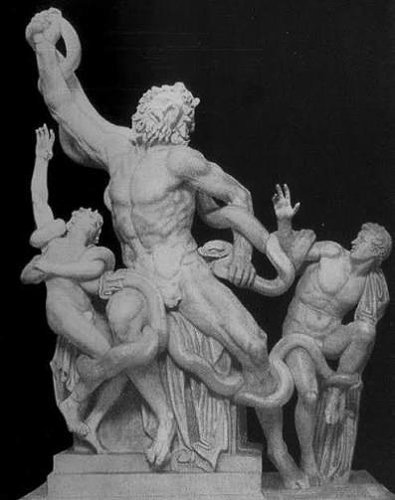
The problem of how to tell a story in a single image — or across a sequence of images — is far older than photography. Long before the camera, artists working in every medium from carved stone to oil on canvas were grappling with the fundamental paradox that Gotthold Ephraim Lessing identified in his Laokoon: oder über die Grenzen der Mahlerey und Poesie (1766): painting and sculpture are spatial arts, apprehended at once by the eye, while narrative is temporal, unfolding sequentially through time.
A poem or a story moves; a picture stands still. The visual artist must therefore choose, as Lessing put it, the fruchtbarer Augenblick — the "fruitful" or "pregnant moment" — the instant that is maximally charged with past and future, that allows the viewer's imagination to reconstruct the entire action from a single frozen frame.
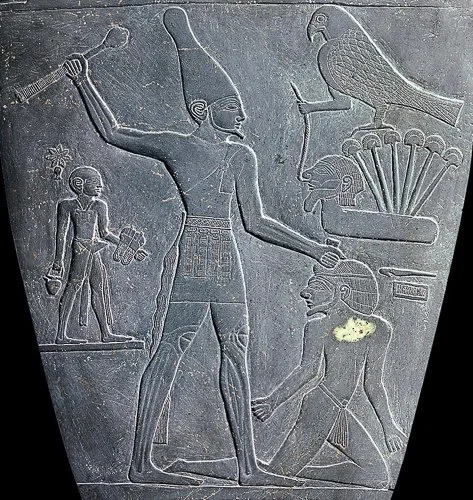
This challenge was being addressed long before anyone had words to describe it. The Narmer Palette (c. 3100 BCE), one of the earliest surviving examples of Egyptian historical narrative, distributes its story across registers — the king triumphant, the defeated enemy, the symbolic animals — using spatial arrangement to imply temporal sequence.
Greek red-figure pottery of the fifth century BCE narrates the myths of Heracles, Achilles, and Odysseus in scenes that presuppose a viewer who already knows the story and can locate any given image within its larger arc; the pot's surface becomes a kind of pre-cinematic storyboard, its figures frozen mid-gesture at the climactic instant.
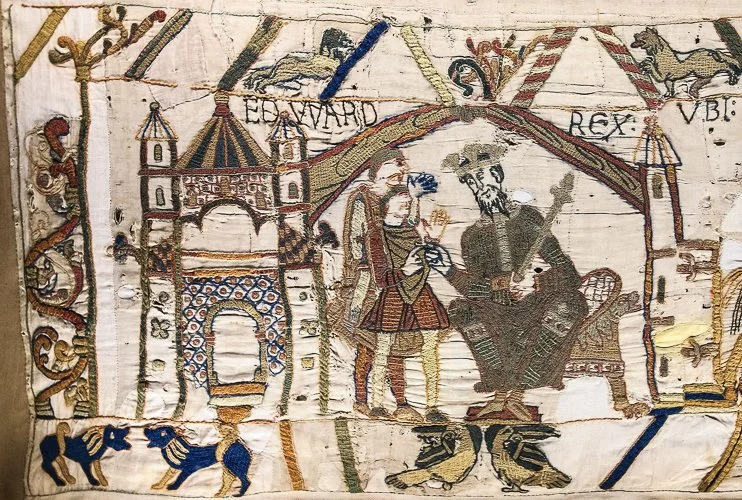
The Bayeux Tapestry (c. 1070s) unrolls its account of the Norman Conquest across seventy metres of embroidered linen, deploying registers, captions, and continuous narrative — figures and horses in motion, buildings simultaneously inside and outside — in a sequential form that anticipates the comic strip and the photographic contact sheet.
Religious art of the medieval and Renaissance periods developed the triptych and the polyptych as instruments of multi-image narrative. An altarpiece by Duccio di Buoninsegna or Rogier van der Weyden distributes the life of Christ across multiple panels, each a complete image in itself, the whole legible only when the viewer moves their attention from panel to panel. The single devotional image — the Pietà, the Annunciation, the Descent from the Cross — employed the principle Lessing would later codify, freezing at the moment of maximum emotional intensity.
Dutch genre painting of the seventeenth century introduced a different mode of visual narrative: not the grand historical or religious subject, but the quotidian scene freighted with implication.
Jan Steen's chaotic households, Johannes Vermeer's domestic interiors with their letters, musical instruments, and distracted gazes — these are pictures that seem to have interrupted a story already in progress. The viewer is invited to construct what happened before and to speculate what will happen after. This is the logic that will reappear in street photography three centuries later.
History painting — the dominant genre in the European academic tradition from the seventeenth to the nineteenth century — required the painter to choose, from the events of a historical narrative (military, mythological, or biblical), the single moment of greatest dramatic force.
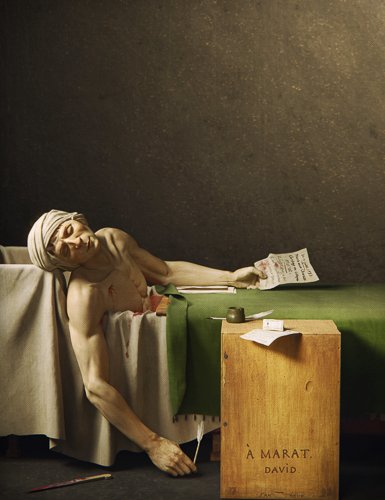
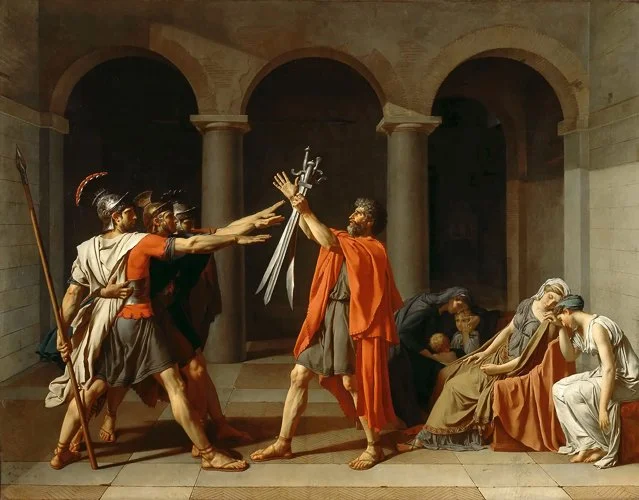
Jacques-Louis David's The Death of Marat (1793) and The Oath of the Horatii (1784–5) are exemplary of how the tradition worked: the viewer was expected to bring to the image a knowledge of the story, and the painting operated as a kind of crystallisation of that story into its most concentrated form. The photograph would inherit this ambition even as it transformed the means by which it was realised.
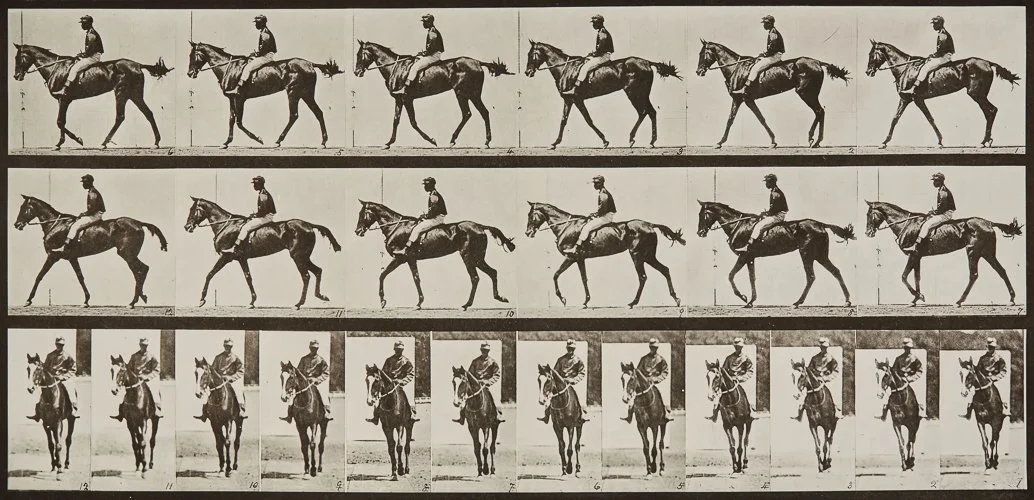
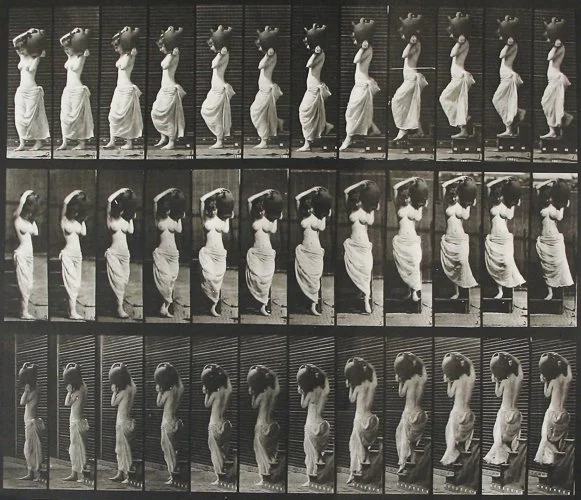
Eadweard Muybridge (1830–1904) sits at the hinge between the pre-photographic and photographic traditions. His systematic motion studies, begun in 1872 when the railroad magnate Leland Stanford commissioned him to resolve a dispute about whether all four of a horse's hooves leave the ground simultaneously during a gallop, produced something genuinely new in the history of visual art: the photographic sequence as analytical instrument.
By 1877, Muybridge had perfected a system of multiple cameras with fast shutters — exposures of approximately 1/2000 of a second — arranged to fire in succession as the animal or human subject passed before them. The resulting strips of images, published in his monumental eleven-volume Animal Locomotion (1887), produced under the auspices of the University of Pennsylvania, did not tell stories in the conventional sense. They decomposed movement into its constituent instants, rendering visible what the eye was too slow to see.
In doing so, they established a visual grammar — sequential frames, temporal progression, narrative through accumulation — that would prove fundamental to photography's storytelling ambitions. Muybridge's zoopraxiscope, which projected these sequential stills as a moving image, also made him a direct precursor of cinema, establishing the bridge between the still photograph and the moving picture that would shape the entire subsequent history of photographic narrative.
The Decisive Moment & the Single Frame
No concept has been more influential in the history of photographic storytelling than the moment décisif — the decisive moment — associated with Henri Cartier-Bresson (1908–2004). The phrase was not, strictly speaking, Cartier-Bresson's own coinage. When his first major book was published in France in 1952 by the publisher Tériade, it appeared under the title Images à la Sauvette — images on the run, or images taken on the sly. The French title gestures toward something more elusive and provisional than the English translation suggests.
It was the American publisher Simon & Schuster, with input from Dick Simon, who titled the English-language edition The Decisive Moment, a phrase adapted from an epigraph Tériade had suggested: a quotation from the seventeenth-century memoirs of Cardinal de Retz, "Il n'y a rien dans ce monde qui n'ait un moment décisif" — "There is nothing in this world that does not have its decisive moment." Henri Matisse designed the cover and handwrote the phrase. In this way, the phrase that came to define an entire school of photographic practice was, somewhat inadvertently, imposed from outside.
The concept, however, was authentically Cartier-Bresson's, and it was not merely about timing. His own formulation of it, from the introductory text to Images à la Sauvette, is more precise than the popular paraphrase would suggest: "To me, photography is the simultaneous recognition, in a fraction of a second, of the significance of an event as well as of a precise organisation of forms which give that event its proper expression."
This is a compound definition. It requires both the recognition of a significant human moment — the emotion, the gesture, the interaction — and the simultaneous recognition of its formal resolution in the viewfinder. The decisive moment is not just when something interesting happens; it is when something interesting happens in a way that can be expressed as a perfect composition. Content cannot be separated from form.
This dual requirement places Cartier-Bresson squarely in the tradition Lessing had described for painting. The "pregnant moment" of visual narrative theory becomes, in Cartier-Bresson's practice, the fraction of a second in which form and meaning coincide — the instant that is simultaneously the most dramatic and the most beautiful. The difference is the camera's capacity to register it.
Cartier-Bresson's instrument was the Leica 35mm rangefinder, which he acquired in 1932. He almost always used it fitted with a 50mm lens — a focal length that he regarded as the closest approximation to the unaided human eye — and he painted the chrome body black to reduce its visibility in the crowd. The Leica's small size, quiet shutter, and ability to load 36 exposures on a single roll of 35mm film made it ideally suited to unobtrusive, rapid work.
It gave what Cartier-Bresson called "the velvet hand, the hawk's eye" — the capacity to work without disturbing the moment one was trying to capture. He described it, in a 1974 remark, as "a sketchbook, a psychoanalyst's couch, a machine gun, a big, hot kiss, an electromagnet, a memory, the mirror of memory."
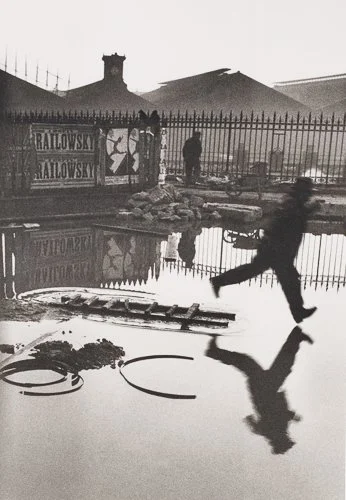
The photograph Derrière la gare Saint-Lazare (Behind the Gare Saint-Lazare, 1932) is among the most celebrated demonstrations of this philosophy. Taken at the Place de l'Europe in Paris — Cartier-Bresson reportedly poked his lens through a gap in a fence — it shows a man leaping above a flooded area behind the station, his reflection mirrored below, at the precise instant before his feet touch the water.
Behind him, posters on a wall advertise a performance by the pianist Alexander Brailowsky, featuring a dancer whose pose echoes the leaper's. Cartier-Bresson later said he had not consciously noticed the posters until he saw the developed print. The image is, among other things, a demonstration of the photographer's unconscious geometry at work: the decisive moment as a convergence of intention and accident.
The debts of this approach to earlier ideas are worth tracing. Lessing's "pregnant moment" in painting, as described above, is one direct intellectual ancestor. But the broader tradition of capturing expressive gesture at its peak — from Raphael's School of Athens to the stop-action poses in Baroque sculpture — also informs the expectation that a single image can be charged with narrative significance.
What Cartier-Bresson added was the specifically photographic proposition that this moment of convergence actually occurs in the world, not in the artist's imagination, and that the photographer's task is to be present and ready for it.
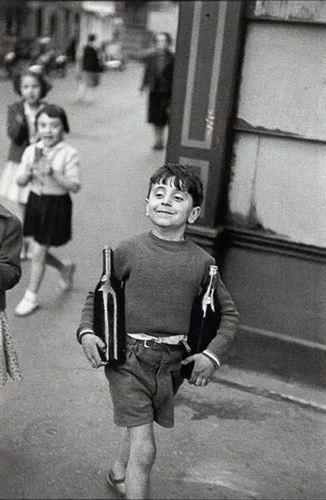
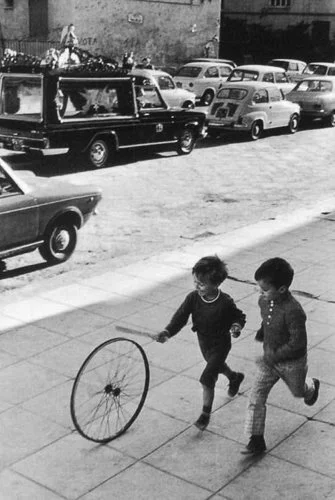

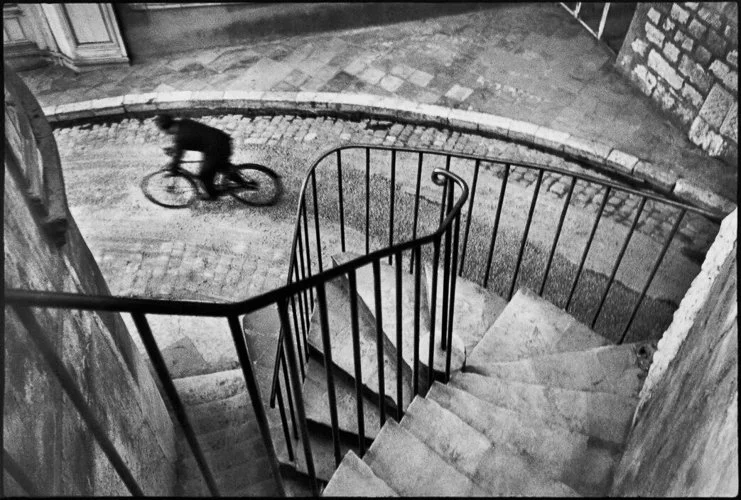
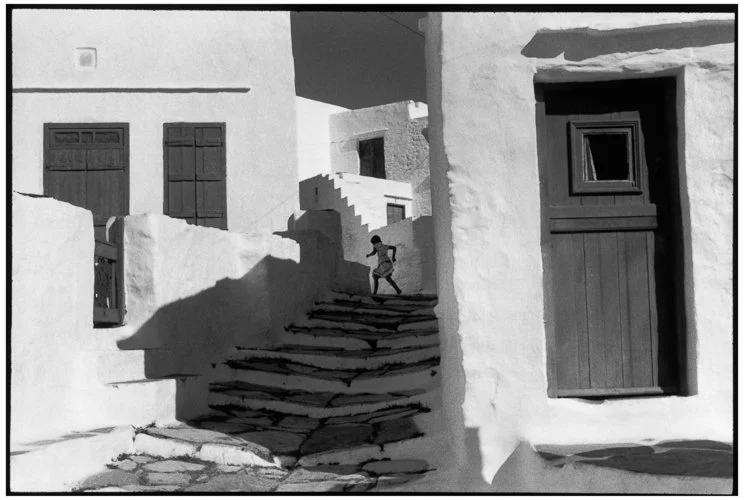
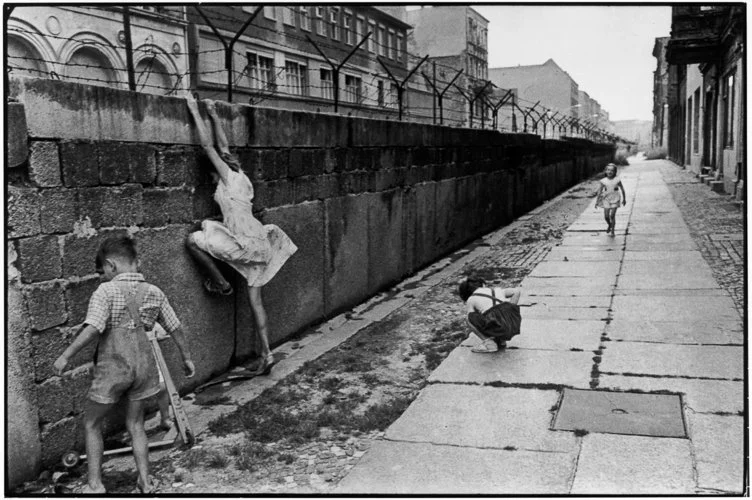
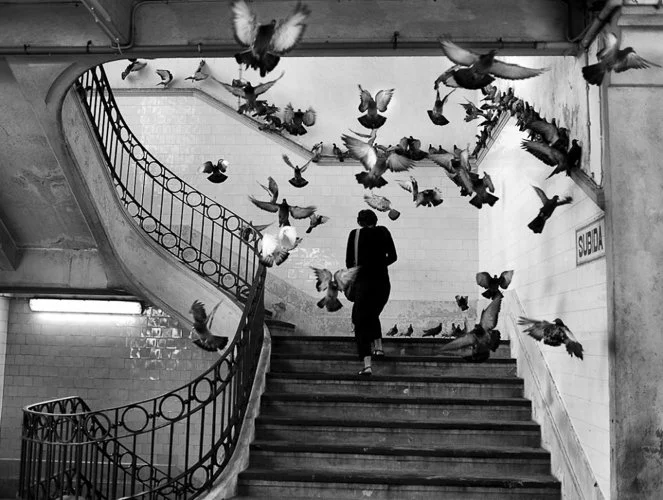
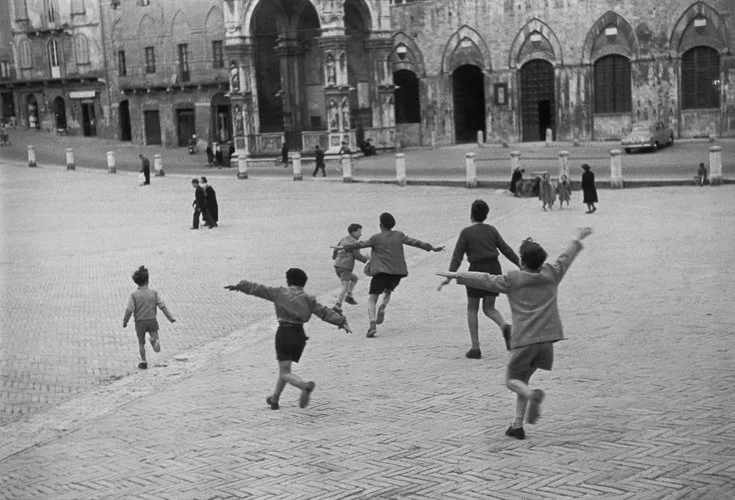
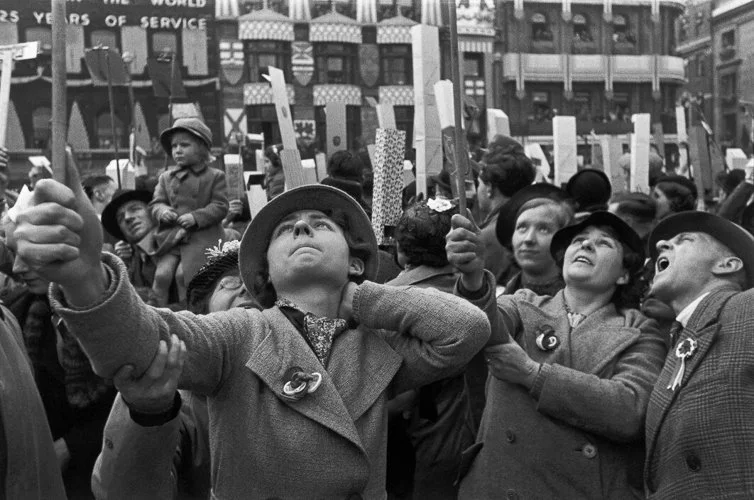
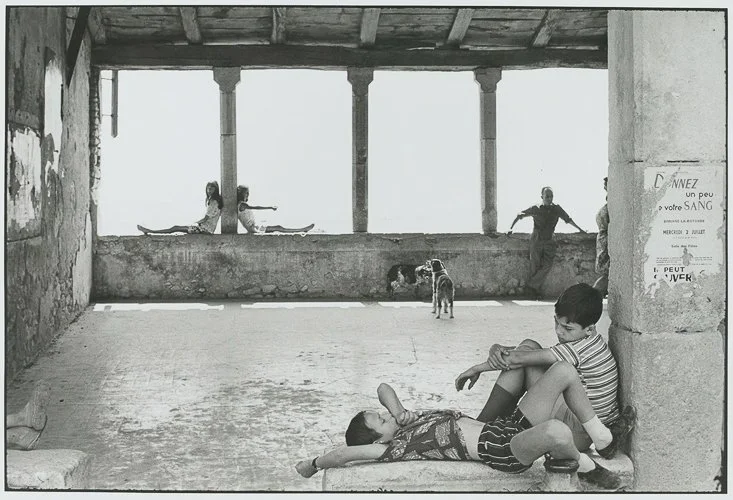
His influence on twentieth-century photojournalism was immense. The Leica-and-35mm aesthetic — mobile, unobtrusive, humanist, built around the single decisive exposure — became the dominant grammar of street photography and reportage for decades.
The agency Magnum Photos, which Cartier-Bresson co-founded in 1947 with Robert Capa, David Seymour ("Chim"), and George Rodger, enshrined the photographer's right to control their own images and assignments. Its collective sensibility — morally engaged, formally rigorous, committed to the single photograph as a unit of meaning — shaped the culture of serious photojournalism through the second half of the twentieth century.
The decisive moment doctrine, however, was never the only approach, even among Cartier-Bresson's contemporaries. Garry Winogrand (1928–1984), Lee Friedlander (b. 1934), and Diane Arbus (1923–1971) each pushed street photography in directions that questioned its implicit humanism and compositional resolution, embracing chaos, estrangement, and the psychological discomfort of the stopped instant. But all of them, in various ways, were working in relation to the tradition Cartier-Bresson had crystallised.
The Photo Essay & the Extended Narrative
If the decisive moment represents photography's aspiration toward the single concentrated narrative image, the photo essay represents its recognition that some stories require more than one picture. The development of the photo essay as a formal genre was inseparable from the development of the illustrated magazine as a publishing medium — and from the innovations of a specific generation of picture editors who understood that photographs, arranged in deliberate sequence, could construct narrative arguments more powerful than text alone.
The critical figure in the essay's institutional history is Stefan Lorant (1901–1997), a Hungarian-born editor who transformed the Münchner Illustrierte Presse in the late 1920s by instituting picture layouts in which photographs were selected, sequenced, and sized to work together as a unit rather than as individual decorative elements.
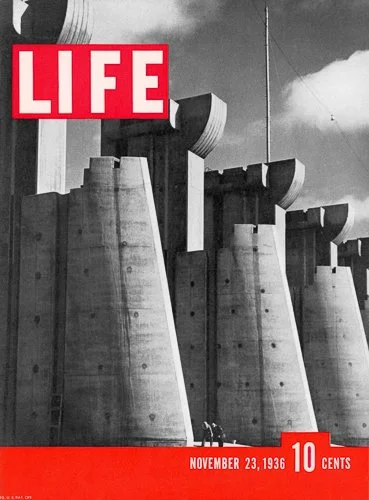
Lorant understood that an editor's job was not merely to select images but to choreograph them — to think about sequence, pacing, contrast, and rhythm across a spread of pages. Forced to flee Nazi Germany in 1933 after his arrest and imprisonment, he brought this sensibility to Britain, where he founded Picture Post in 1938. Vu, the French magazine founded by Lucien Vogel in 1928, had been making similar experiments in Paris; Life, launched by Henry Luce on 23 November 1936, would become the dominant platform for the form in the United States.
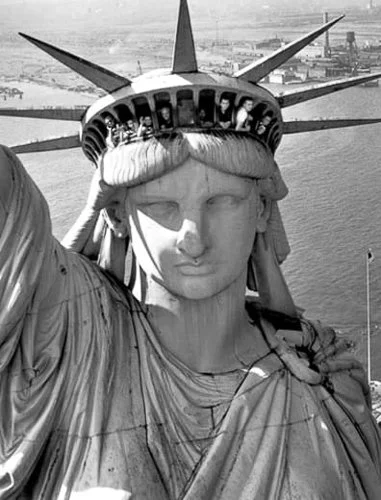
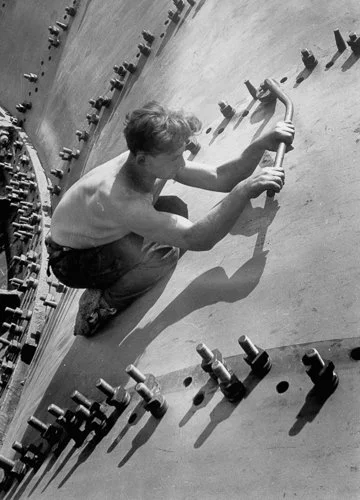
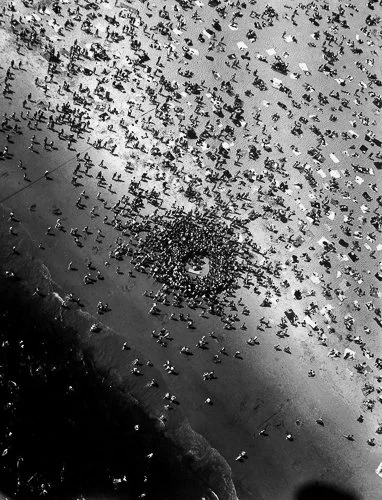
Life's first cover was taken by Margaret Bourke-White (1904–1971), and her photograph of the Fort Peck Dam in Montana — massive, monumental, and strangely human in its industrial grandeur — immediately announced the magazine's visual ambitions. Within two years, Life was the most widely read periodical in the United States, reaching a readership of approximately twenty million. It provided both the funding and the editorial framework within which the photo essay reached its highest development.
The grammar of the photo essay — the conventions by which a sequence of images constructs a narrative — was not formulated all at once, but a recognisable set of conventions emerged through practice.
An essay typically opens with an establishing shot: a wide view that places the subject in its environment, that gives the reader a sense of scale and context. It progresses through medium and close-up images, portraits, detail shots, and interaction photographs — each performing a different narrative function — before arriving at a closing image that provides resolution, or at least the sense of having arrived somewhere.
The signature photograph, or what Life's editorial culture sometimes called the "climax" image, was the picture that contained all the key storytelling elements in a single frame — the essay's version of the decisive moment.
The master of this form, and the figure who raised it to the level of literary art, was W. Eugene Smith (1918–1978). Smith brought to the photo essay an intensity of engagement — what he described as a fierce moral commitment to his subjects — that set him apart from the competent craftsmen around him. He had been described, with some justice, as "perhaps the single most important American photographer in the development of the editorial photo essay."
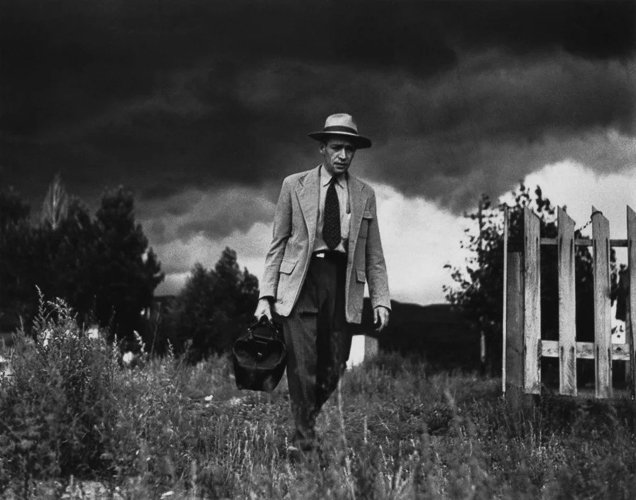
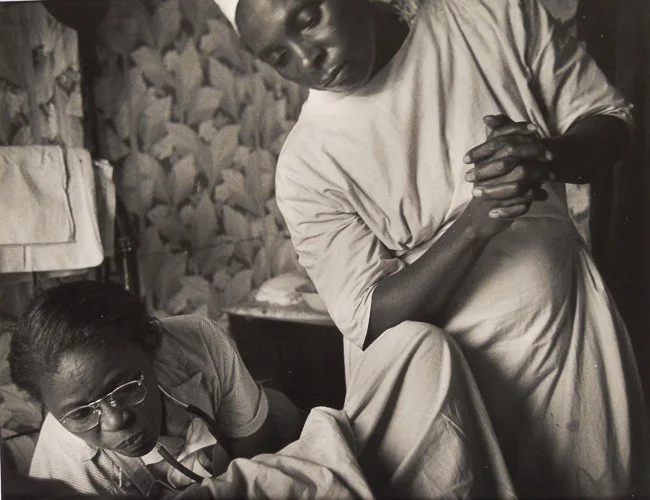
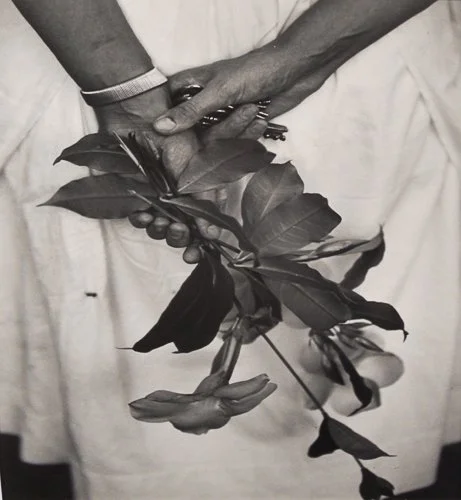
His essay "Country Doctor," published in Life on 20 September 1948, is widely regarded as the first fully realised extended editorial photo story. Smith spent approximately three weeks embedded with Dr Ernest Ceriani, the sole general practitioner serving the rural community around Kremmling, Colorado — more than 2,000 people spread across a sparsely populated mountain region. He waited, watched, and photographed exhaustively before selecting the images.
The result was not a reportage in the conventional news sense but something more like a short novel told in photographs: a sustained portrayal of a single human being in his daily and nightly work, revealing through accumulated detail the loneliness, the moral weight, and the occasional grace of a life dedicated to medicine in an isolated community. The essay's power derives from Smith's willingness to spend time — to achieve the intimacy that time alone makes possible — and from the magazine's corresponding willingness to fund that commitment without demanding deliverables by a fixed date.
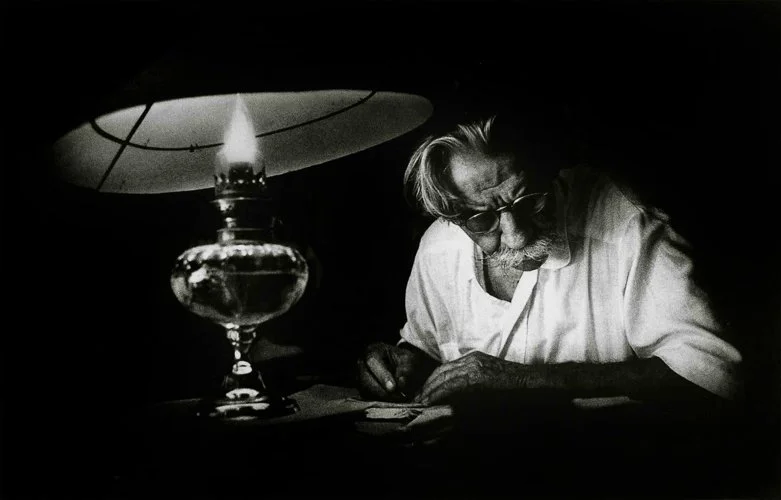
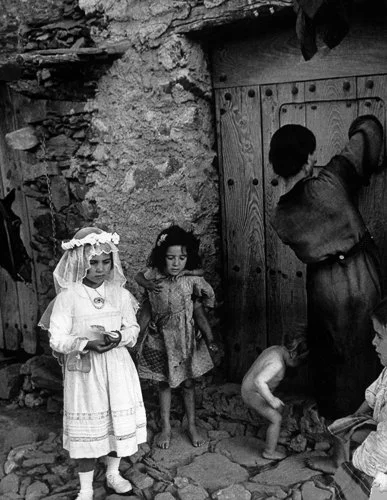
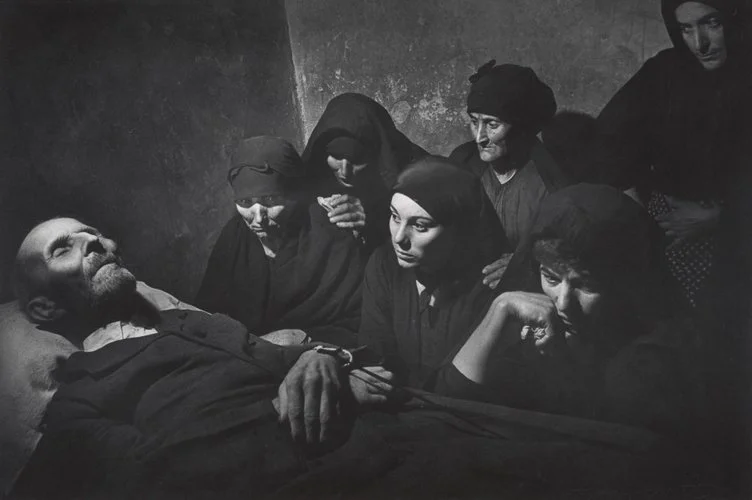
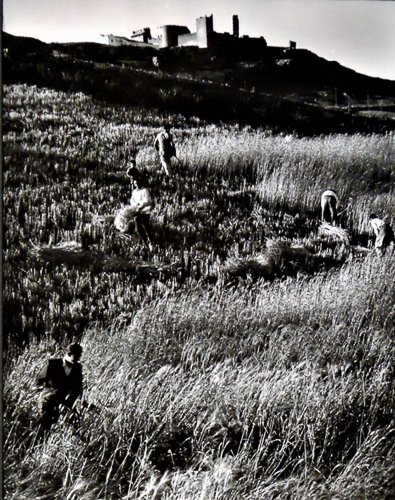
"Spanish Village" (Life, 9 April 1951) deepened Smith's project of humanist documentary. He spent a month in 1950 in the village of Deleitosa, in Extremadura, photographing under the watch of the Guardia Civil. The essay that resulted is a meditation on poverty, Catholicism, and the daily rhythms of life under Francoist dictatorship — its most famous image, a woman washing the body of the dead, rendered in the idiom of Renaissance religious painting while retaining the specificity of documentary fact.
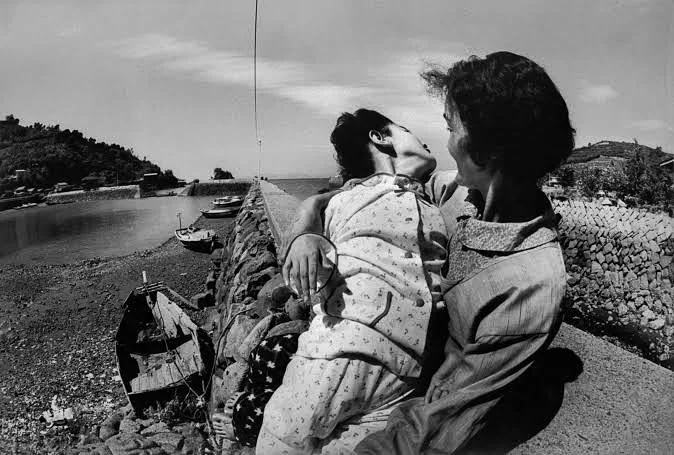
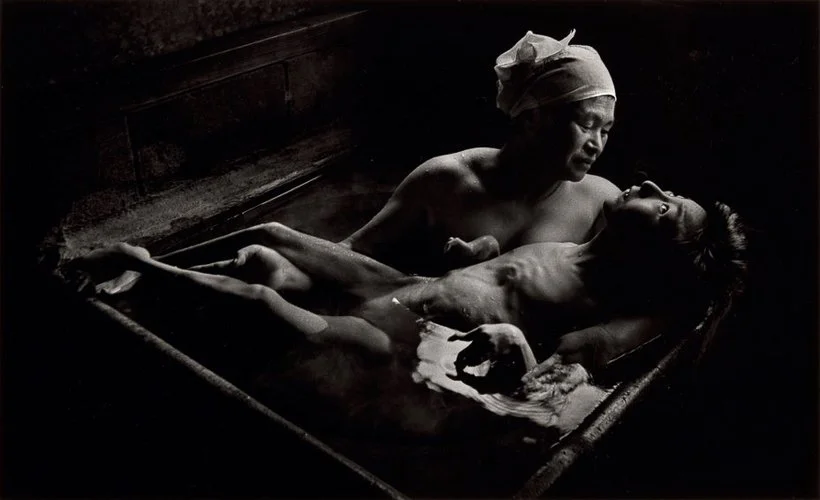
Smith's final and arguably greatest work, Minamata, was produced in collaboration with his wife Aileen Mioko Smith. Moving to the Japanese fishing village of Minamata in 1971, they documented over several years the devastating effects of mercury poisoning caused by the Chisso Corporation's industrial discharge into the bay.
The resulting essay — published as "Death-Flow from a Pipe" in Life in 1972 and expanded into the book Minamata (1975) — used the photo essay's accumulated grammar to bear witness to an environmental and human catastrophe of the first order. During a press conference related to the case, Smith was beaten severely by Chisso employees; he continued working. The image of Tomoko Uemura being bathed by her mother, widely known as "Tomoko in Her Bath," was described as "the Pietà of the 20th century" — an explicit acknowledgement that the photo essay's aspirations could extend into the register of religious art.
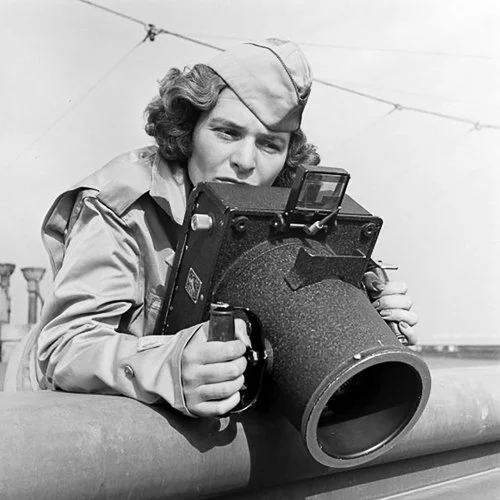
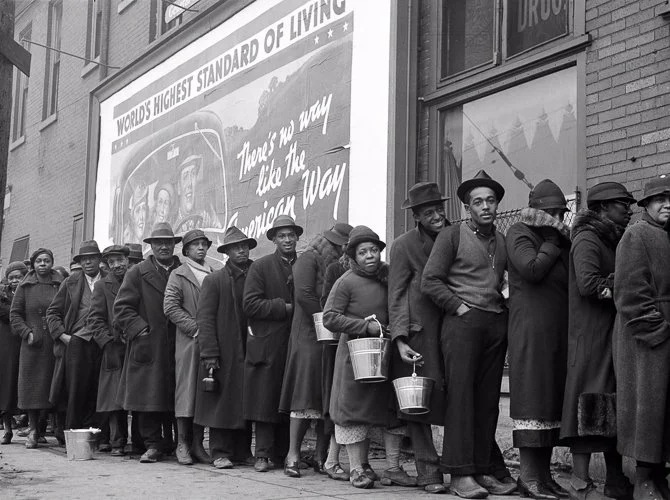
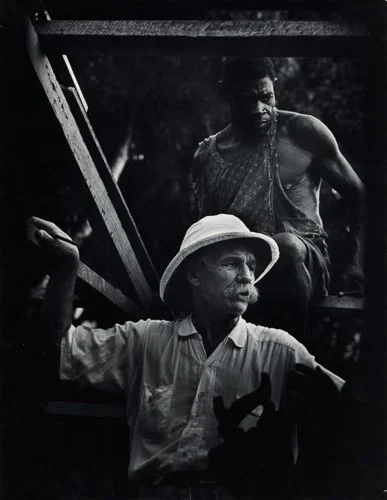
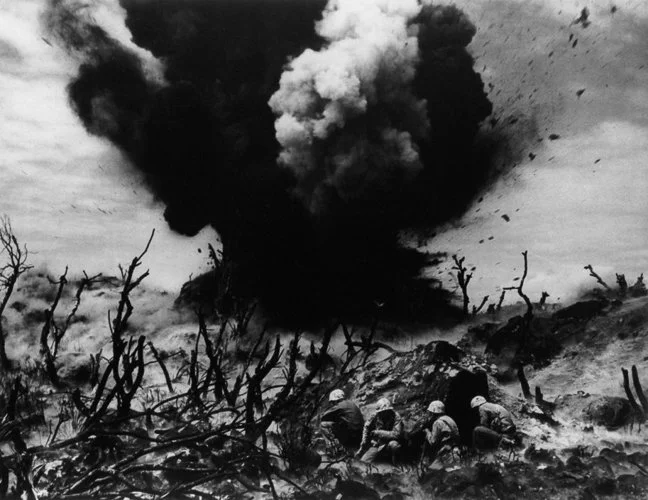
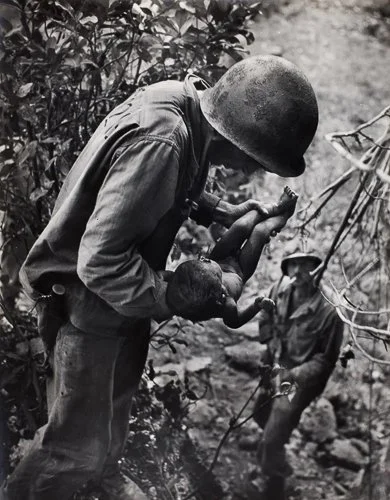
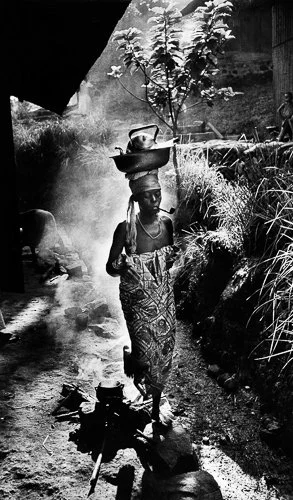
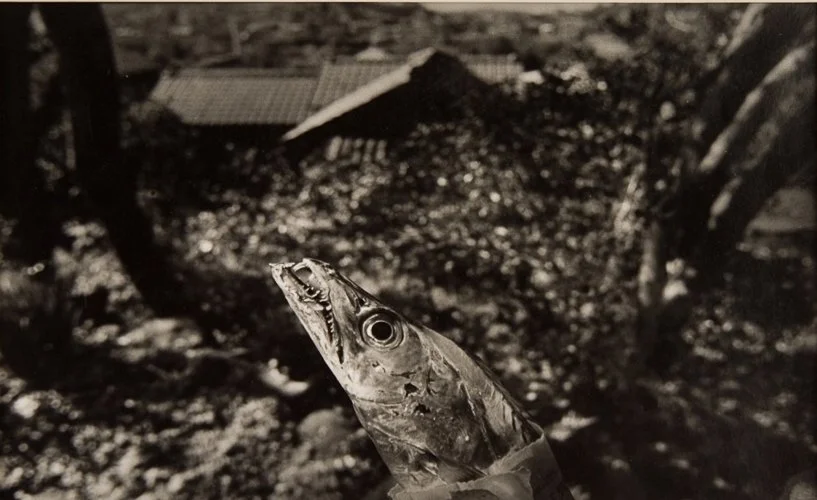
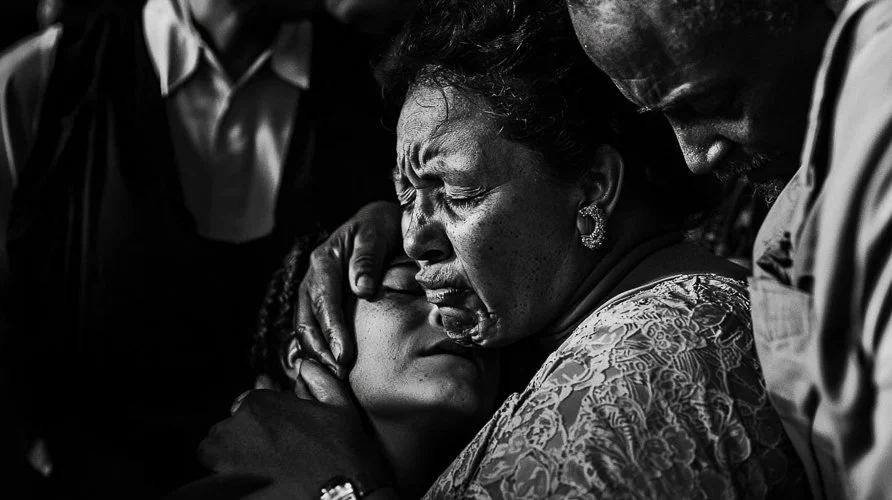
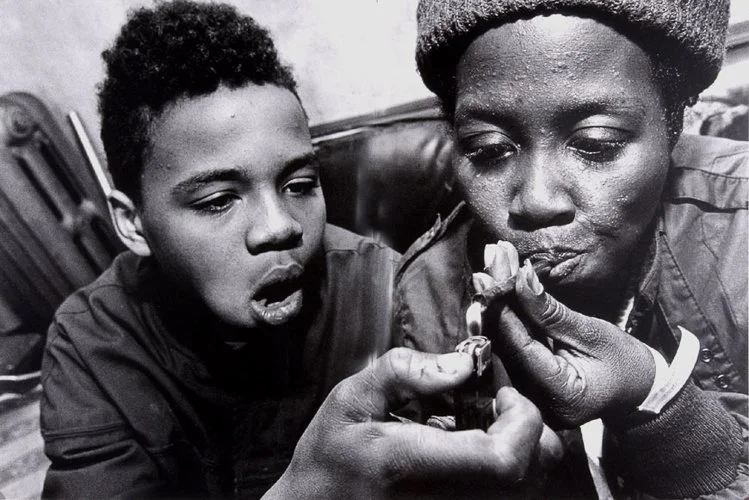
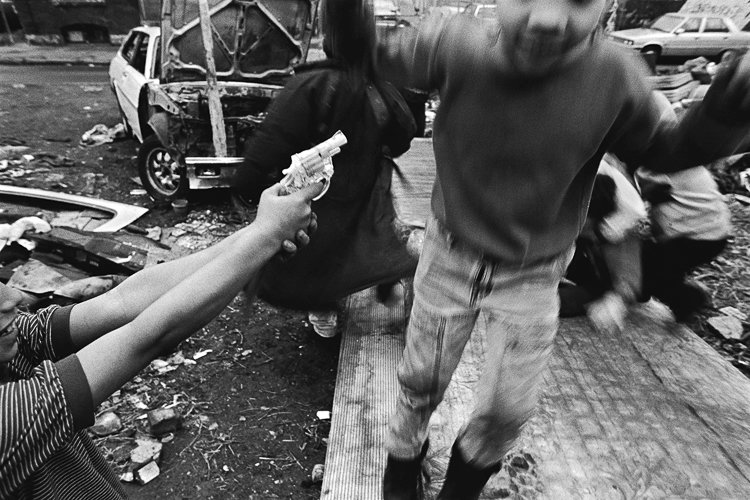
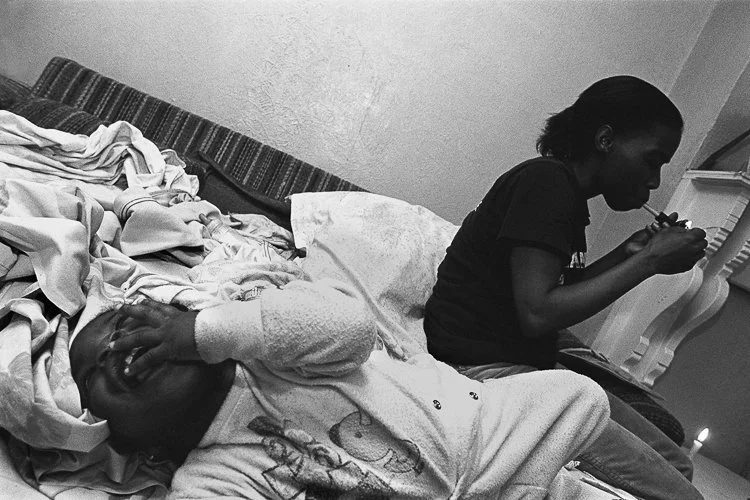
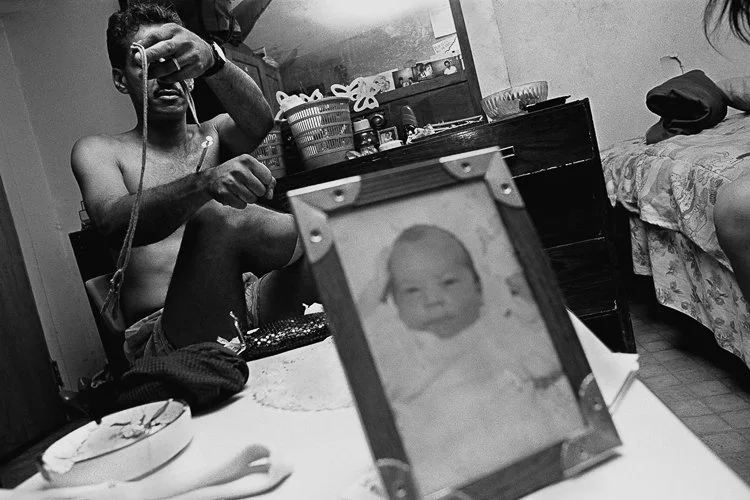
The development of the photo essay's specific grammar was not Smith's achievement alone. Eugene Richards (b. 1944) brought a related intensity to subjects closer to home in America — drug addiction (Cocaine True, Cocaine Blue, 1994), illness, poverty, emergency medicine — using a physically close, sometimes confrontational style that refused the dignity of aesthetic distance. His work demonstrates that the essay's grammar could accommodate formal approaches quite different from Smith's more classically composed work.
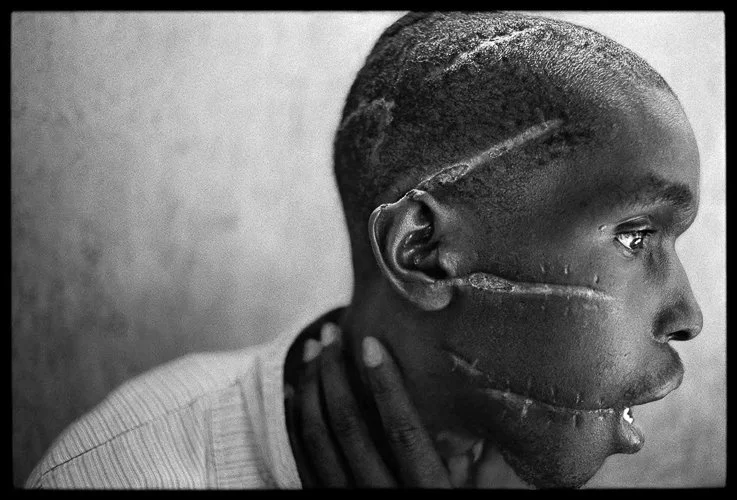
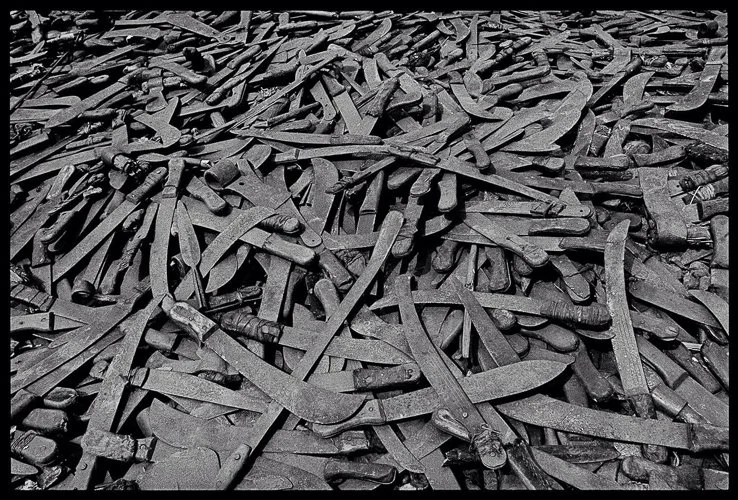
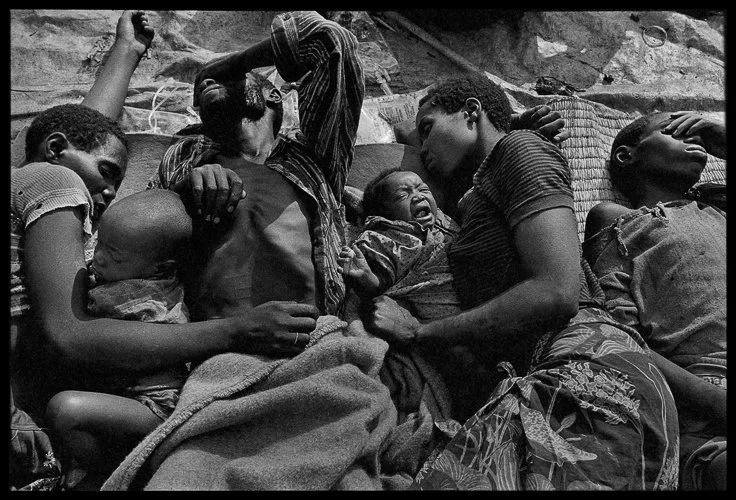
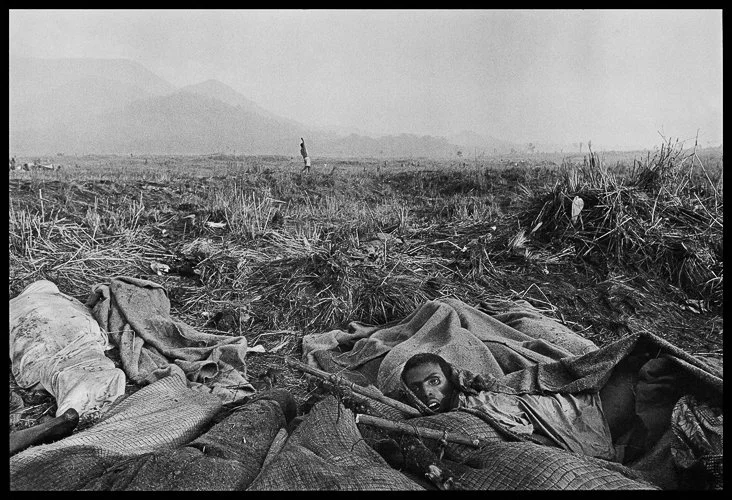
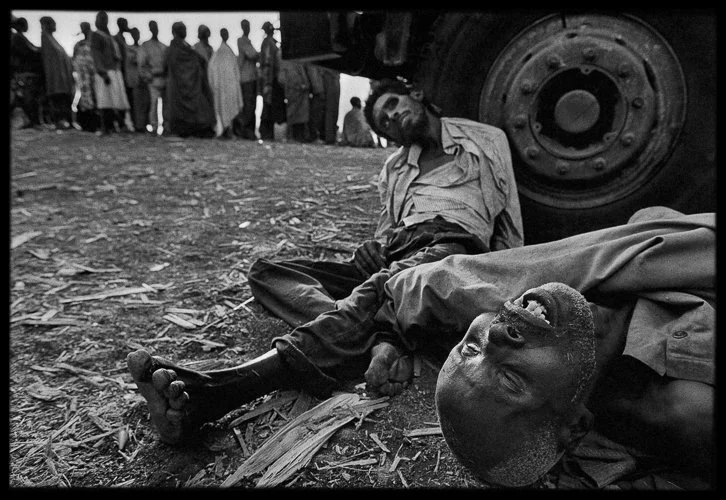
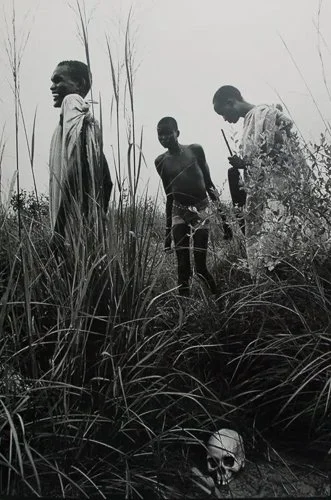
James Nachtwey (b. 1948) extended the tradition of the socially engaged photo essay into the conflict zones of the late twentieth century — Northern Ireland, El Salvador, Nicaragua, Rwanda, Bosnia, Kosovo, Afghanistan, Iraq — with a moral seriousness and physical courage that earned him five Robert Capa Gold Medals.
His 1999 book Inferno, nearly five hundred pages and weighing close to five kilograms, is a monument of the photo essay tradition: an overwhelming accumulation of evidence that forces the viewer to keep looking. Like Smith before him, Nachtwey understood that the essay's power derived from its refusal to let any single image bear the full weight of its subject. The story needed the sequence.
Documentary & the Long Project
The photo essay, as developed in the magazine context, was, at its core, a bounded form: a project with a defined subject, a beginning, and an end, delivered to a publisher by an agreed date. The assignment model that supported it — a magazine commissions a photographer, specifies a story, pays expenses and a fee, and publishes the result within weeks or months — created certain imperatives.
The work needed to be legible, accessible, and resolved within the framework of the layout. The sustained independent documentary project operated according to a different logic entirely.
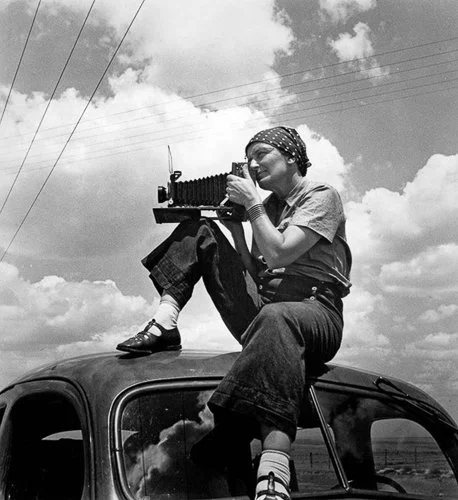
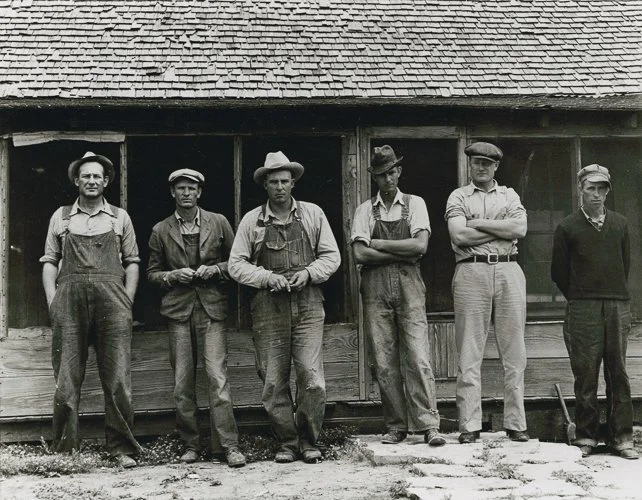
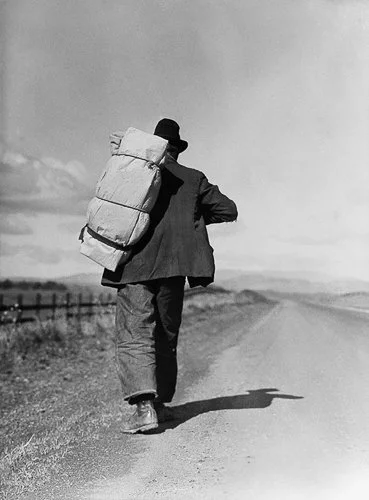
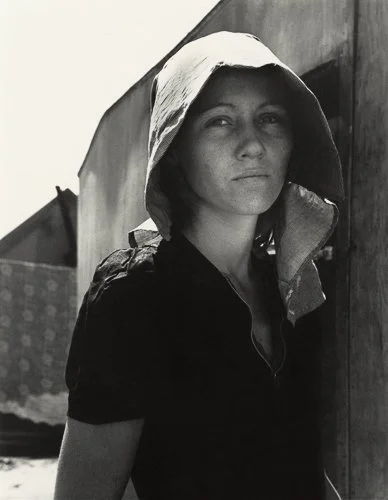
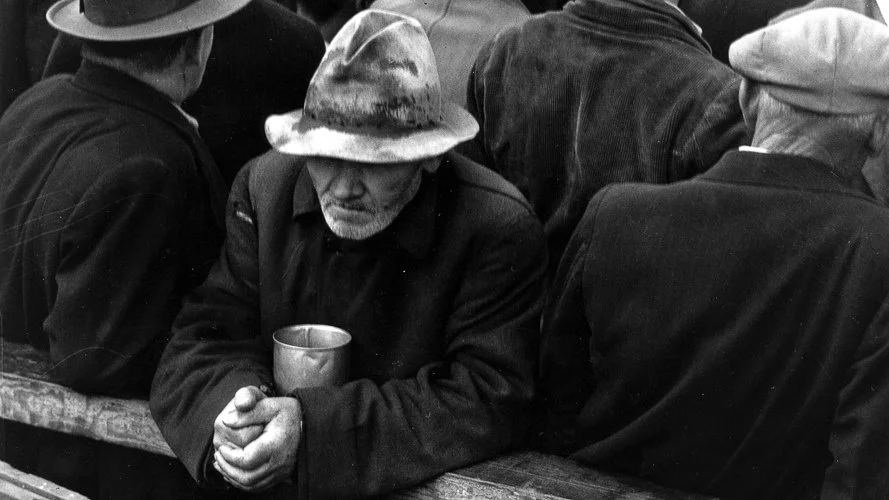
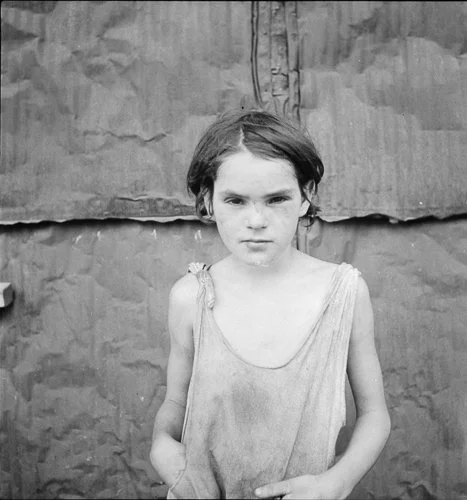
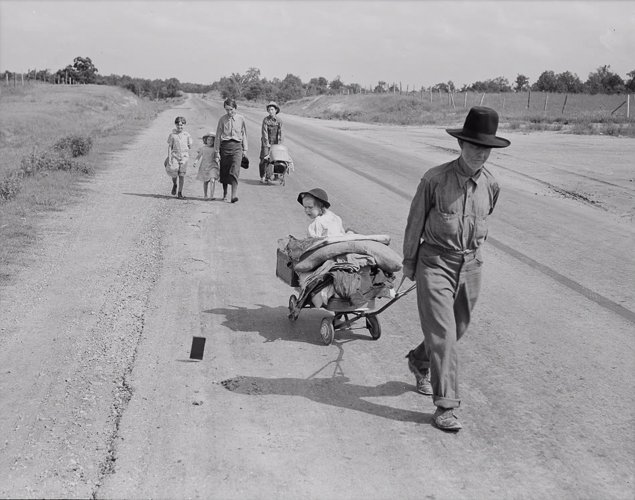
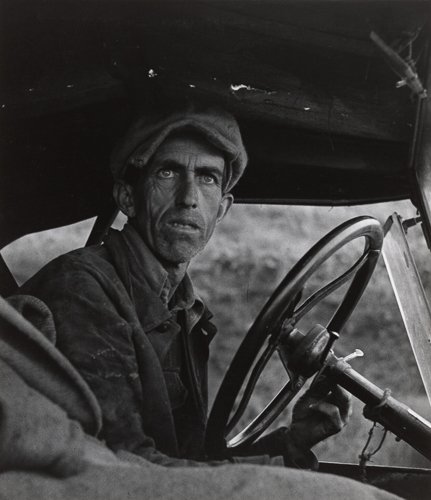
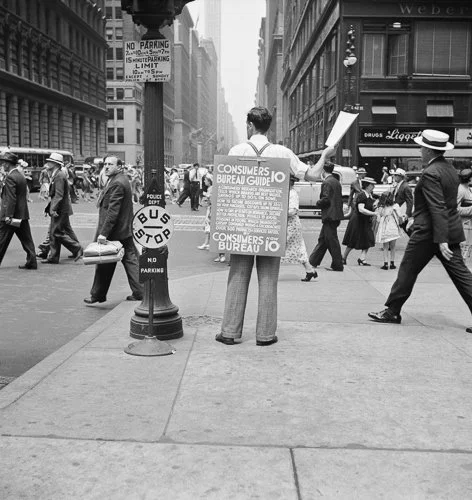
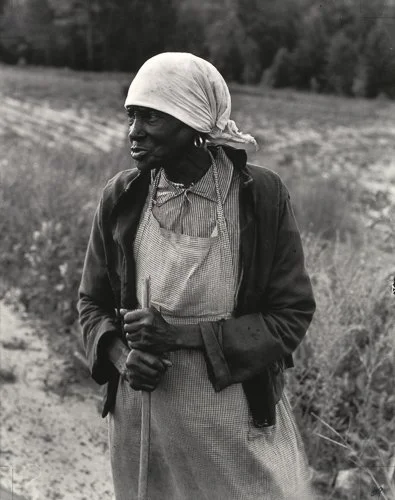
The model for this kind of work was established by the Farm Security Administration's photography project, initiated under Roy Stryker in 1935 and continuing through the early years of the Second World War. The FSA employed a group of photographers — Dorothea Lange, Walker Evans, Ben Shahn, Russell Lee, Arthur Rothstein, Jack Delano, Gordon Parks, and others — to document the conditions of rural poverty and displacement during the Depression years.
The brief was deliberately open-ended: to show America to Americans, to build a visual record of a society under stress. Over its existence, the project produced approximately 270,000 photographs, constituting one of the most extensive documentary archives in photographic history.
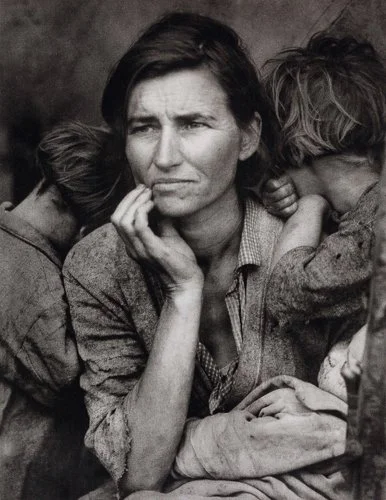
Dorothea Lange (1895–1965) produced within this framework the most iconic single image to emerge from the project: Migrant Mother (1936), a portrait of Florence Owens Thompson, a 32-year-old mother of seven in a pea-pickers' camp at Nipomo, California.
The photograph — which Lange took in a matter of minutes, making six exposures before moving on — was reproduced widely within days of its making and became the defining image of Depression-era suffering. But the FSA project as a whole was something different from the individual image: it was a sustained, institutional, long-term documentary project, the first of its kind, and it established the model of the photographer as sustained witness rather than episodic observer.
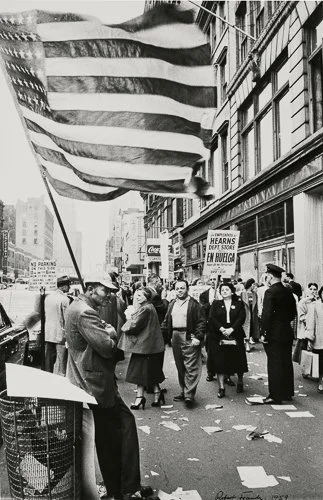
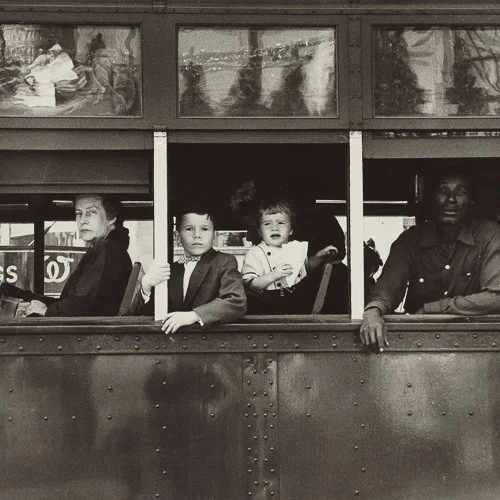
Robert Frank (1924–2019) transformed the documentary tradition by making it personal. Born in Zurich, trained in Switzerland, and later working in New York, Frank received a Guggenheim Fellowship in 1955 — supported by, among others, Walker Evans — to travel across the United States and photograph, as his proposal put it, what a poet might feel confronting the richest country on earth.
Over approximately two years, Frank made some 28,000 exposures; he selected 83 for the book. Les Américains was first published in Paris by Robert Delpire on 15 May 1958, as part of the Encyclopédie Essentielle series; the American edition, titled The Americans, was published by Grove Press in 1959, with an introduction by Jack Kerouac. American critics initially received the work with hostility — Popular Photography described the images as "poorly exposed, badly printed, and carelessly focused" — before it was slowly recognised as what it is: perhaps the most influential photography book of the twentieth century.
What Frank had done was to detach the documentary project from its institutional and didactic functions. The FSA photographers were working for a government agency with a social mission; Frank was working from his own vision of America — its loneliness, its racial divisions, its cheap glamour and its quiet desperation — organised not as an argument but as a lyric sequence.
The Americans draws on the grammar of the photo essay but deploys it according to aesthetic and emotional logic rather than journalistic logic. It is closer, as critics have noted, to a poem or to a piece of music than to a magazine story.

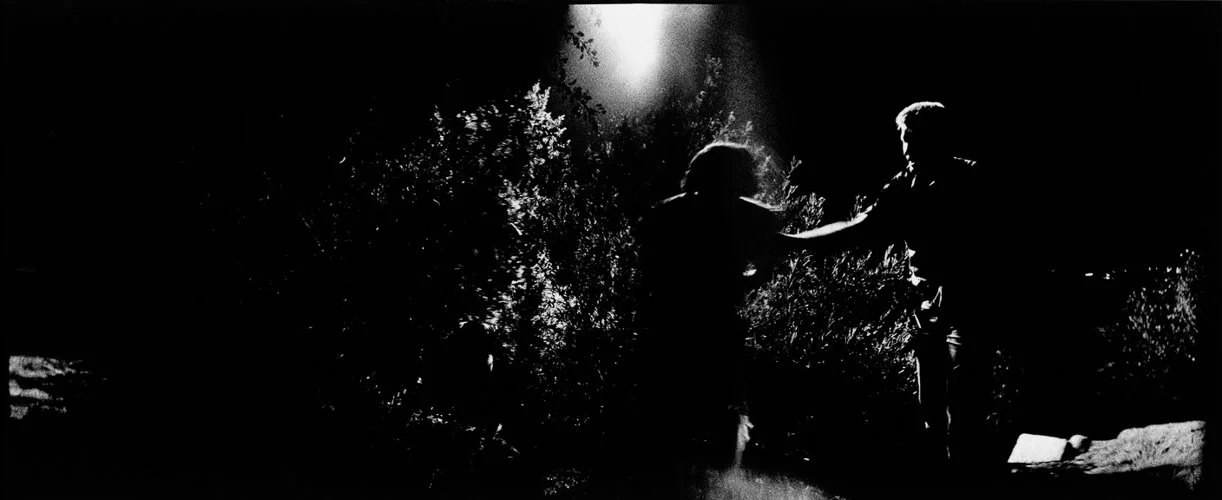
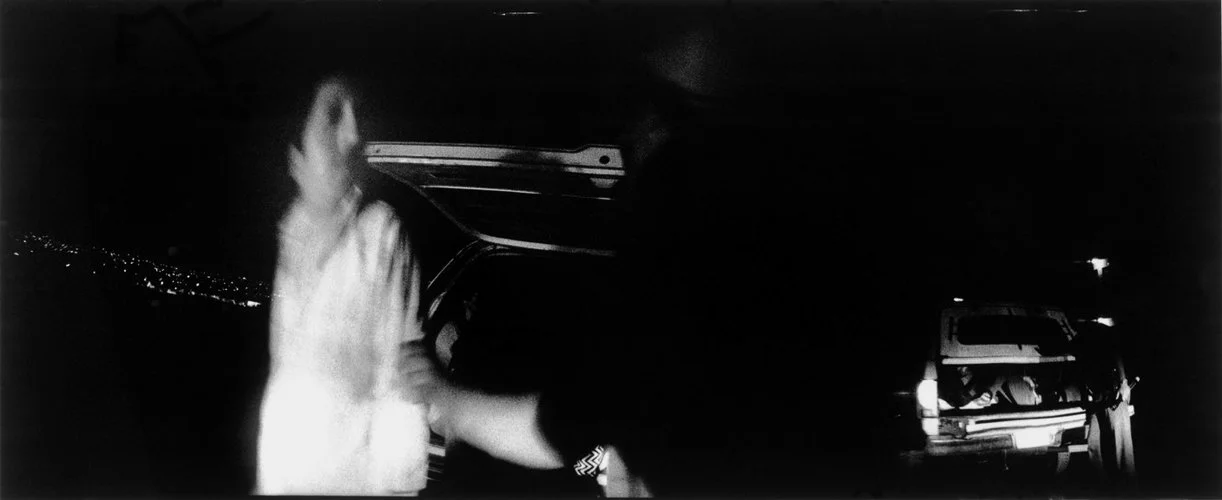
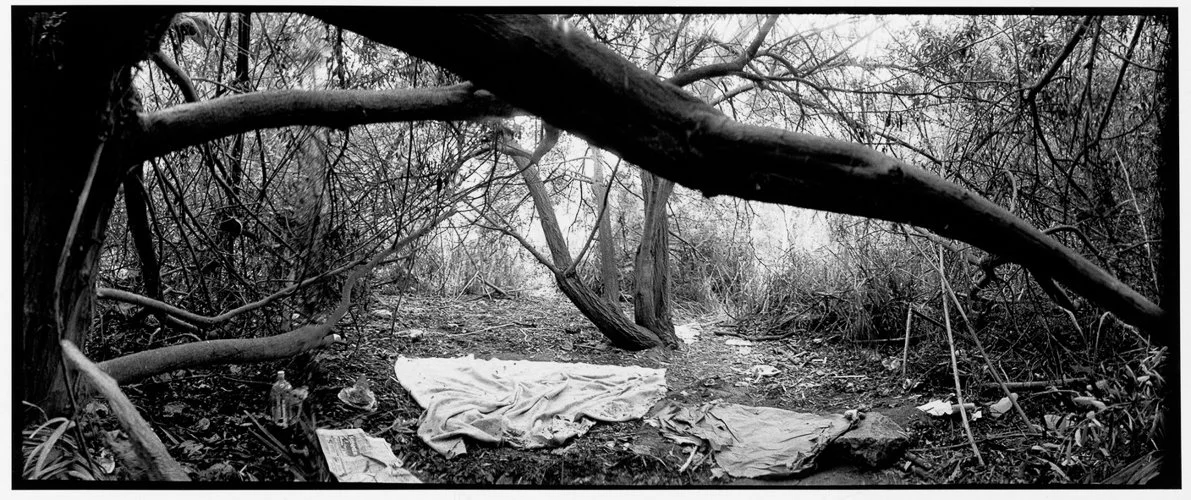
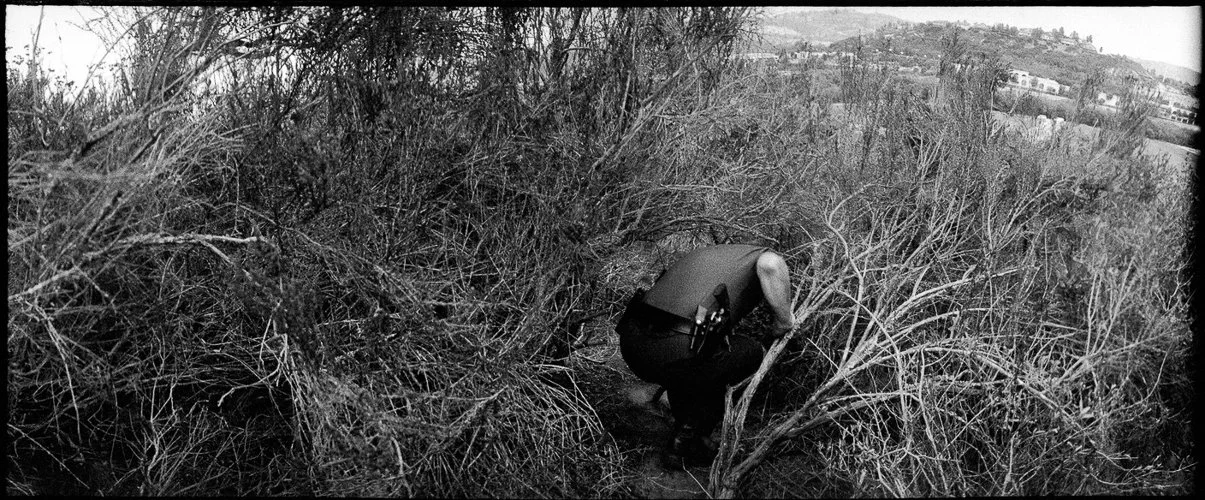
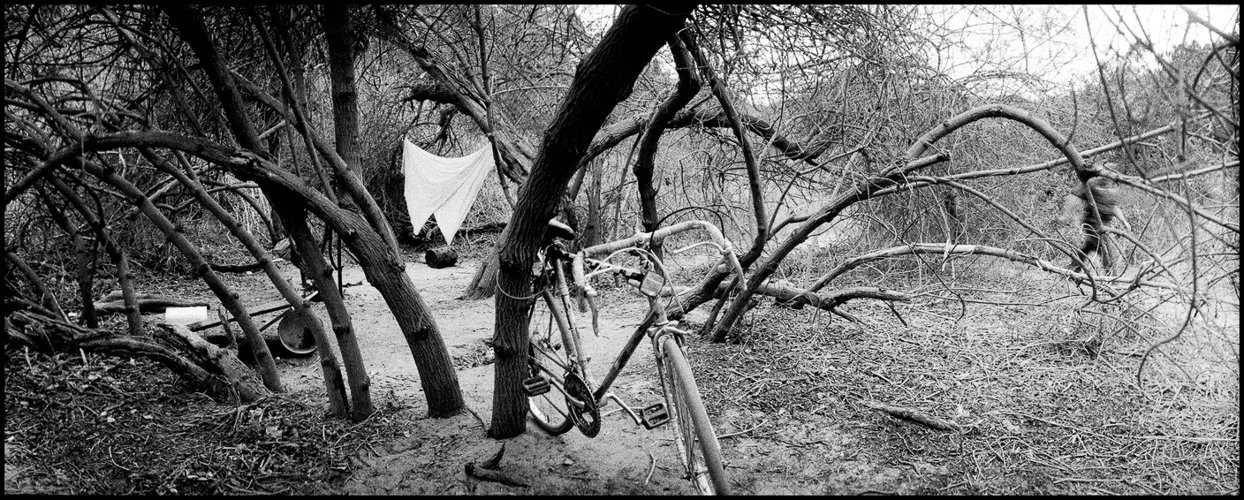
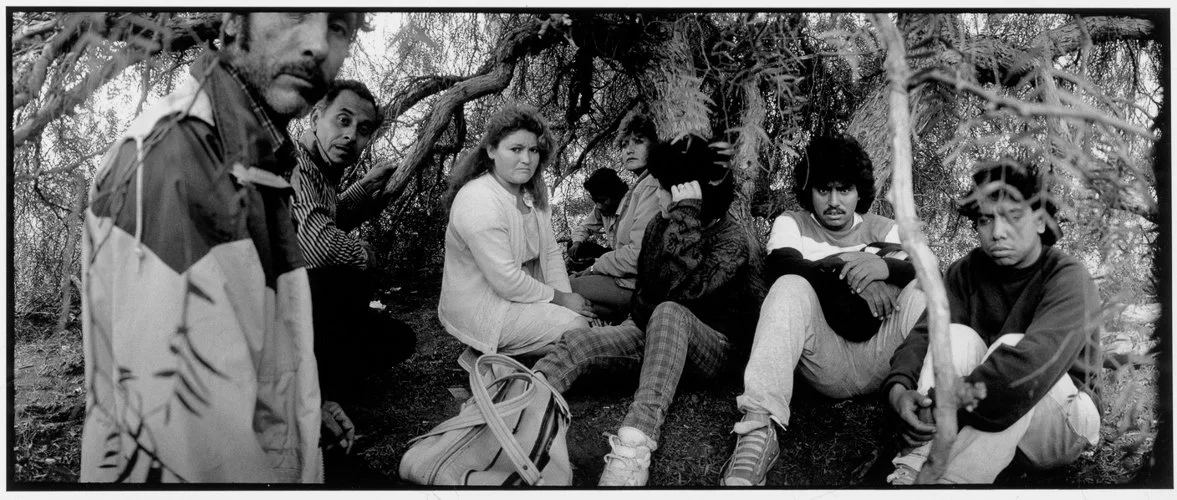
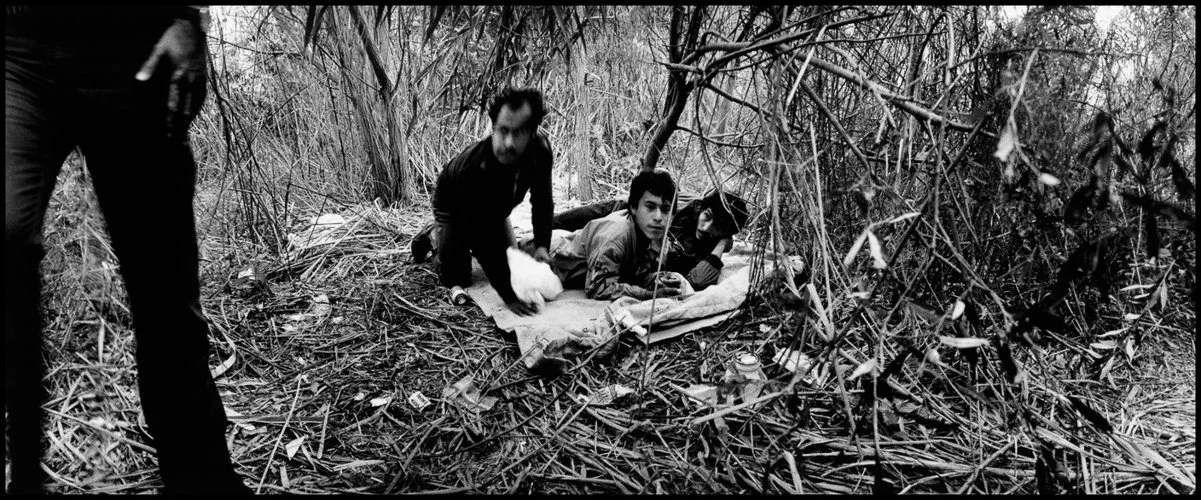
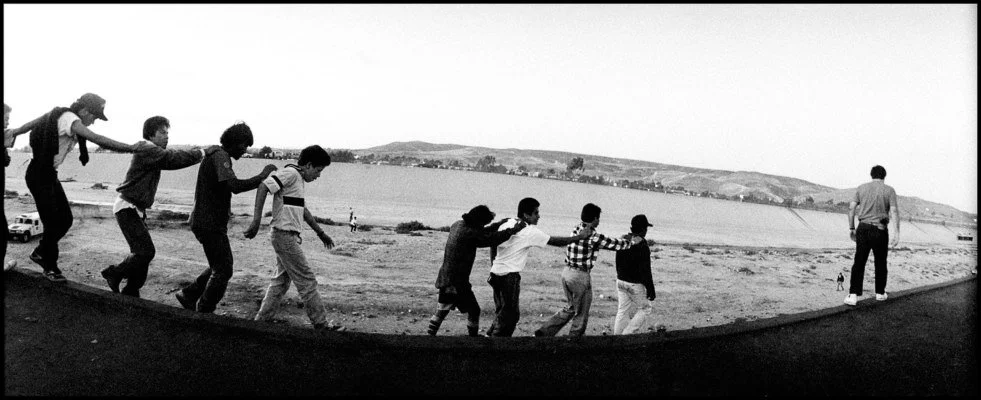
Susan Meiselas (b. 1948) spent several years during the Nicaraguan insurrection (1978–79) embedded with the Sandinista forces, producing the body of work collected in Nicaragua (1981). Her project combined documentary immediacy with a sustained engagement over time — she returned repeatedly — and raised questions about the photographer's role in relation to the political struggles she was recording.
Her subsequent project, Kurdistan (similarly extended over years and multiple visits), demonstrated the long project's capacity to register historical change in ways that the single assignment cannot. At the time of writing, she is currently President of the Magnum Foundation.
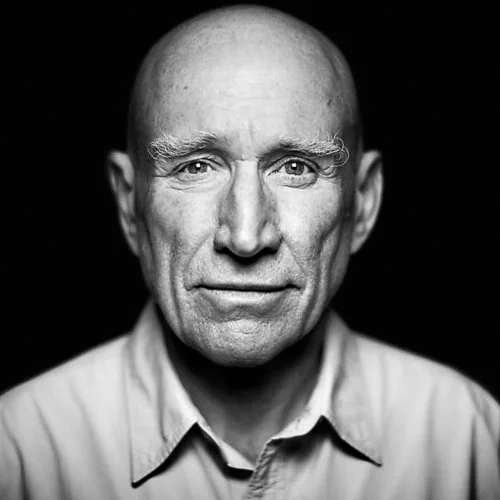
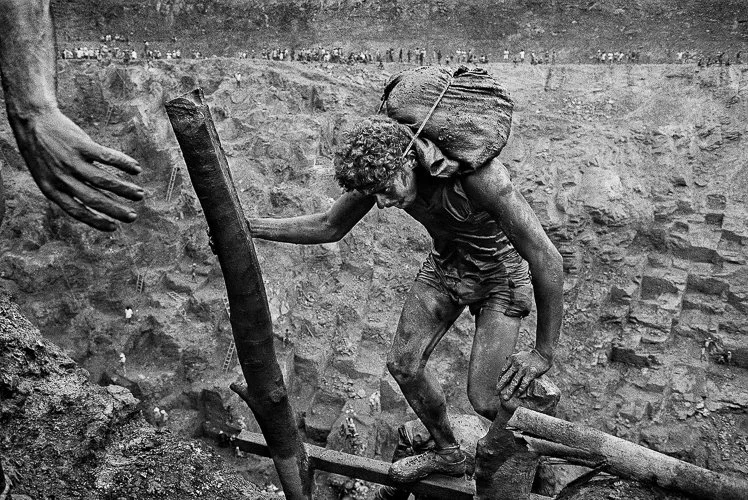
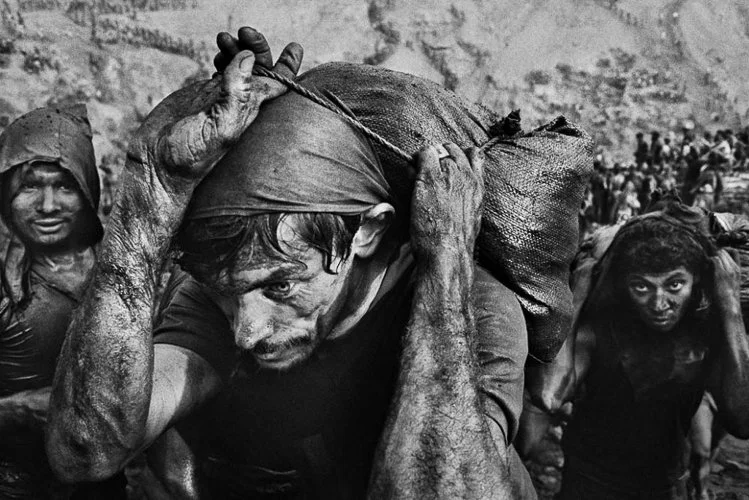
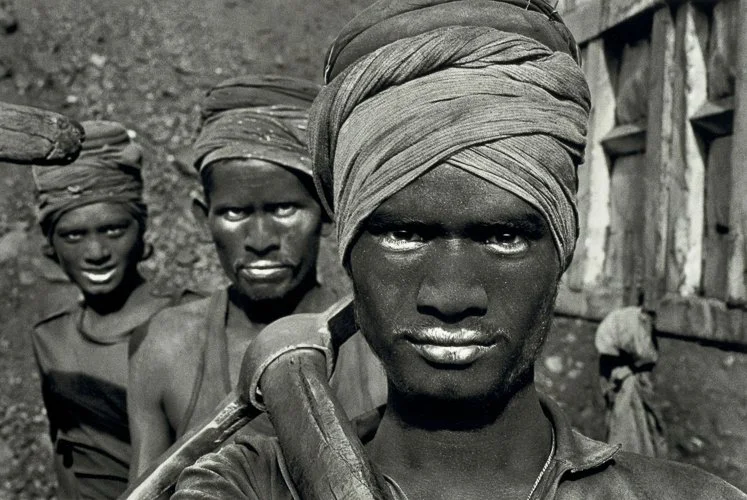
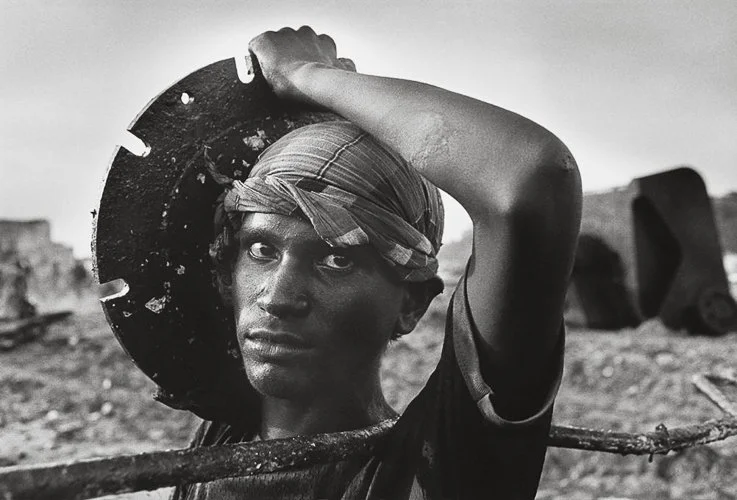
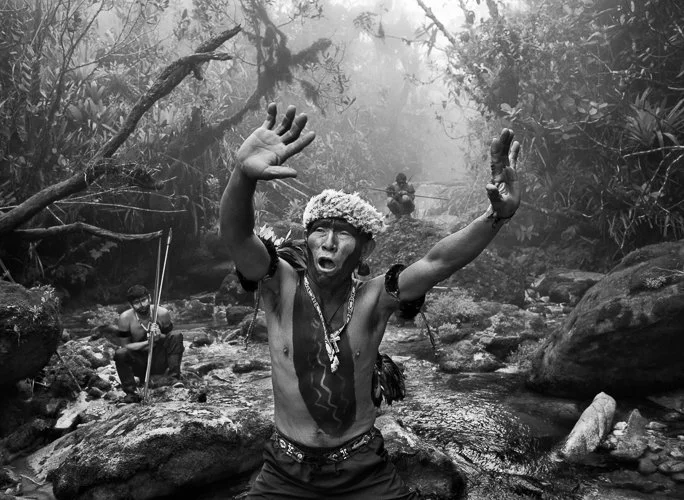
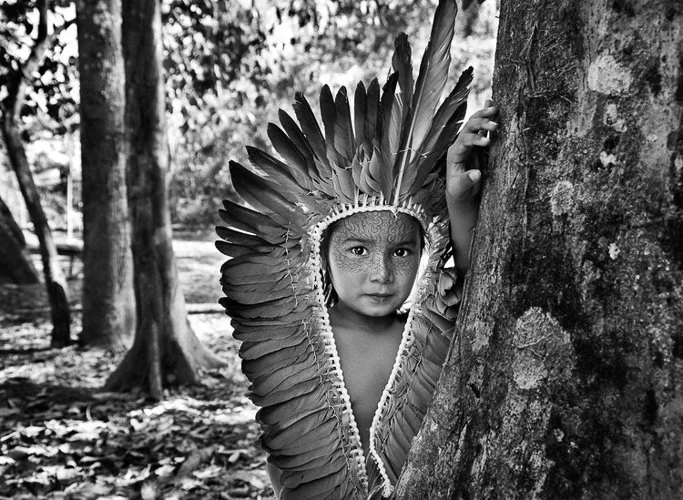
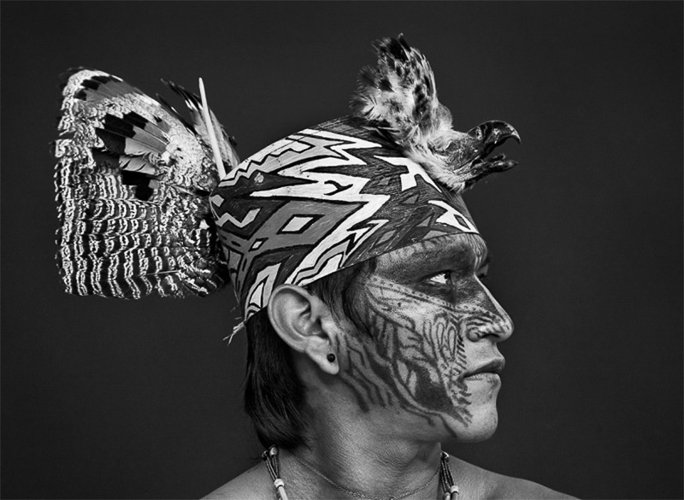
Sebastião Salgado (1944–2025) built his career on a series of long-term documentary projects of encyclopaedic ambition.
Other Americas (1986), produced through extensive travel across Brazil, Ecuador, Bolivia, Peru, Guatemala, and Mexico between 1977 and 1984, documented the spiritual and physical lives of indigenous and rural communities.
Workers: An Archaeology of the Industrial Age (1993) assembled six years of work across forty countries to produce a monument to manual labour at the historical moment of its disappearance.
Migrations: Humanity in Transition (2000) addressed the mass displacement of peoples worldwide.
Genesis (published 2013), the product of an eight-year expedition beginning in 2004, turned to the natural world.
Each of these projects was conceived at a scale and with a commitment that no magazine assignment could accommodate; each depended on independent funding, sustained access, and the photographer's willingness to spend years in the service of a single idea.
Salgado's work has attracted criticism as well as admiration — Susan Sontag, among others, raised questions about the aestheticisation of suffering in large-scale black-and-white photography — but its ambition, its rigour, and its scope remain without parallel in the tradition of the long documentary project.
War Photography & the Single Iconic Image
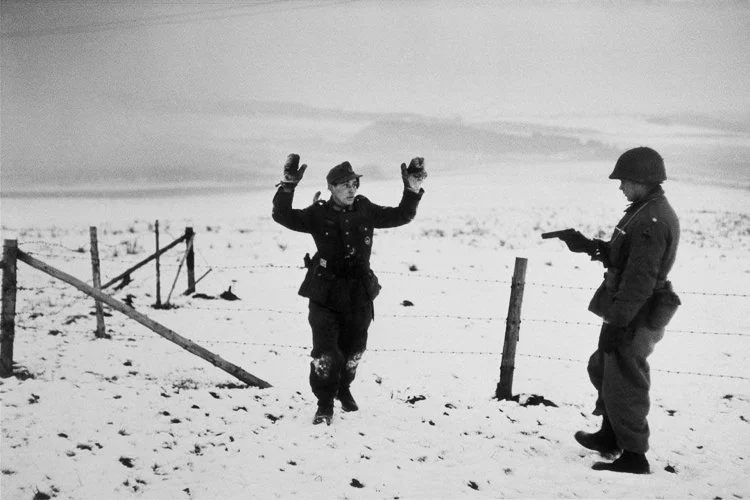
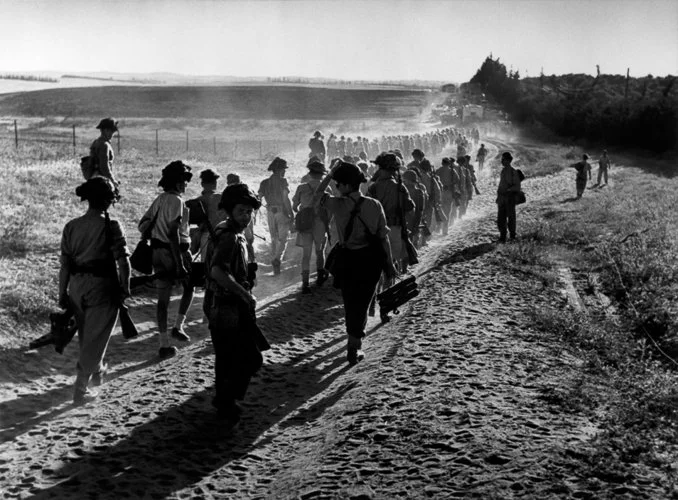
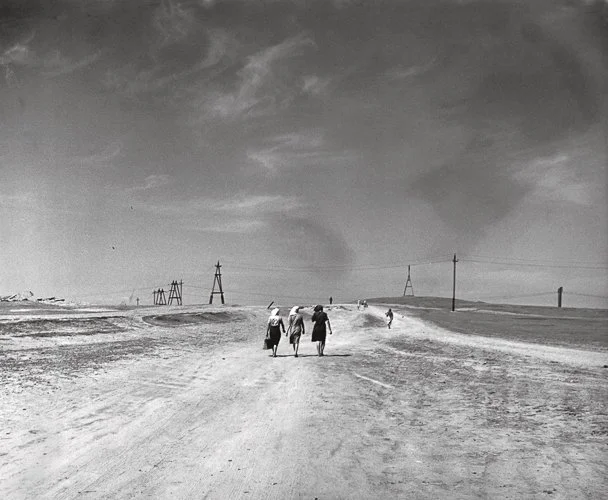
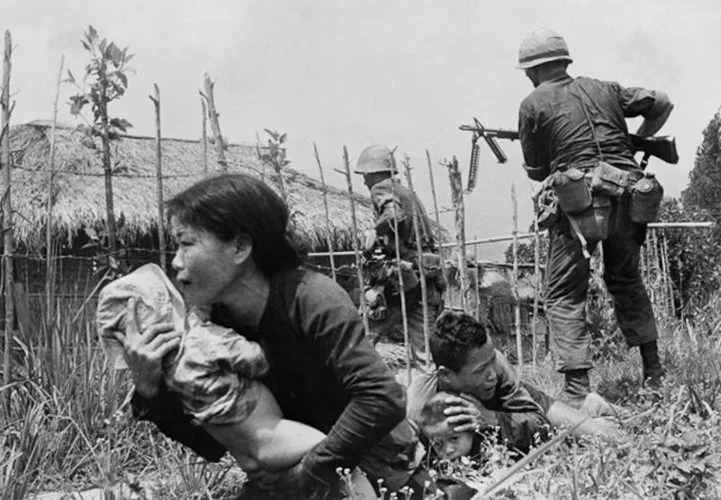
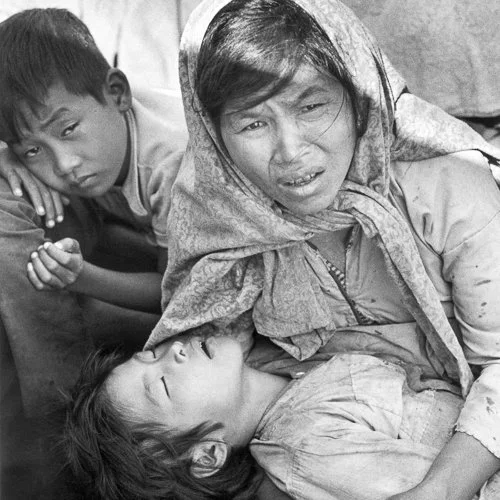
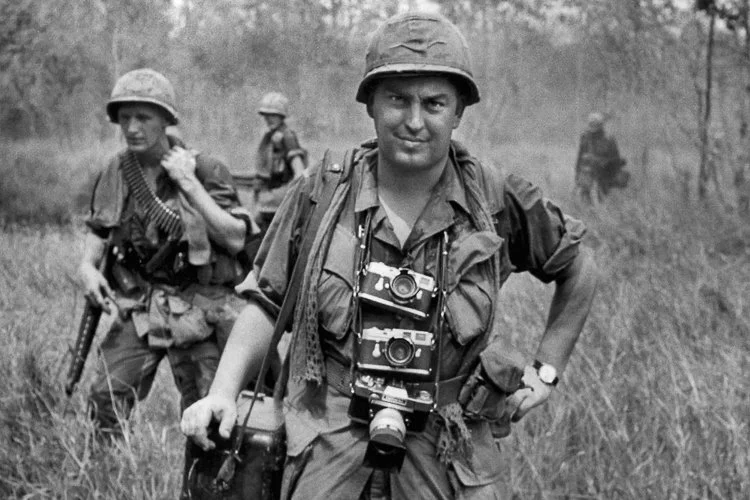
War photography has produced the most concentrated examples of photography's power to create single images that define public understanding of entire conflicts, and it has also produced the most acute ethical debates about what that power costs.
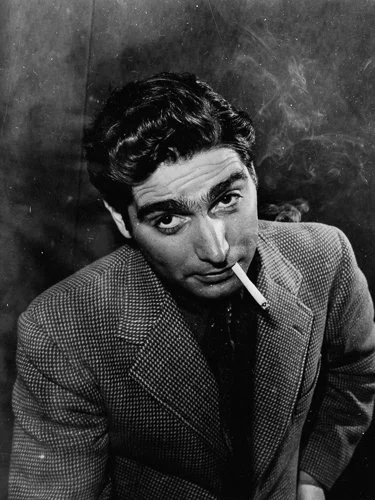
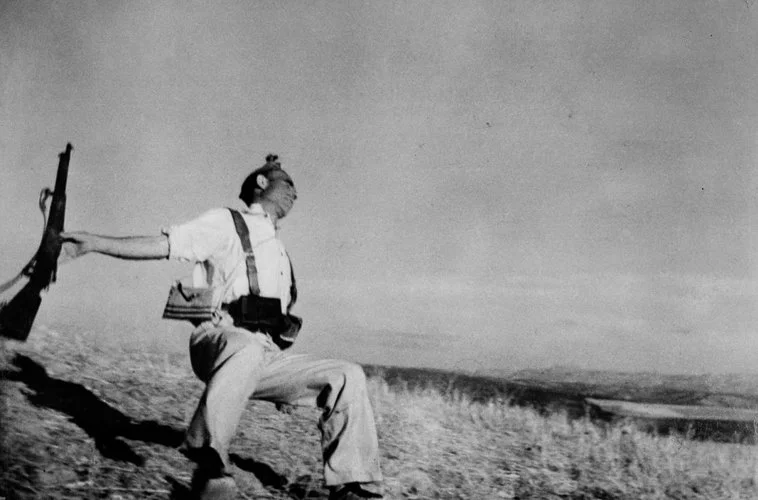
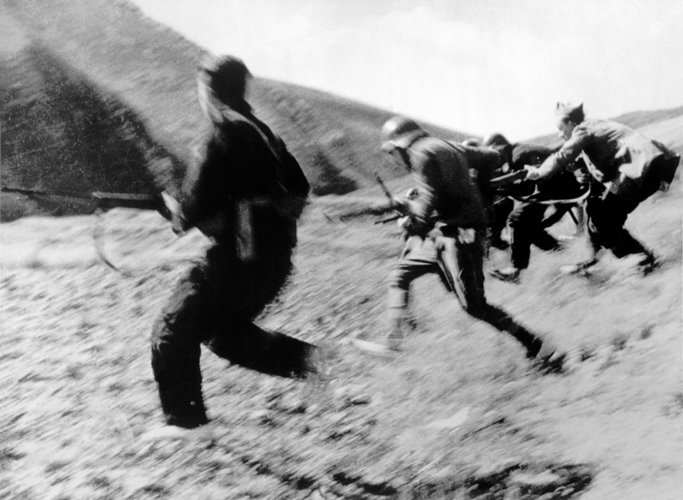
Robert Capa (1913–1954) — born Endre Ernő Friedmann in Budapest — is the central figure in the tradition of the iconic war image. His most famous photograph, made during the Spanish Civil War and known as The Falling Soldier (full title: Loyalist Militiaman at the Moment of Death, Cerro Muriano, September 5, 1936), was first published in the French magazine Vu on 23 September 1936, and subsequently in Life on 12 July 1937. It appears to show a Republican soldier at the instant of death, his body falling backwards, rifle slipping from his hand. Upon publication, it was acclaimed as one of the greatest war photographs ever made.
The photograph has been the subject of an authenticity debate since the mid-1970s. Critics and researchers have raised several categories of doubt.
First, the location: José Manuel Susperregui's forensic analysis of the landscape visible in the image, published in his 2009 book Sombras de la Fotografía, concludes that the photograph was taken not at Cerro Muriano, as claimed, but near the town of Espejo, approximately fifty kilometres away — and that Espejo was well behind the front lines at the time, meaning the "action" would have had to be staged.
Second, the identity of the subject: the soldier was later claimed to be the anarchist militiaman Federico Borrell García, but researchers have noted that Borrell, who was indeed killed at Cerro Muriano that day, does not clearly match the man in the photograph.
Third, a 2007 documentary, La sombra del iceberg, and the discovery of related photographs apparently taken at the same location and at the same time suggest a series of staged poses.
There is, critically, no surviving negative of the photograph. Capa's biographer Richard Whelan defended the photograph's authenticity, and the International Centre of Photography has maintained that the case against it is unproven. The debate remains, as of this writing, unresolved — which is itself significant: no other photograph in the canon has sustained such a prolonged and serious challenge to its status as a document.
Capa's working motto — "If your pictures aren't good enough, you're not close enough" — encapsulates the ethics and aesthetics of the war photographer's tradition. He was killed in 1954, stepping on a landmine in Vietnam.
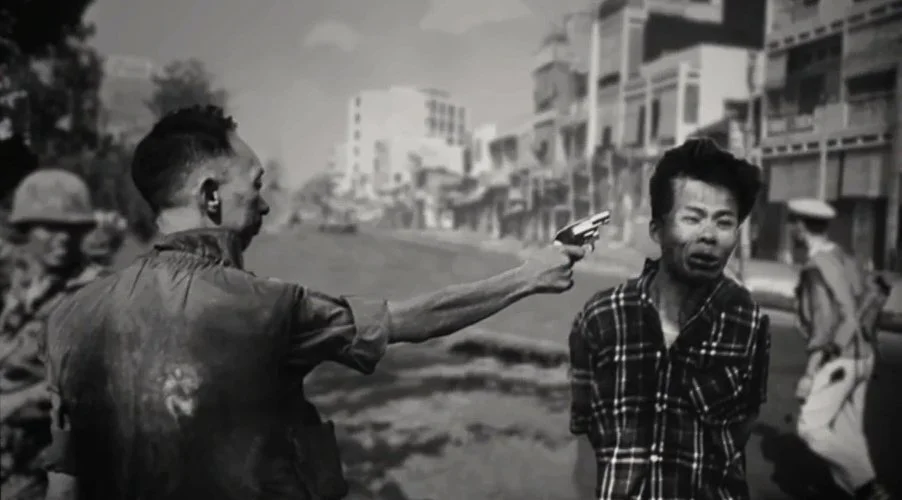
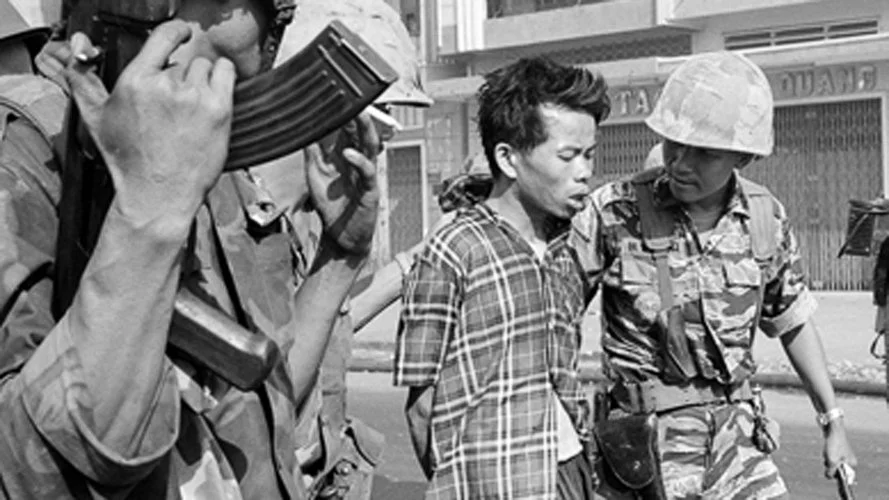
Eddie Adams (1933–2004), working for the Associated Press, photographed the summary execution of Nguyễn Văn Lém by General Nguyễn Ngọc Loan on a Saigon street on 1 February 1968, during the opening phase of the Tet Offensive. The photograph won the 1969 Pulitzer Prize for Spot News Photography.
Adams later reflected on what it had done: "The general killed the Viet Cong; I killed the general with my camera. Still photographs are the most powerful weapon in the world. People believe them; but photographs do lie, even without manipulation. They are only half-truths." His equivocation about his most famous image — an image he did not wish to be remembered by — captures the ethical ambivalence of the iconic war photograph: its power to shape public understanding is real, but that power operates precisely because the photograph strips context from its subject.
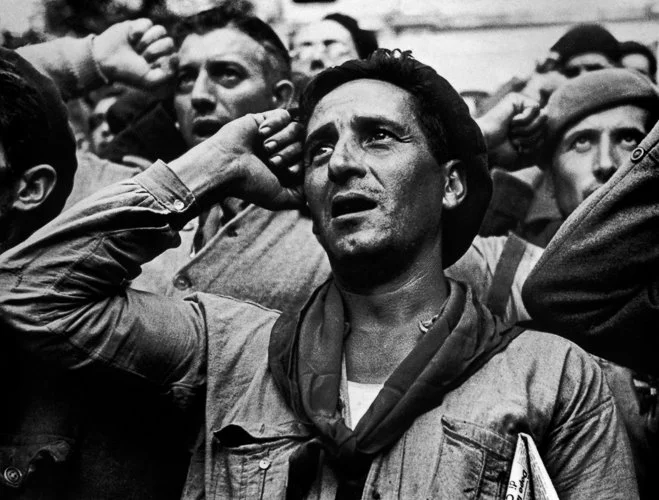
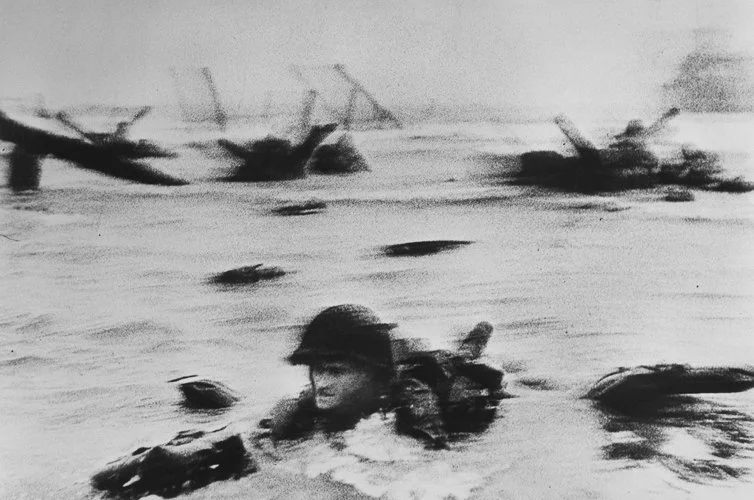
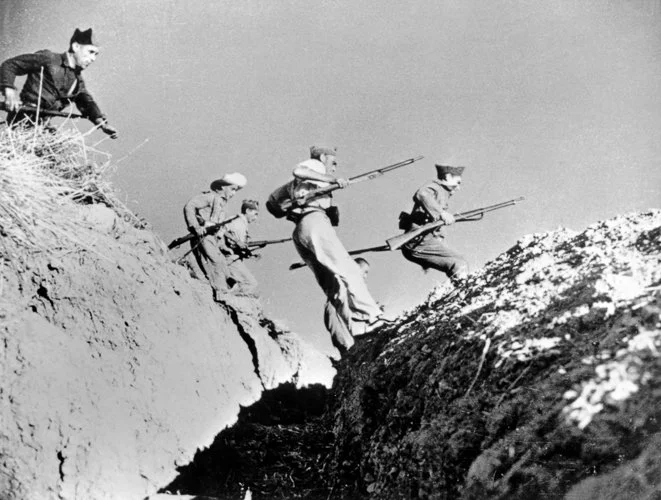
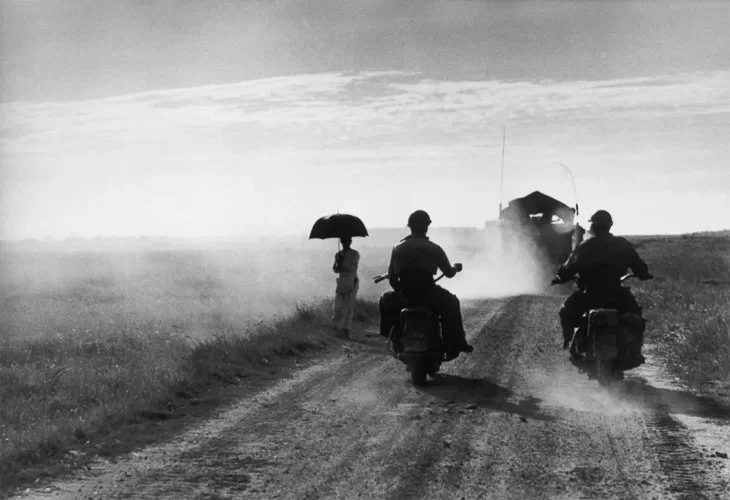

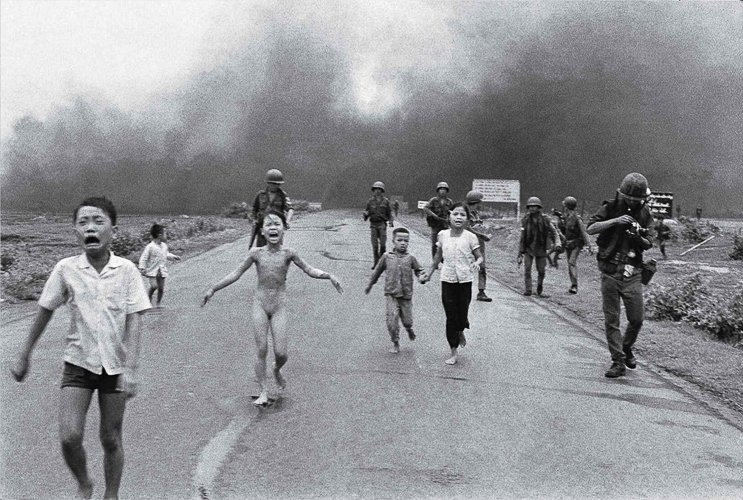
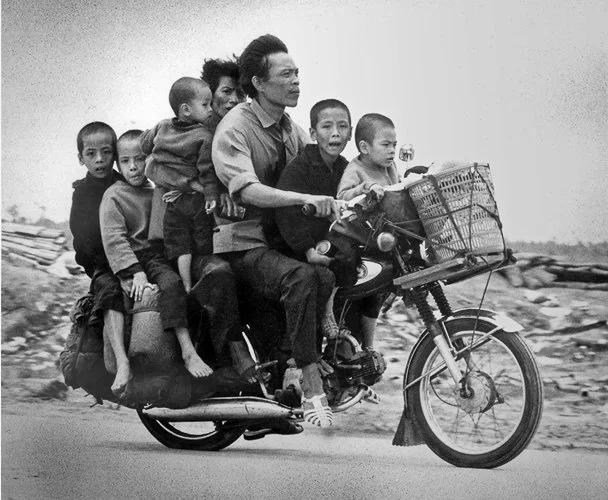
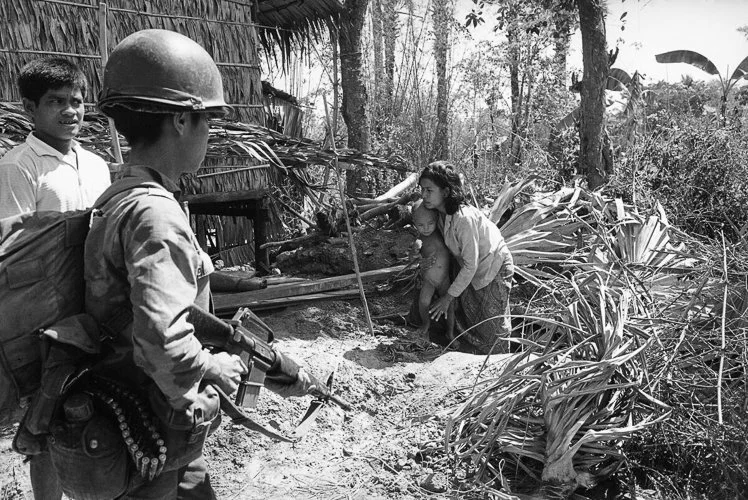
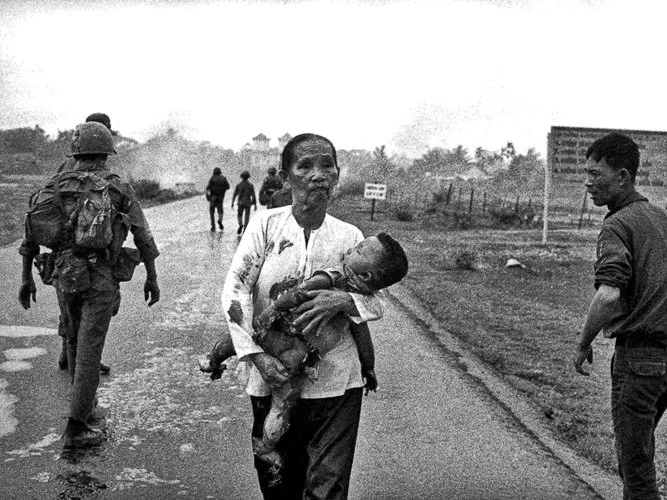
Nick Ut (b. 1951) photographed the aftermath of a napalm attack near Trang Bang on 8 June 1972, capturing the nine-year-old Kim Phuc — later identified as Phan Thi Kim Phúc — running naked down Highway 1, her clothes burned from her body. The Associated Press almost declined to transmit the image because of its depiction of a child's nudity; it was published the following day worldwide and came to define popular opposition to the war in Vietnam.
Note: attribution of this photograph was subject to a significant controversy beginning in 2024–2025, when World Press Photo suspended its previous attribution to Ut pending review of evidence suggesting the photograph may have been taken by a Vietnamese freelance photographer, Nguyen Thanh Nghe. The Associated Press, which originally published the image under Ut's name, has not altered its attribution. The situation remained contested as of this writing.
The iconic war photograph raises a set of questions that have no satisfactory answers. Does it reduce complex political situations to a single emotional image? Does it exploit suffering for aesthetic effect? Does it, by fixing a conflict in the public imagination as a single resonant picture, ultimately distort historical understanding as much as it illuminates it? Eddie Adams's own words suggest that the single decisive image — the photograph as a weapon — exacts a cost not only on its subjects but also on its makers.
Constructed & Conceptual Narrative
From approximately the mid-1970s onward, a significant strand of photographic practice began to question the premises on which both the decisive moment and the documentary tradition rested: the assumption that the photograph's value derived from its status as a record of something that actually happened.
A group of artists working across photography, performance, and conceptual art began using the medium to construct rather than record, to stage rather than observe, to question the conventions of photographic representation rather than operate within them.
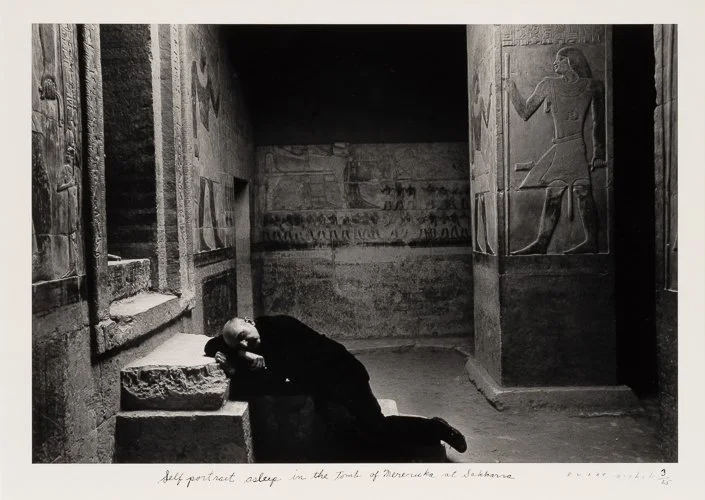
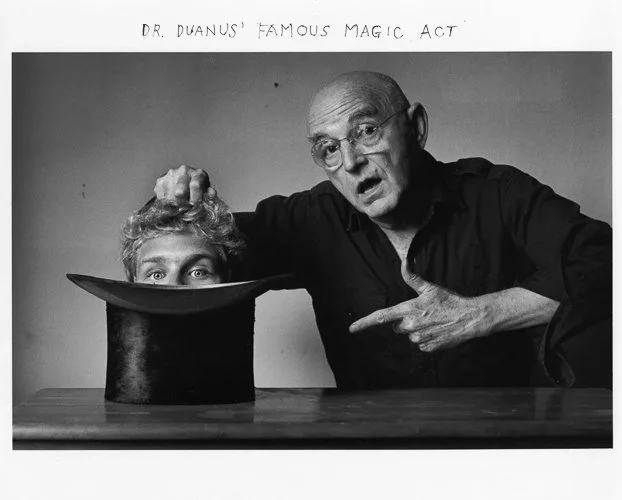
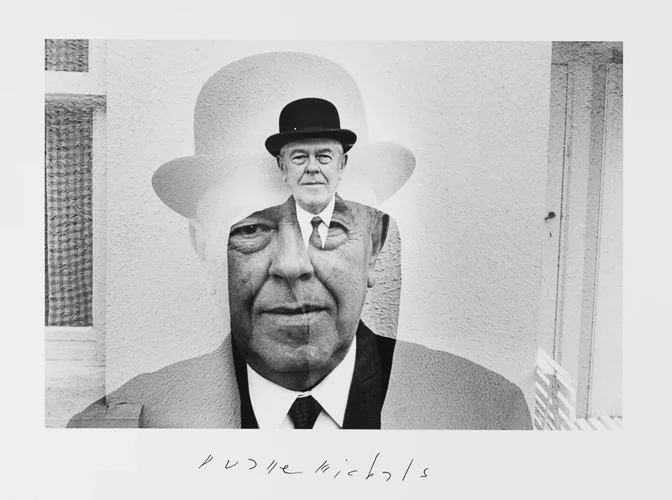
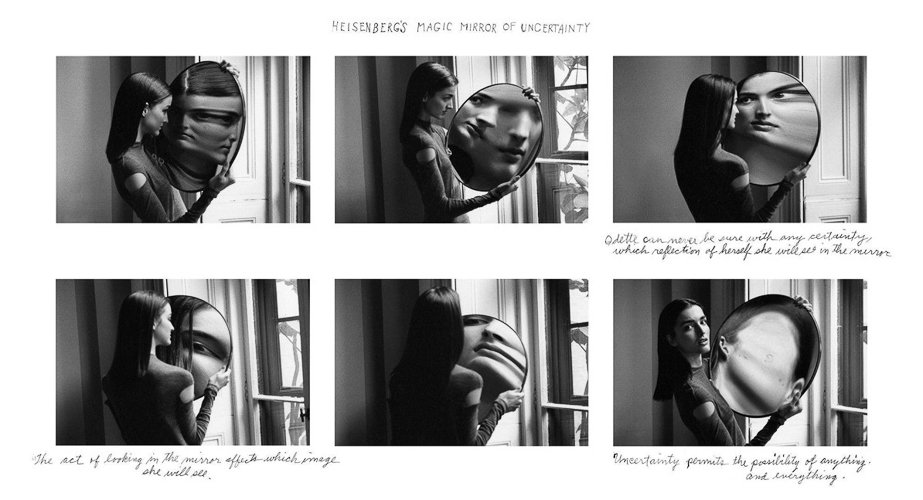
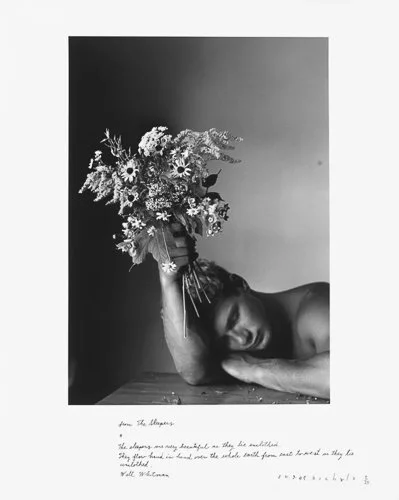
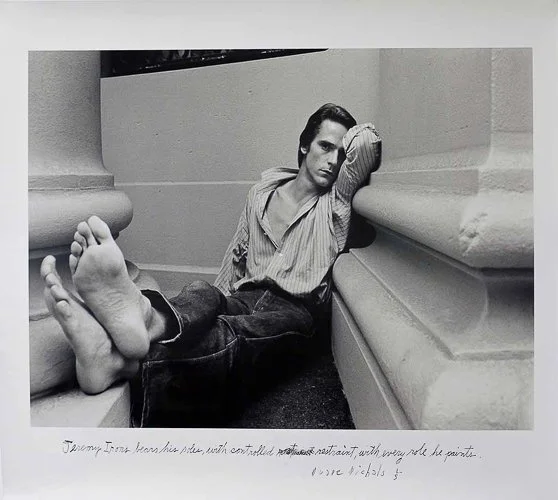
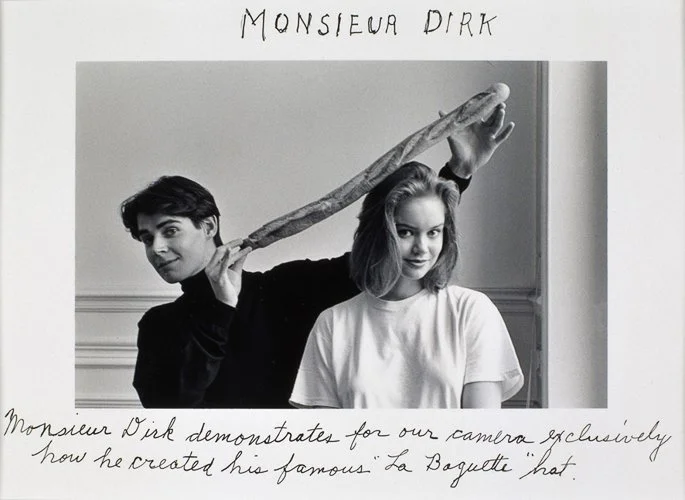
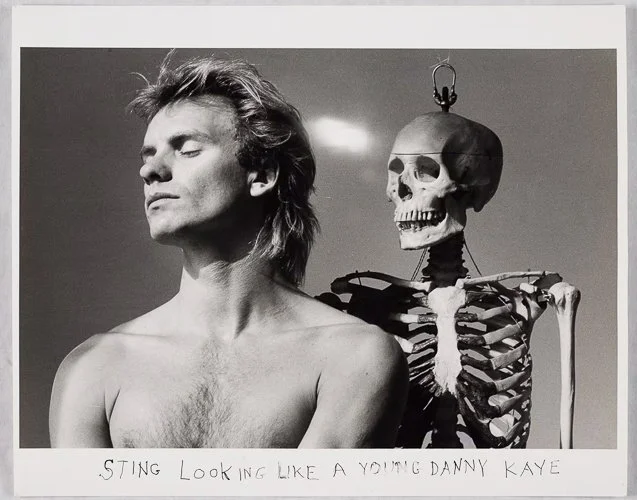
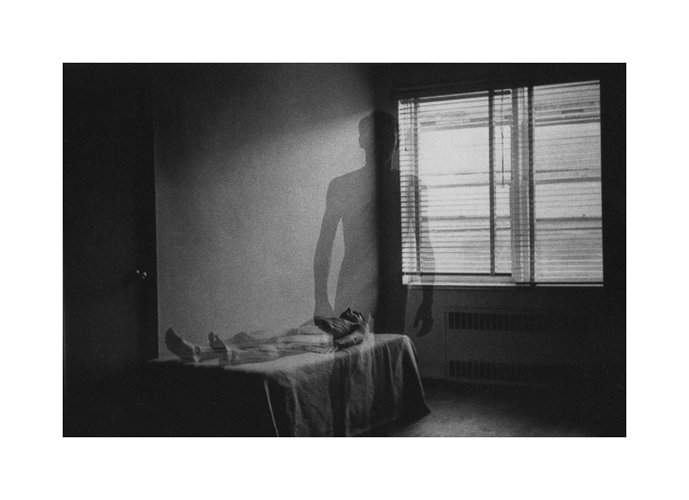
Duane Michals (1932-2026) was among the earliest and most formally inventive of these practitioners. Beginning in the 1960s, Michals developed the photographic sequence as a narrative and philosophical vehicle, staging theatrical scenarios that unfolded across a series of frames — often five or six images — accompanied by his own handwritten text.
Works such as The Spirit Leaves the Body (1968) and Things Are Queer (1973) used the sequence's inherent temporality to explore states of mind, metaphysical speculation, and psychological uncertainty that lay beyond the reach of any single decisive moment. Michals believed that what cannot be seen is infinitely more important than what can be seen; photography's limitation as a documentary medium became, in his hands, its greatest imaginative resource.
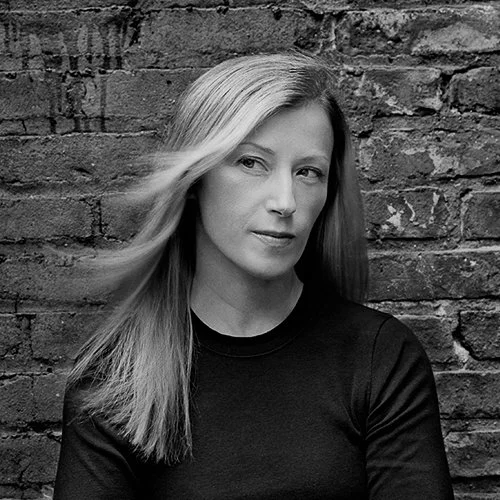
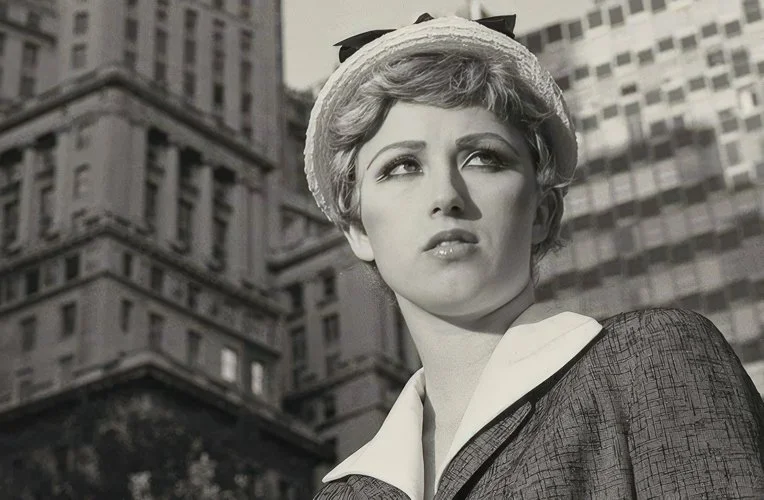
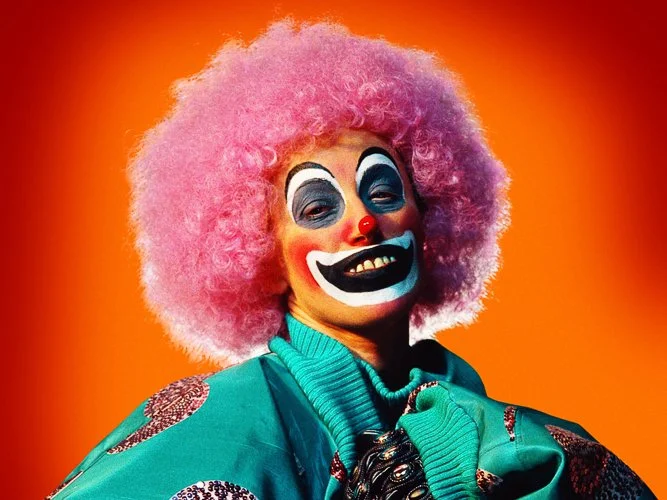
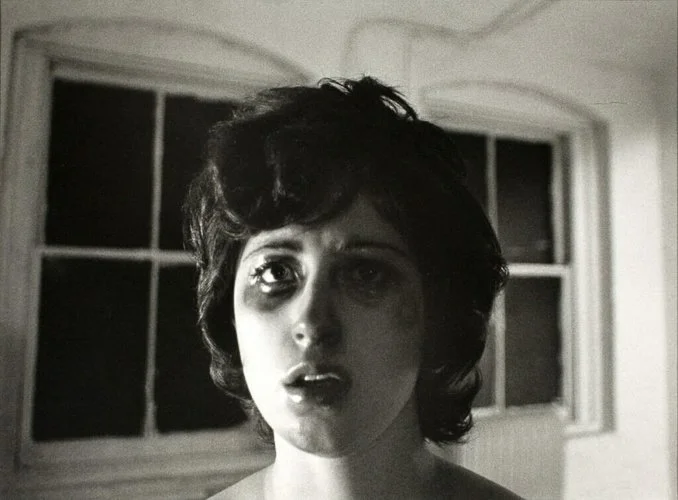
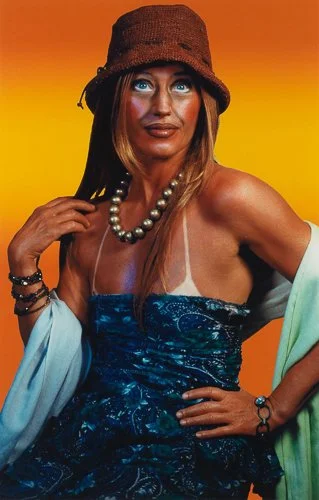
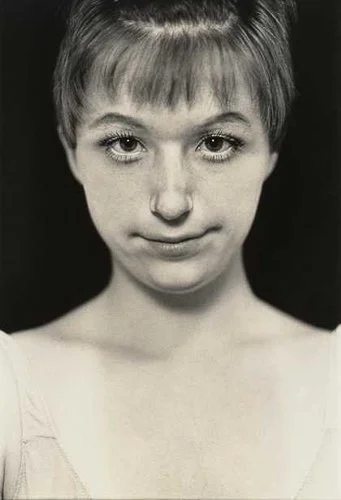
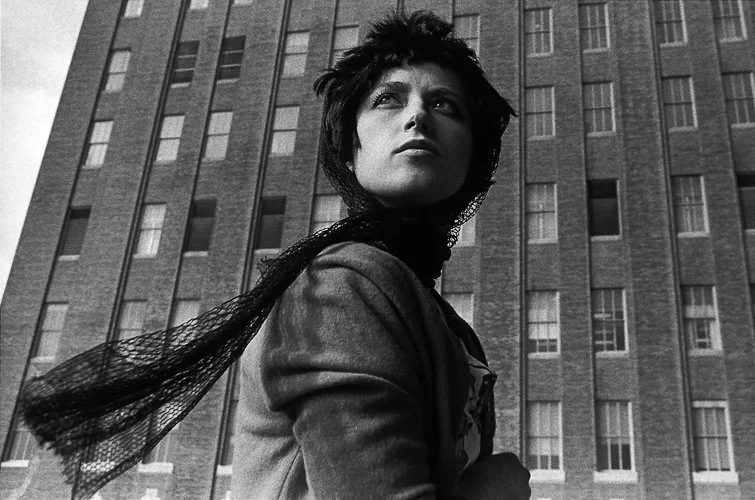
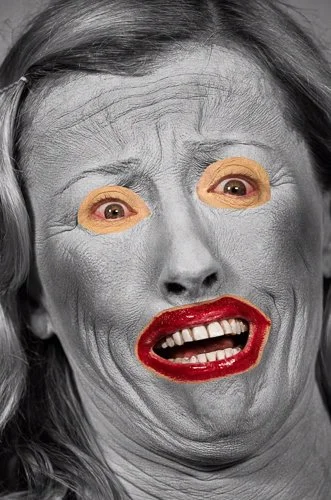
Cindy Sherman (b. 1954) began work on Untitled Film Stills in 1977, moving to New York and taking up her position at Artists Space, and continued the series through 1980 (with one additional image added later, bringing the total to seventy photographs).
The series, first exhibited in its entirety at Metro Pictures in Manhattan in 1981 and acquired in its entirety by the Museum of Modern Art in December 1995, consists of seventy black-and-white photographs in which Sherman photographs herself in a range of stereotypical female roles drawn from the visual grammar of 1950s and 1960s cinema — film noir, B-movie, European art-house film, Hollywood melodrama.
The characters — office girl, bombshell, housewife, girl on the run — are always looking away from the camera, always apparently unaware of being observed. They are, unmistakably, images in someone's story; but whose story, and what story, is deliberately left open.
Sherman's project is a sustained act of deconstruction. By staging and photographing herself in roles drawn from cinematic convention, she reveals how heavily the grammar of narrative photography — its lighting, its framing, its construction of femininity — depends on inherited codes. The Untitled Film Stills look like they come from movies that do not exist; they feel like memories of something seen, but the source cannot be located. The series has been described as "arguably one of the most significant bodies of work made in the twentieth century."
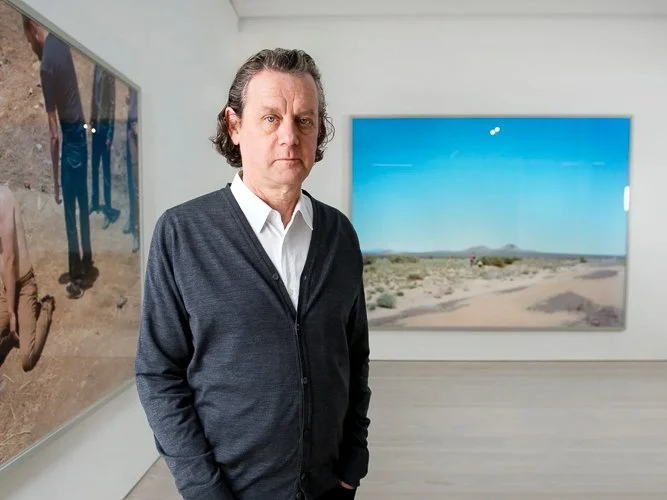
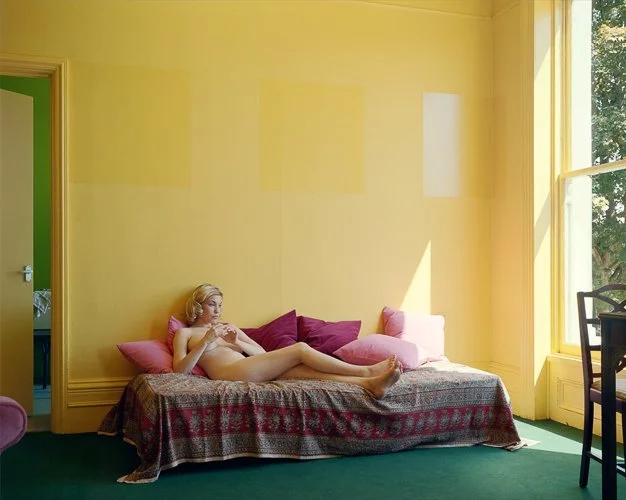
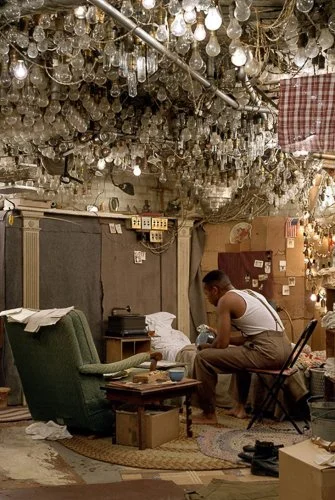
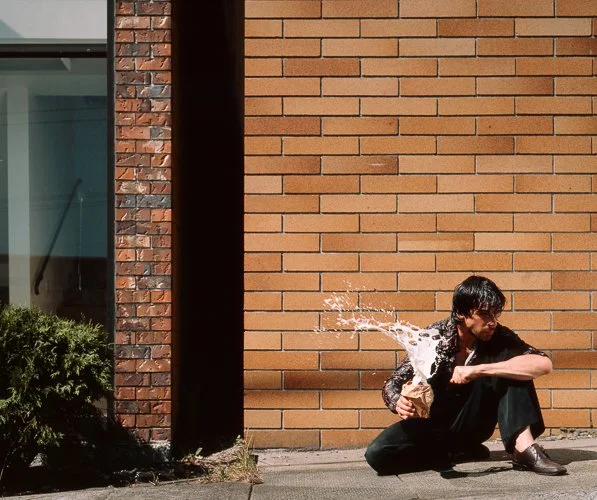
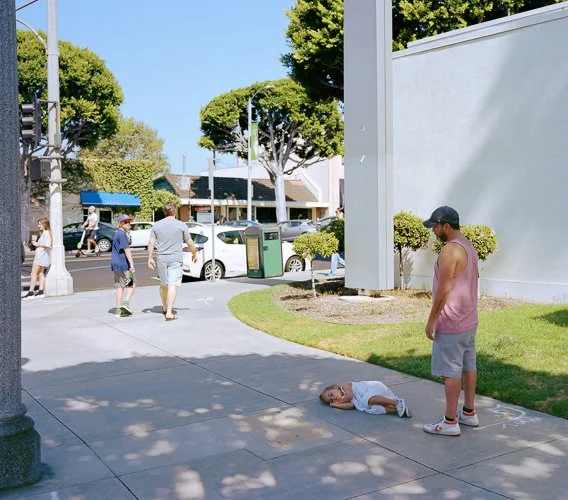
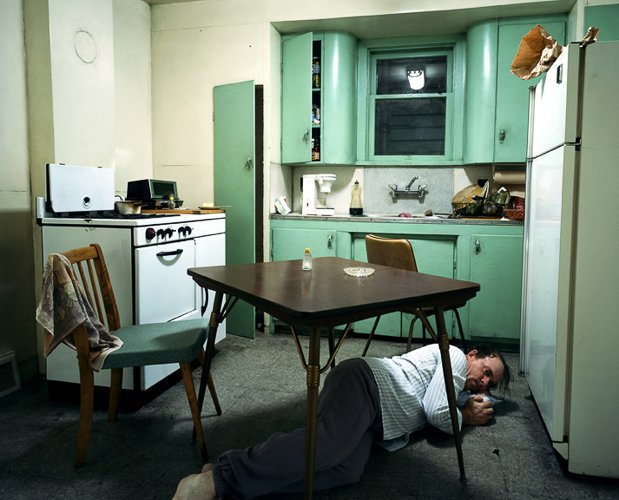
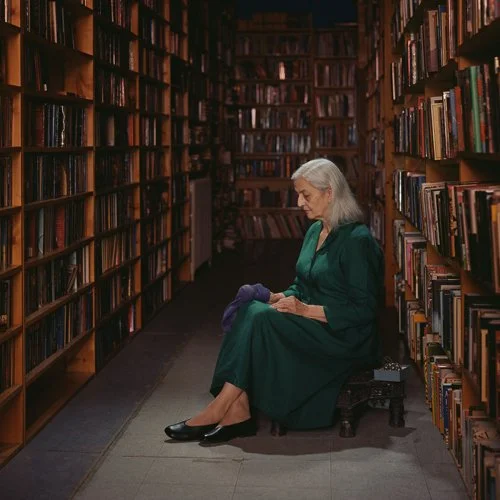
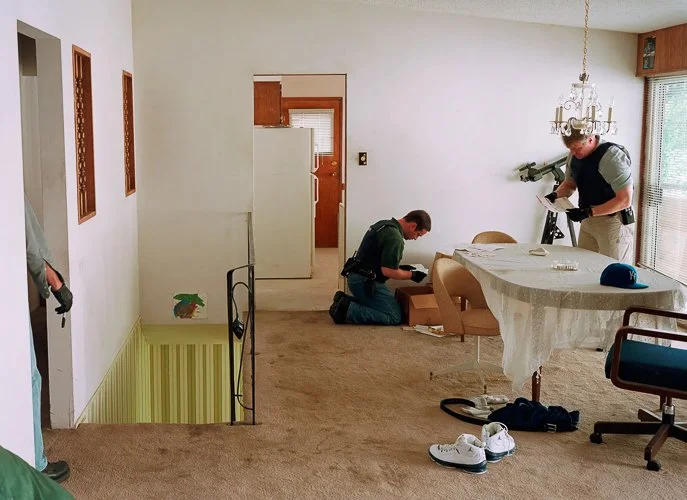
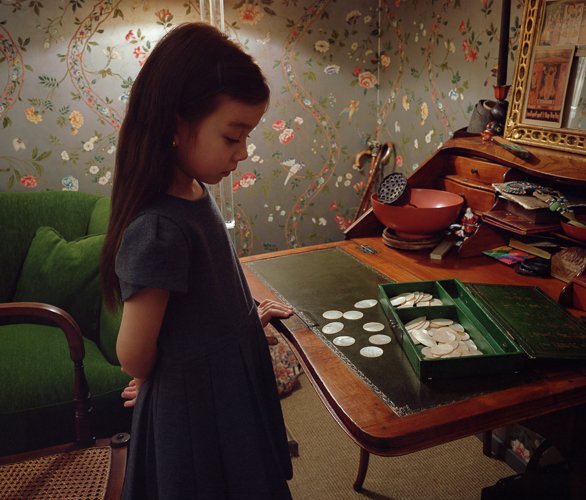
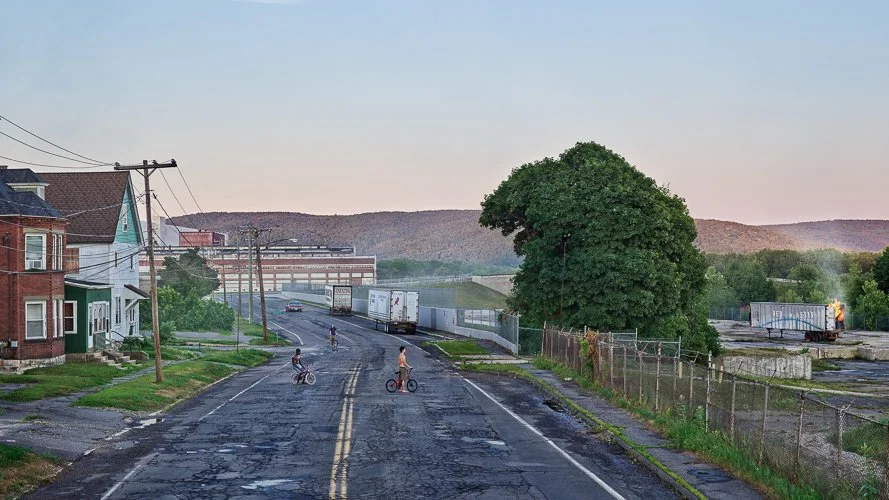

Jeff Wall (b. 1946) approached the staging of photographic narrative from a different direction, drawing on the tradition of history painting and the scale and frontality of the large-format transparency. Wall's works — mounted in lightboxes that illuminate them from behind — are typically large-scale colour images of scenes from everyday life that are, in fact, extensively staged and planned. Works such as A Sudden Gust of Wind (after Hokusai) (1993) and Dead Troops Talk (1992) draw explicitly on art-historical precedents while presenting themselves with the immediacy and specificity of documentary photographs.
Wall described his method as "cinematography": preparation, planning, collaboration with subjects — the same process, in principle, as making a film, compressed into a single frame. His work legitimised staged photography within the fine art canon and influenced a generation of photographers working in the space between document and construction.
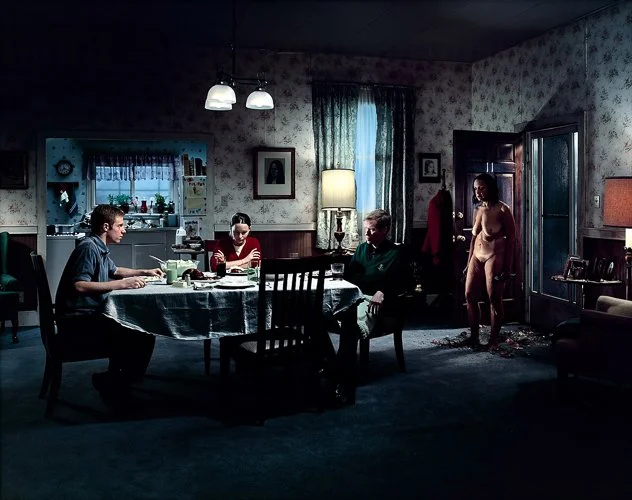
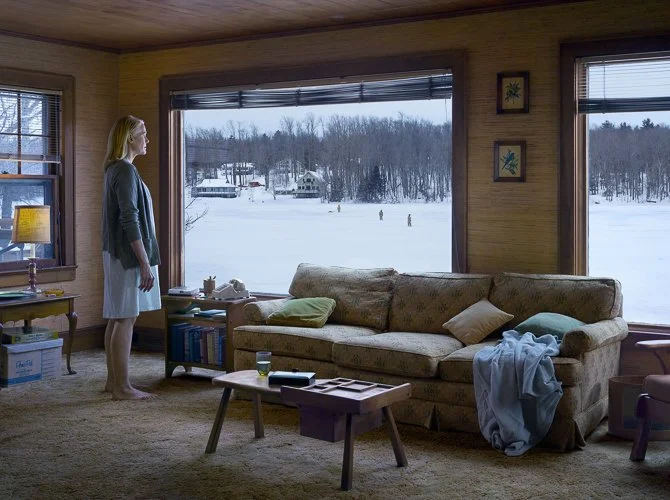
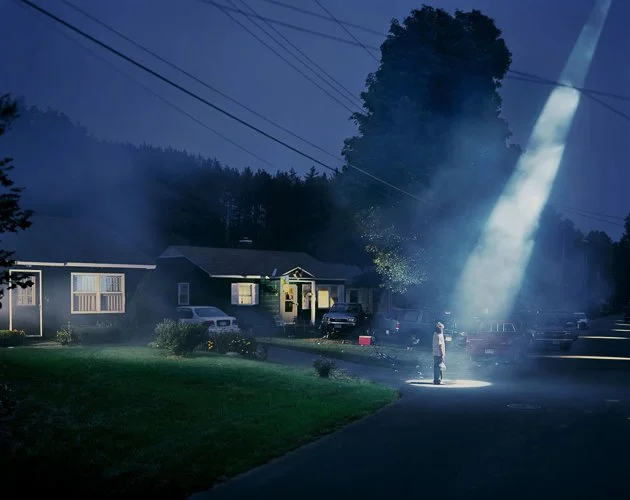
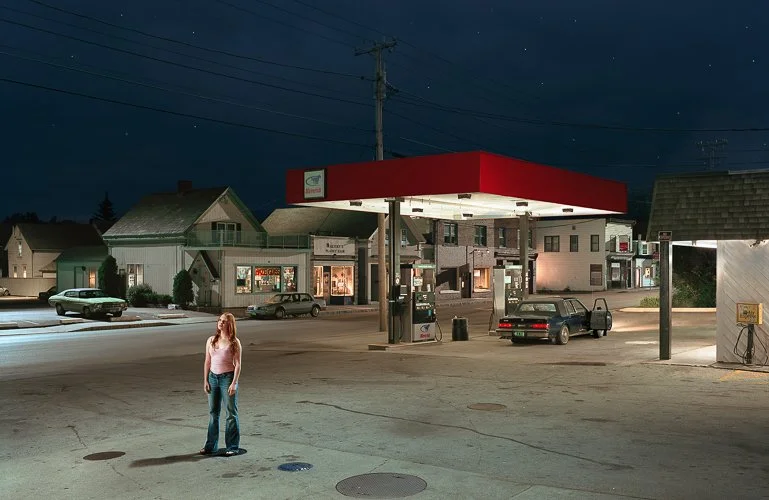
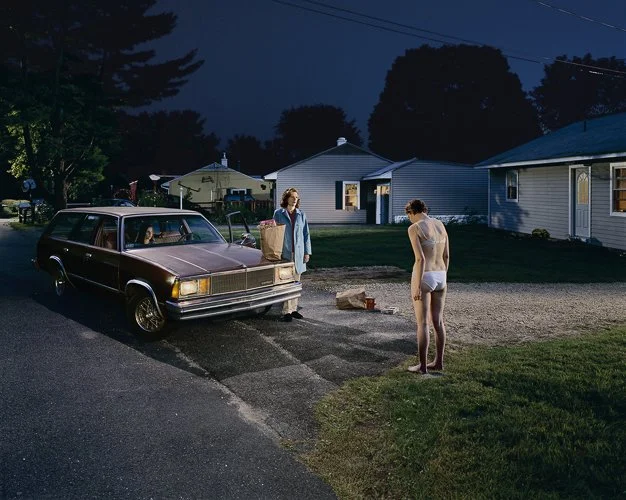
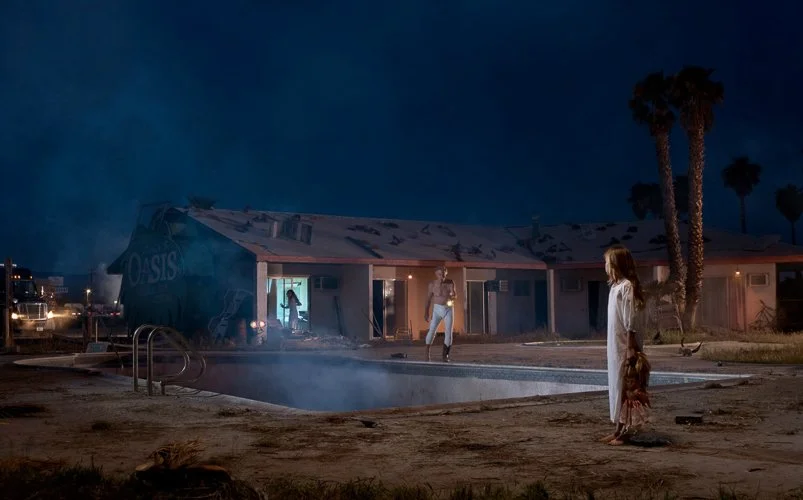
Gregory Crewdson (b. 1962) extended the cinematic logic further, staging photographs of American suburban life with the production apparatus of Hollywood: large film crews, elaborate lighting rigs, constructed sets, and actors. His images — most notably the series Twilight (1998–2002) and Beneath the Roses (2003–2008) — are scenes of quiet, unnamed dread: the suburban house at night, the woman standing motionless in a flooded room, the car halted in the middle of a street at 2 a.m.
They are, in a sense, single frames from a film that does not exist, charged with the narrative expectation that a decisive moment would produce in documentary photography while simultaneously announcing that no such moment occurred — that everything in the image was invented. Crewdson has described his idea as "to construct the world with photography."
Together, these practitioners established that photography's storytelling range was not limited to the mere recording of events. The constructed image, the staged sequence, the fictional still — each expands the medium's capacity to explore states of mind, cultural structures, and imaginary worlds that documentary could not access.
Colour, Mood & the Narrative Everyday
For most of the history of serious photojournalism and documentary photography, colour was regarded with deep suspicion. Walker Evans described colour photography as "vulgar." Cartier-Bresson worked almost exclusively in black and white.
The tonalities of the silver print were identified with seriousness, truth, and art; colour was the province of advertising, fashion, and the tourist snapshot. This consensus began to fracture in the early 1970s, and the fracture was, in retrospect, a decisive shift in the narrative possibilities available to photographers.
The key figures in this shift were three American photographers — William Eggleston, Stephen Shore, and Martin Parr — each working independently but arriving at roughly similar conclusions: that colour was not a decoration applied to a photograph but a structural element of its meaning; that the quotidian, suburban, and apparently banal were as worthy of serious photographic attention as the grand historical event; and that the snapshot aesthetic — its apparent casualness, its indifference to conventional composition — was a resource rather than a limitation.
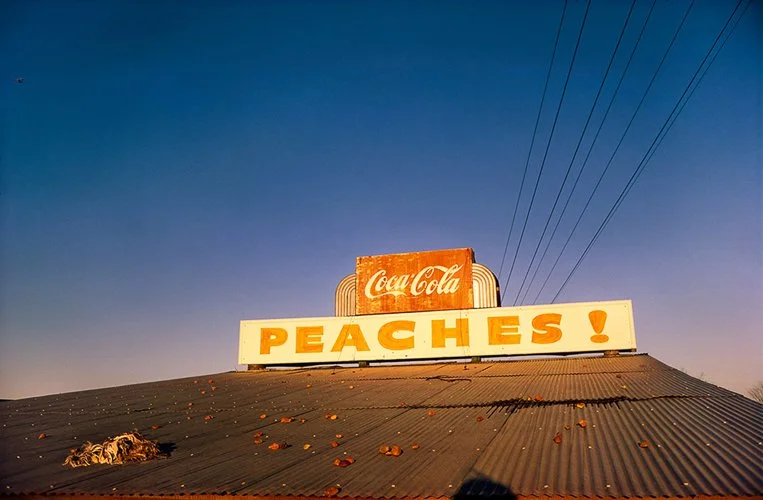
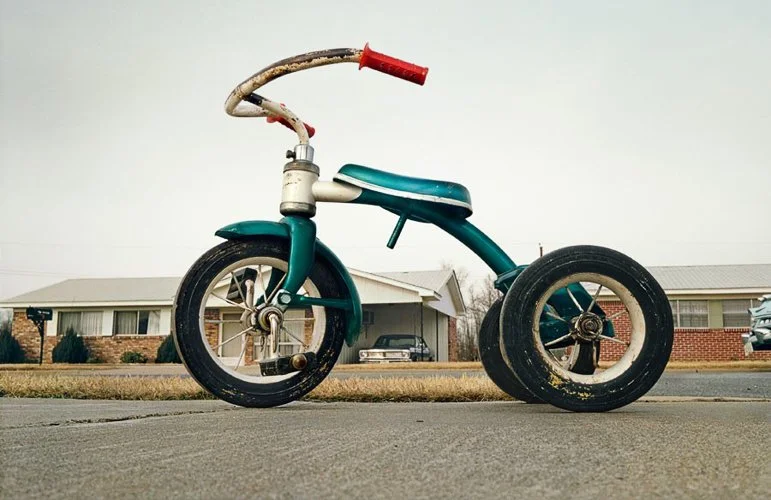
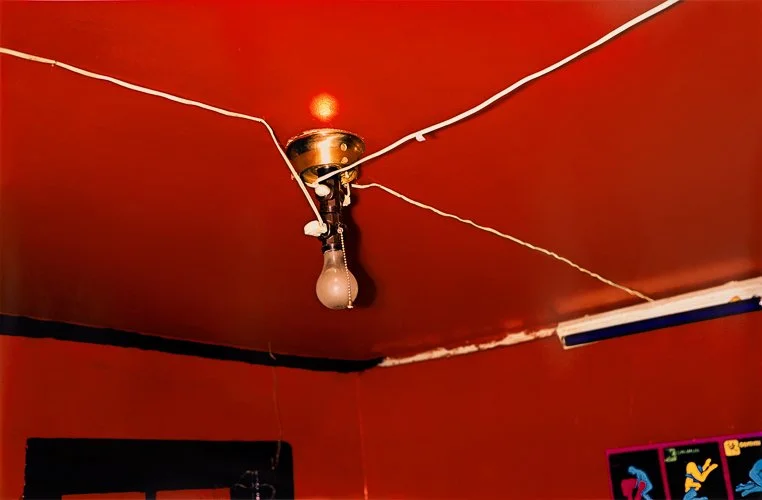
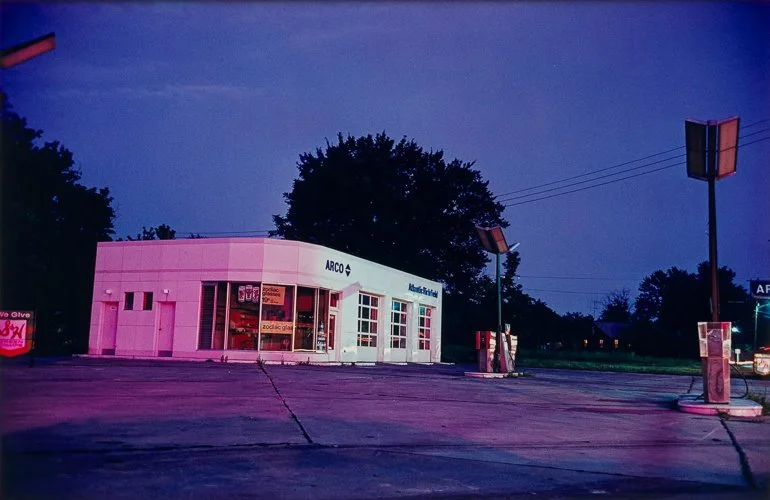
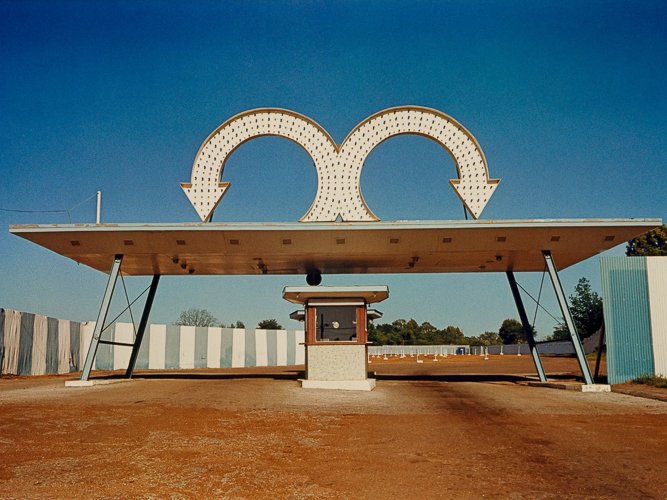
William Eggleston (b. 1939), a self-taught photographer from Memphis, Tennessee, had been working in colour since the mid-1960s, initially with transparency film and later with colour negative, printed using the dye-transfer process — a technique borrowed from commercial advertising that produced images of saturated, almost hallucinatory vividness. He met the photographer, and director of photography at the Museum of Modern Art, John Szarkowski, in the late 1960s, and on 25 May 1976, Eggleston became the first photographer to be given a solo exhibition of colour prints at MoMA.
The show, titled "William Eggleston's Guide," was received with considerable hostility: the New York Times's lead art critic Hilton Kramer described the work as "perfectly banal, perhaps" and "perfectly boring, certainly." Today, the exhibition is recognised as one of the most significant moments in twentieth-century photography.
Eggleston described his approach as "photographing democratically": he paid equal attention to all subjects — a red ceiling, a tricycle in a Memphis driveway, a man with a gun in a field — treating none as more inherently important than another. This was not indifference but a specific proposition about the nature of the photographic narrative: that any subject, attended to with sufficient precision, yields a story; that the everyday is not a lesser subject but a different one, requiring different instruments.
Colour, in Eggleston's hands, became a vehicle for what might be called the narrative of mood — images that locate the viewer in a specific sensory and emotional world without necessarily implying a conventional story arc.
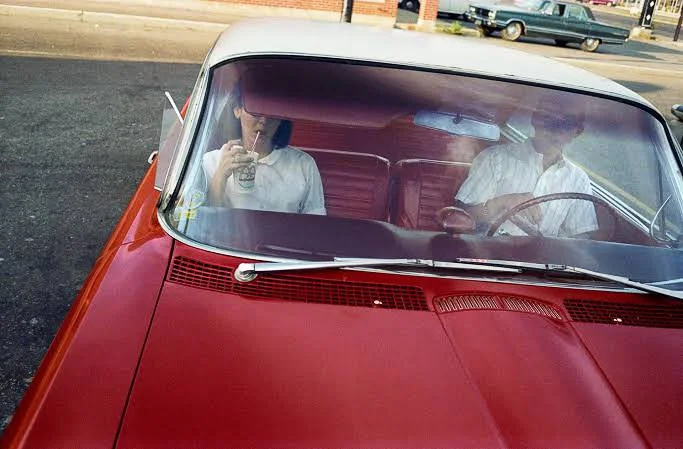
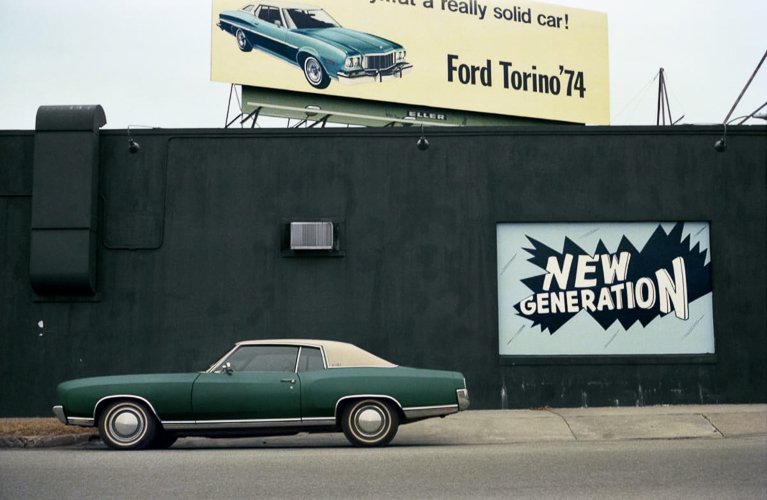
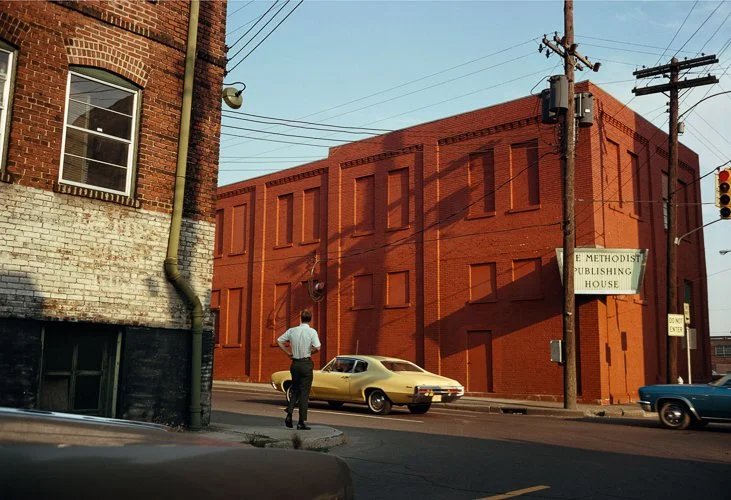
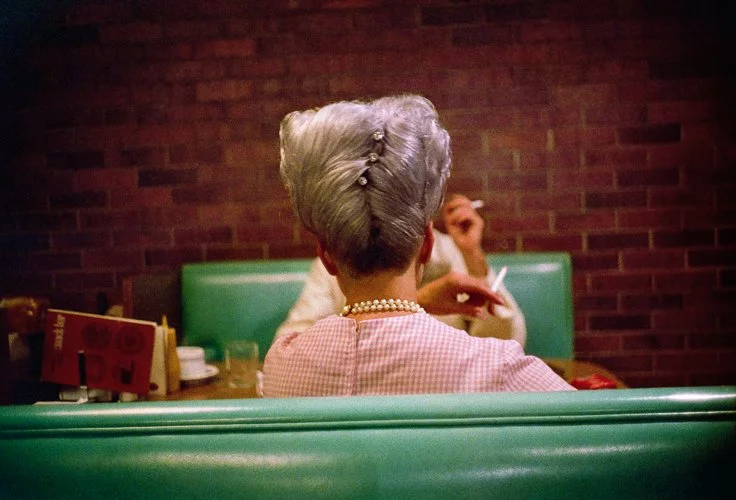
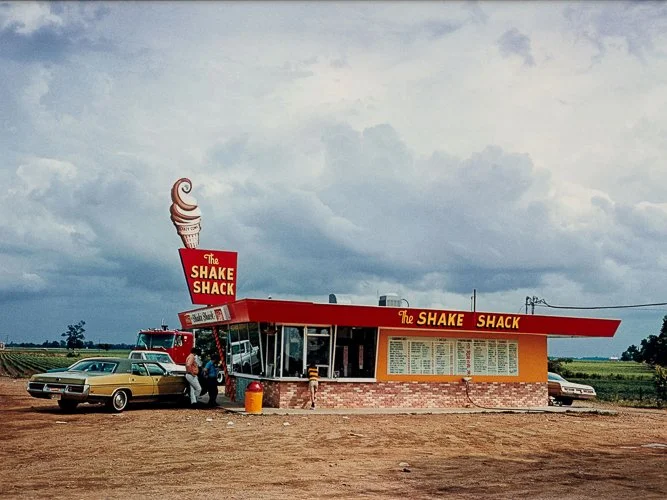
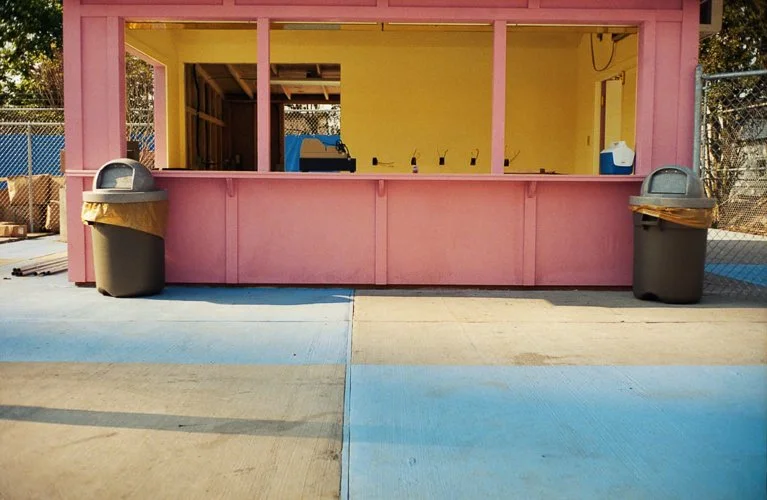
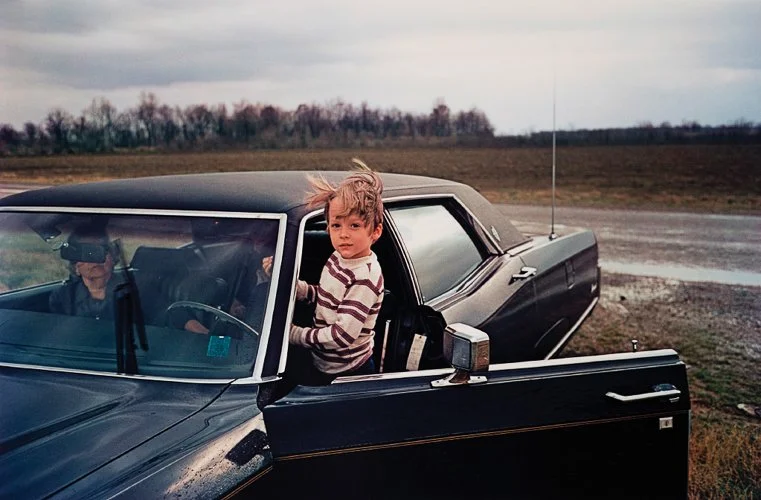
Stephen Shore (b. 1947) approached the colour vernacular through formal rigour. Working with large-format cameras — 4×5" and eventually 8×10" — on cross-country road trips through the 1970s, he photographed the American landscape with a matter-of-fact directness that absorbed his subjects — roadside motels, intersection storefronts, parking lots, meals in diners — into compositions of extraordinary clarity. His 1971 show at the Metropolitan Museum of Art (black-and-white) and his 1976 show at MoMA (colour) preceded Eggleston's MoMA debut that same year, establishing both as pioneers of the colour turn.
His book Uncommon Places (1982) became a foundation text for photographers working in the colour vernacular, influencing Andreas Gursky, Thomas Struth, and an entire subsequent generation of photographers working on the American and European landscape.
Martin Parr (1952–2025) translated these sensibilities into a British idiom with a very different tonal register: satirical, affectionate, and frequently uncomfortable. Parr switched from black and white to colour in 1982, citing the influence of Eggleston, Shore, and Joel Meyerowitz, and never looked back.
His project The Last Resort (1983–1985), made at the run-down Liverpool seaside resort of New Brighton, used colour's capacity to render the tacky and the over-saturated — gaudy swimwear, processed food, concrete and litter — as a meditation on Thatcherite Britain and the nature of leisure under pressure.
Later projects, including Common Sense (1995–9) and Think of England (2000), extended this approach to consumerism, globalisation, and mass tourism worldwide. Parr's work demonstrates that colour photography's narrative register encompasses not only mood and atmosphere but social critique, and that the apparently comic can be a vehicle for serious observation.
Contemporary Practitioners
The later decades of the twentieth century and the opening of the twenty-first have seen the concept of photographic storytelling expand considerably beyond the definitions that prevailed during the decisive moment era. New practitioners have extended, complicated, and in some cases fundamentally revised what it means to tell a story with a camera.
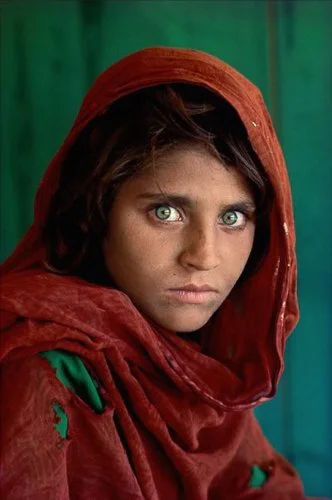
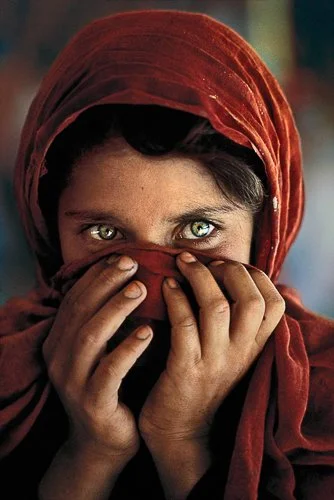
Steve McCurry (b. 1950) is the photographer whose single image has perhaps most powerfully demonstrated the continued viability of the humanist portrait tradition. Afghan Girl — a portrait of a young Pashtun refugee in the Nasir Bagh camp near Peshawar, Pakistan, taken on Kodachrome 64 film with a Nikon FM2 and a 105mm lens in December 1984 — appeared on the cover of National Geographic in June 1985 and became what the magazine described as the most recognised photograph in its history.
CNN called it "the world's most famous photograph." The image operated according to principles as old as the history of the portrait: the directness of the gaze, the quality of light, the expressive precision of the subject's features — but it derived its additional charge from the political and humanitarian context of the Soviet–Afghan War and the refugee crisis it had produced.
The identity of the subject remained unknown for more than seventeen years. In January 2002, McCurry travelled to Afghanistan with a National Geographic team and, after extensive effort, located the woman: her name was Sharbat Gula, by then approximately thirty years old, who had returned to Afghanistan from the camp in 1992. Her identity was confirmed by iris recognition. She had never seen the photograph until McCurry showed it to her that year.
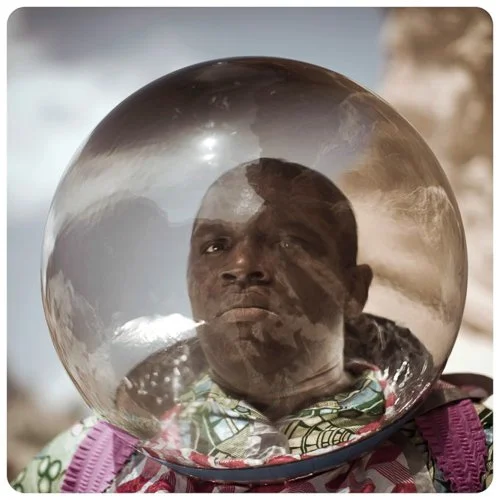
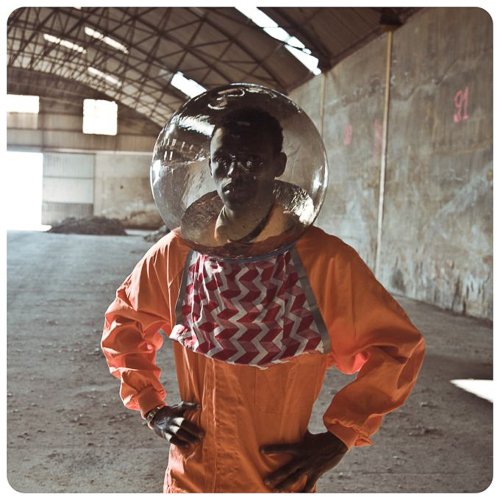
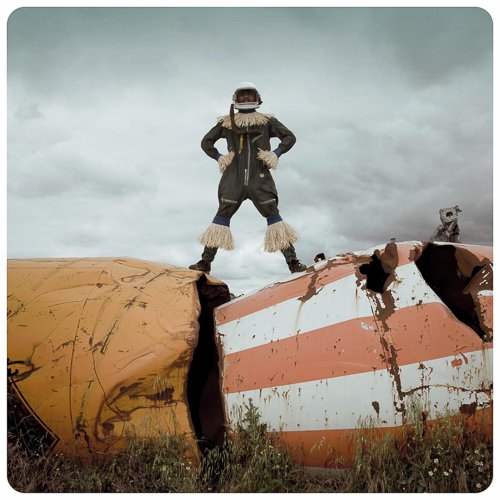
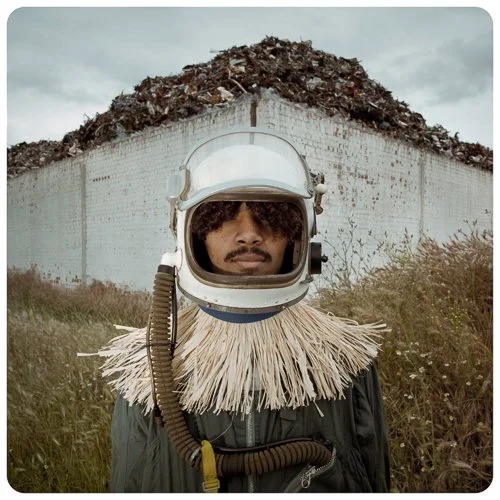
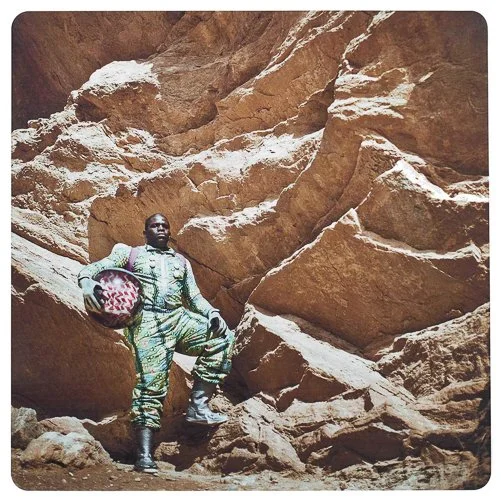
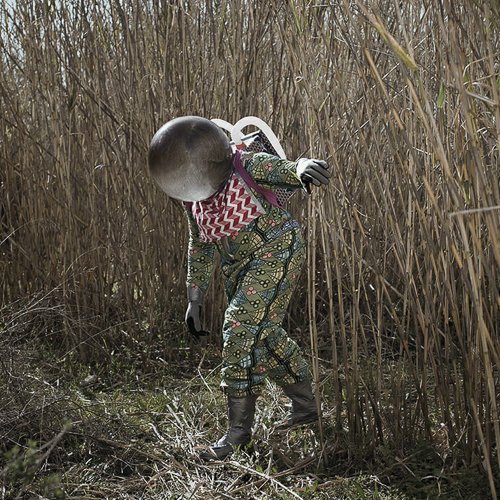
Cristina de Middel (b. 1975) represents a different kind of contemporary practice — one that deliberately inhabits the unstable territory between documentary and fiction. Her 2012 series The Afronauts reimagined the largely forgotten history of the Zambian Space Academy, a project launched in 1964 by Edward Mukaka Nkoloso to train twelve "afronauts" for a mission to Mars and the Moon — a project that collapsed rapidly for lack of funding and international support.
De Middel researched the historical record, then staged reenactments of it: her "afronauts" are actors, her costumes are constructed, her landscapes are chosen for effect. The resulting images are vivid, funny, and unsettling, mixing the aesthetics of the photodocumentary with the self-conscious artificiality of the staged tableau. The Afronauts asks what "documentary" means when the events being documented are both real and forgotten, and when photography's claim to truth is itself historically contingent.
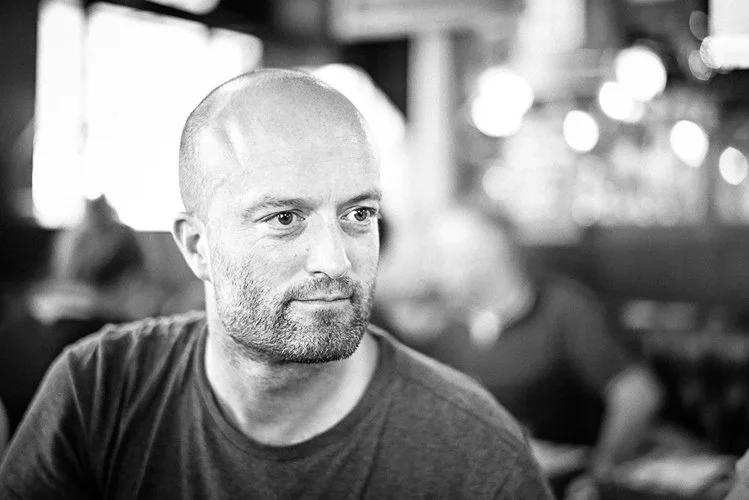
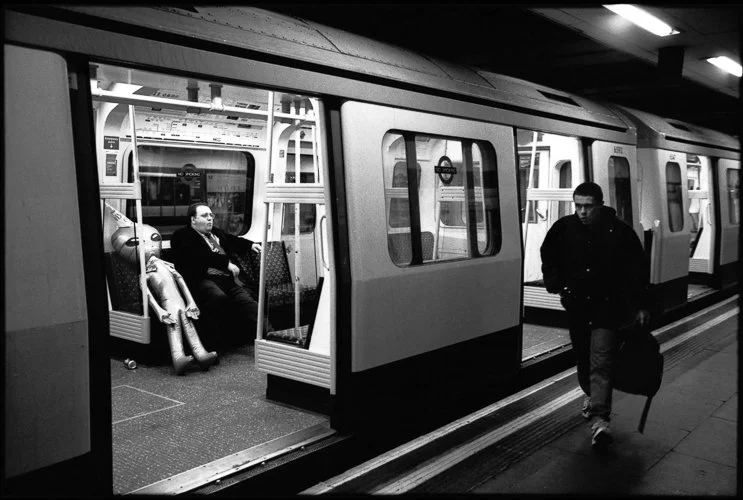
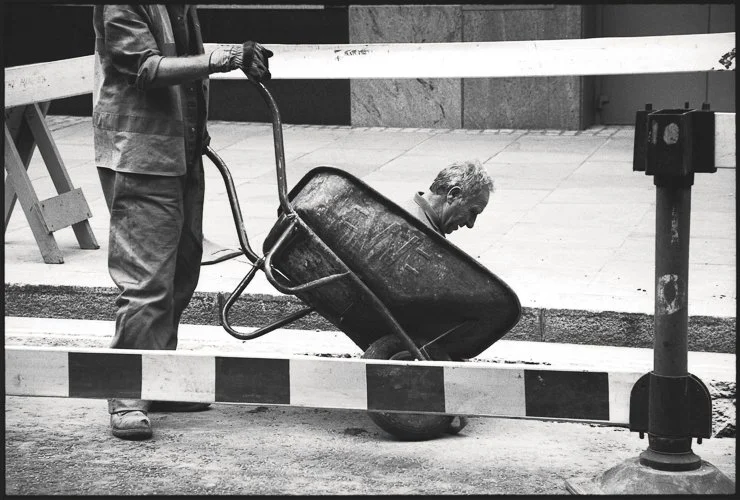
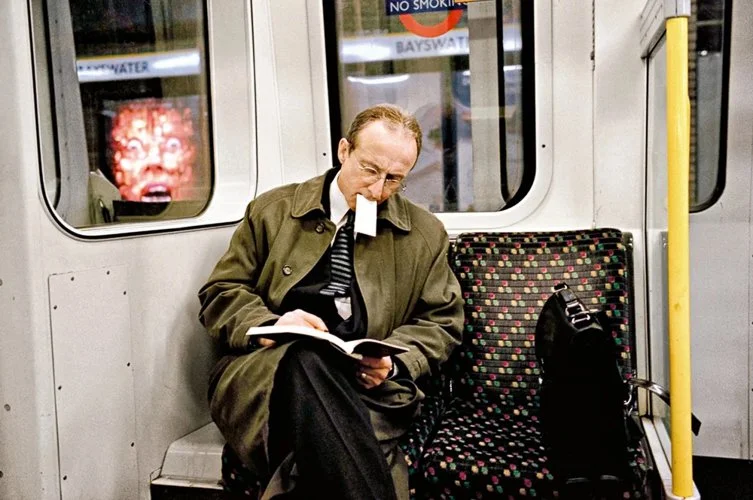
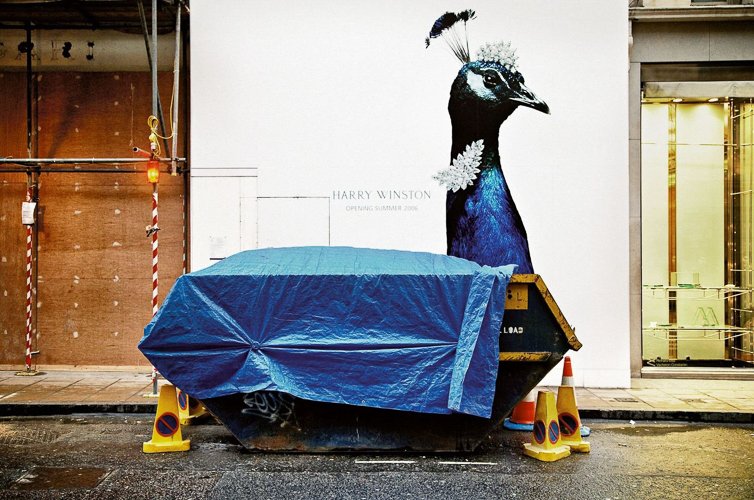
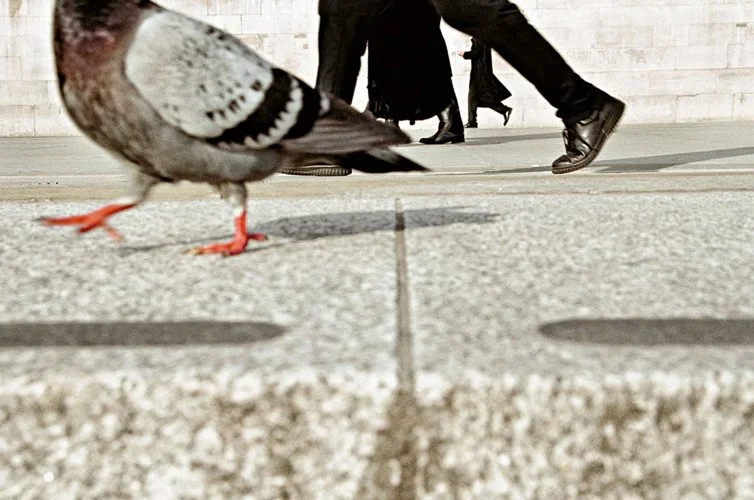
Matt Stuart (b. 1974) continues the tradition of the decisive moment in the streets of London, working as a direct heir to Cartier-Bresson and the humanist street photography tradition. Stuart hunts, as he has said, for serendipitous juxtapositions — the coincidence of unrelated visual elements that, once framed, become a story: a pedestrian whose gesture echoes a pattern on a wall, a dog and a distant figure whose movements rhyme across a street.
His approach is fundamentally optimistic about the world's capacity to produce meaning spontaneously, and it represents the ongoing vitality of a tradition that some had declared exhausted.
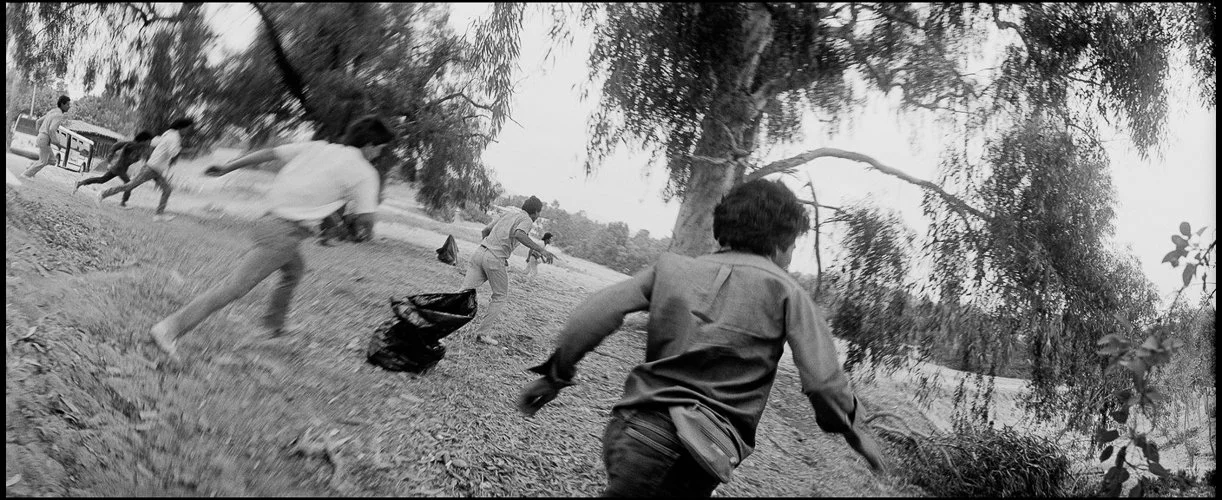
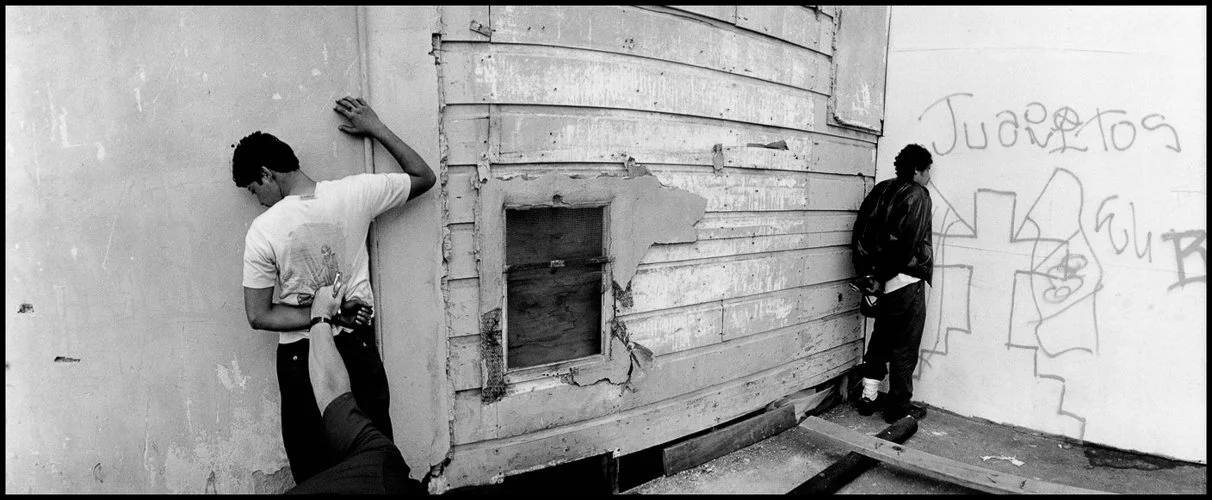
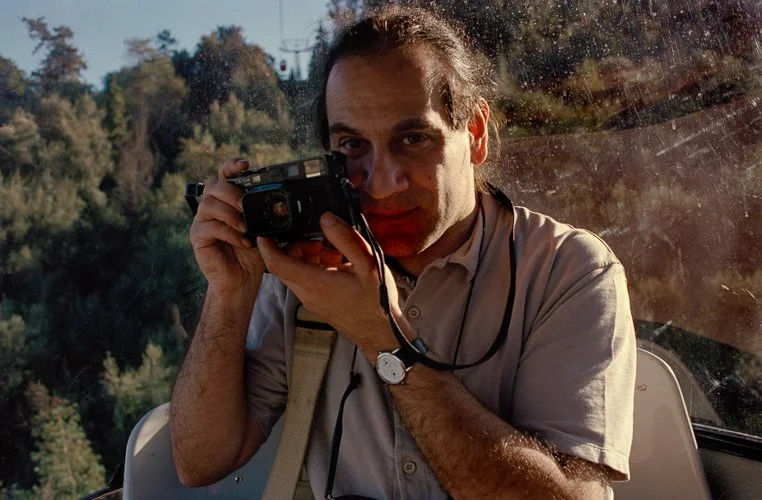
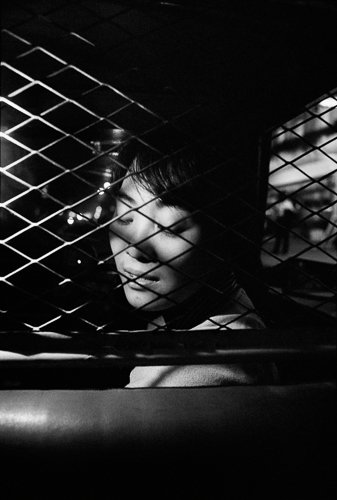
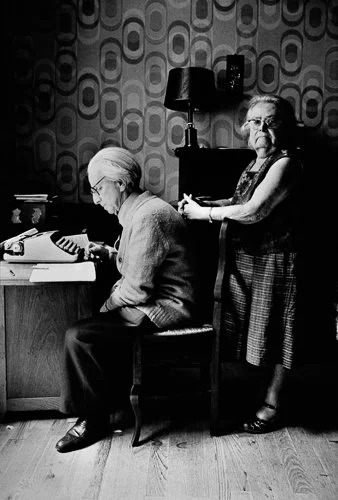
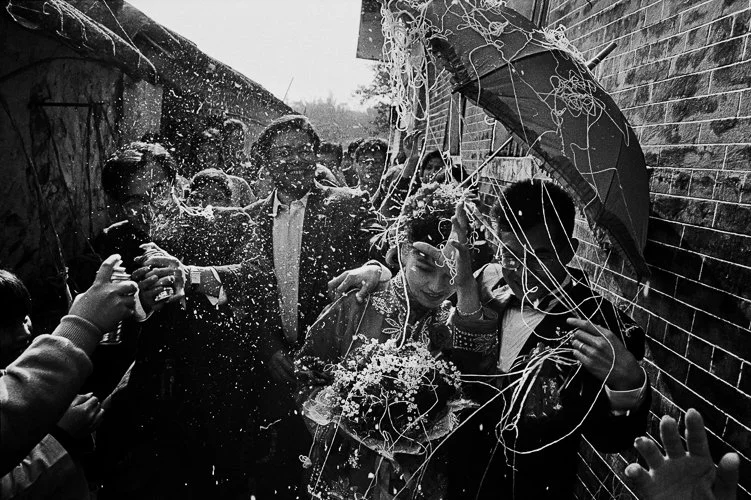
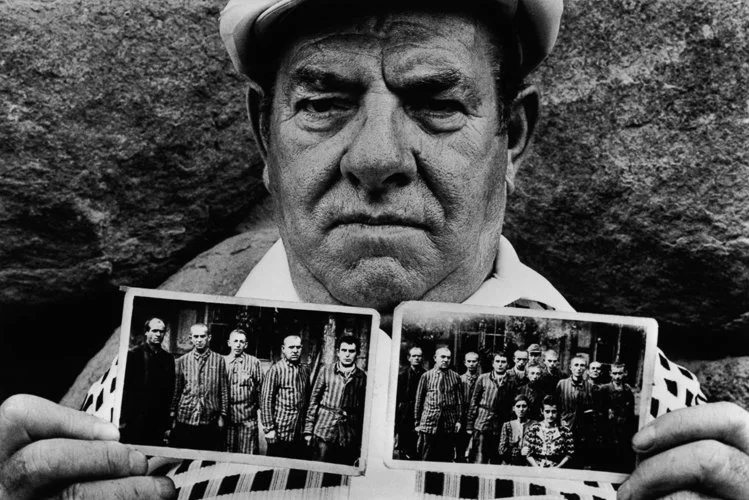
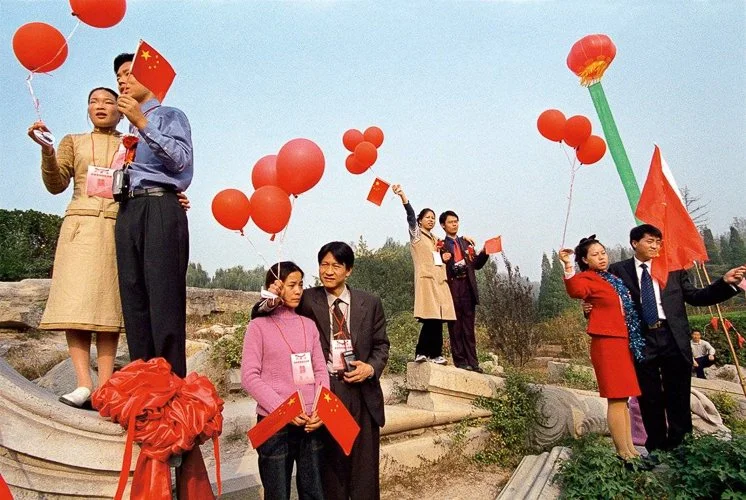
Patrick Zachmann (b. 1955), a member of Magnum Photos, builds his photographic narratives through long-term engagement with specific communities — Chinese diaspora, North African immigrants in France, and the gangs of Naples.
His approach is the antithesis of the decisive moment: preferring extended access, deep familiarity, and the kind of contextual richness that only months or years of presence can produce. His work has been described as incorporating "cinematic ploys interwoven with narrative strands of fiction" — not because he stages his images, but because his long engagement with his subjects allows him to capture moments of such specific density that they read as composed. He maintains detailed diaries alongside his photography, recognising that images alone cannot carry the full weight of the stories he is recording.
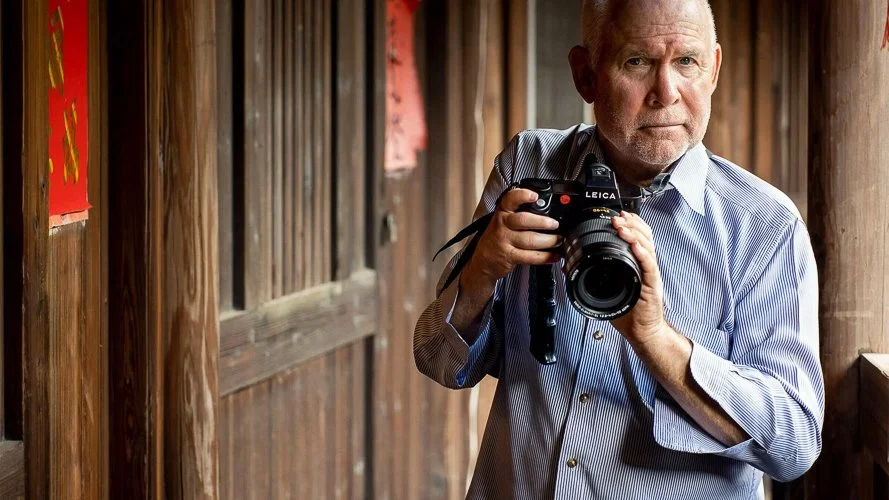

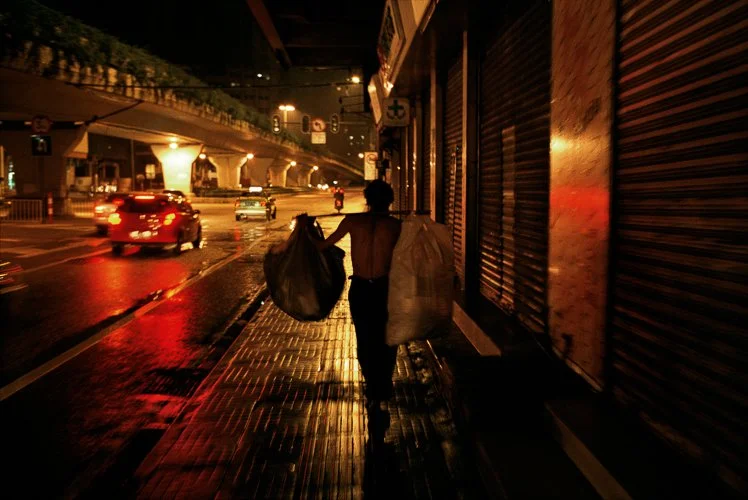
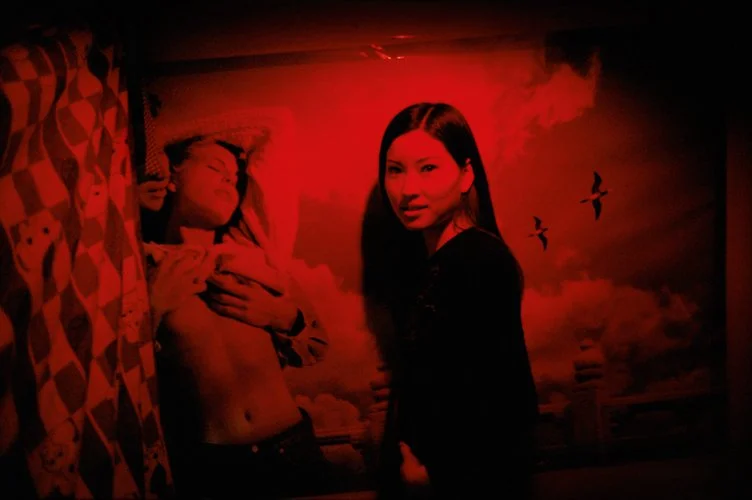
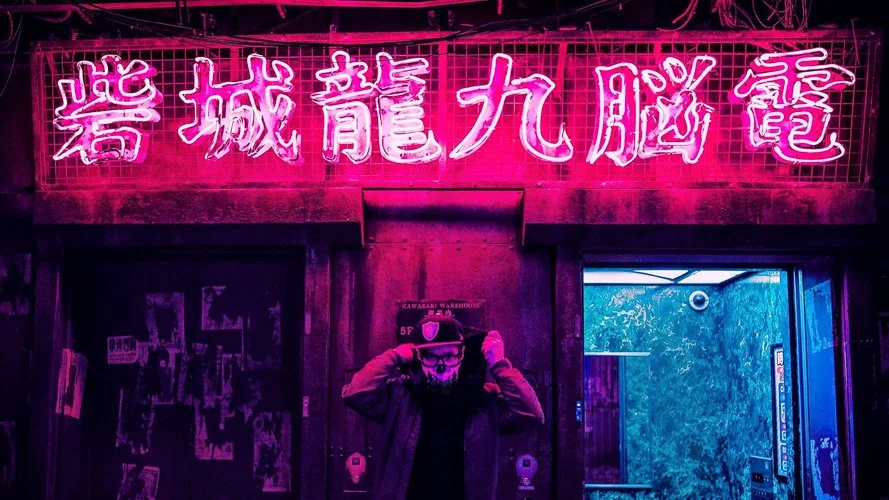
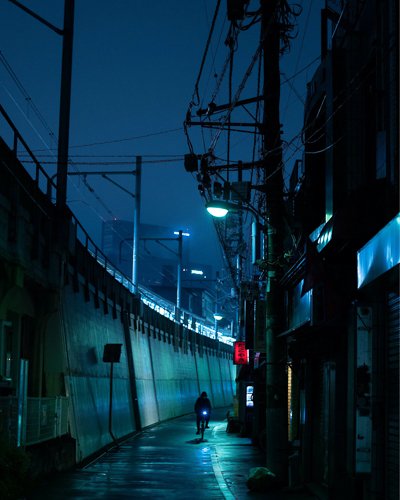
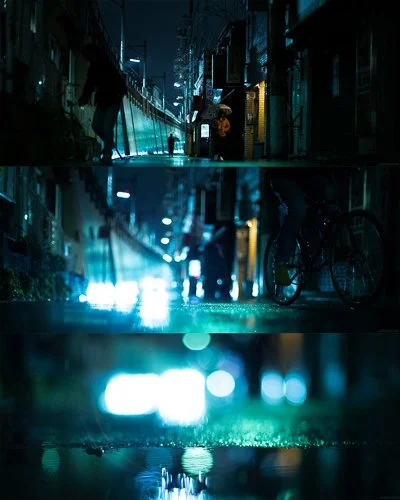
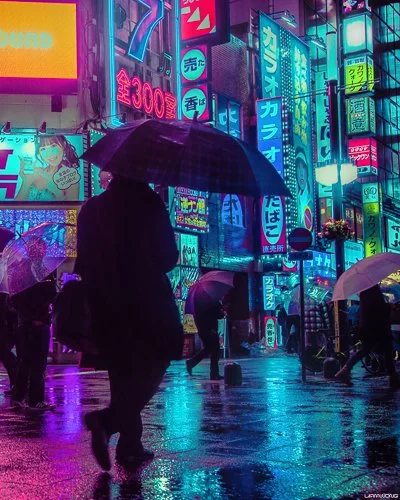
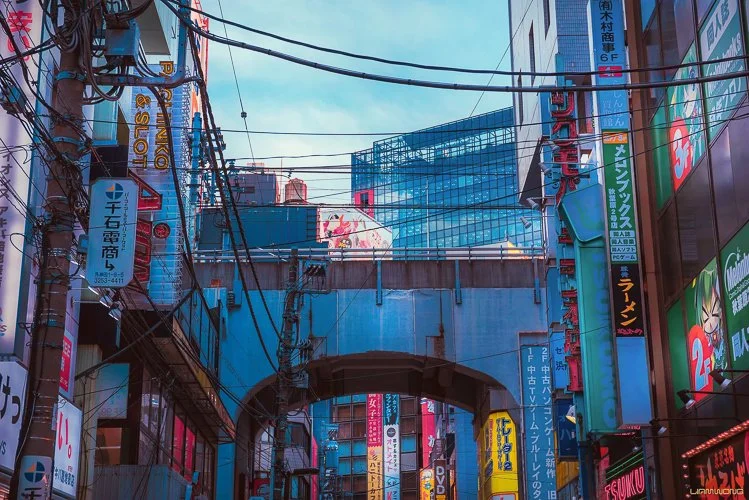
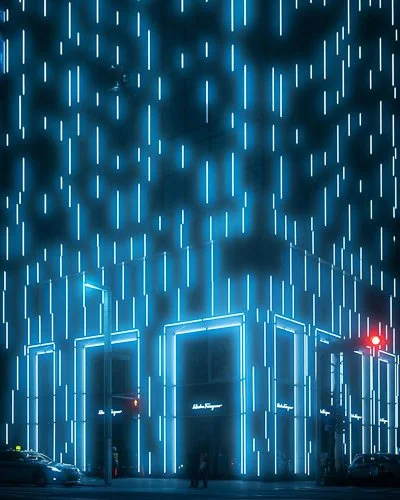
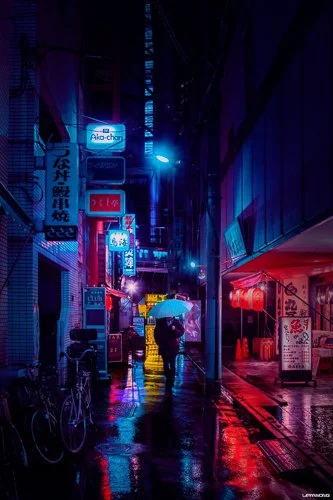
Liam Wong (b. 1987), a Scottish photographer who came to the medium through a career as a video game art director at Ubisoft (becoming the company's youngest Art Director), developed the series TO:KY:OO from December 2015 onward, photographing Tokyo's nighttime streets with an aesthetic drawn explicitly from cyberpunk cinema, neon-noir, Japanese animation, and science fiction.
His debut monograph TO:KY:OO (2019) — which included written contributions from game creator Hideo Kojima and visual futurist Syd Mead — became the largest crowdfunded photography book in UK history.
A second book, After Dark (2022), extended the project to other cities. Wong's practice raises interesting questions about the relationship between photographic narrative and digital aesthetics: his images are post-processed to enhance their neon luminosity, occupying a position between the documentary record and the constructed image, reflecting the visual culture of a generation raised on video games and digital cinema.
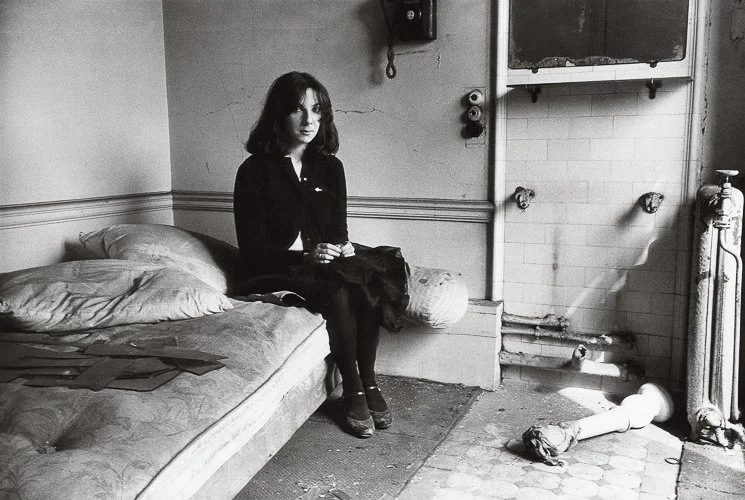
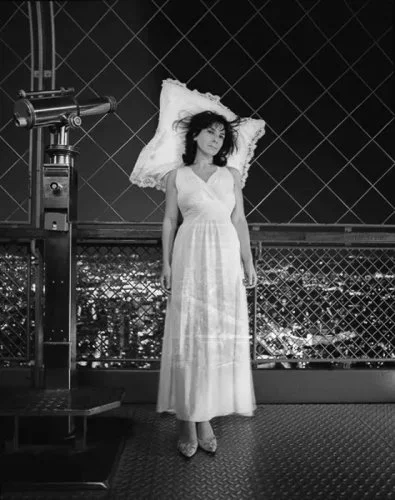
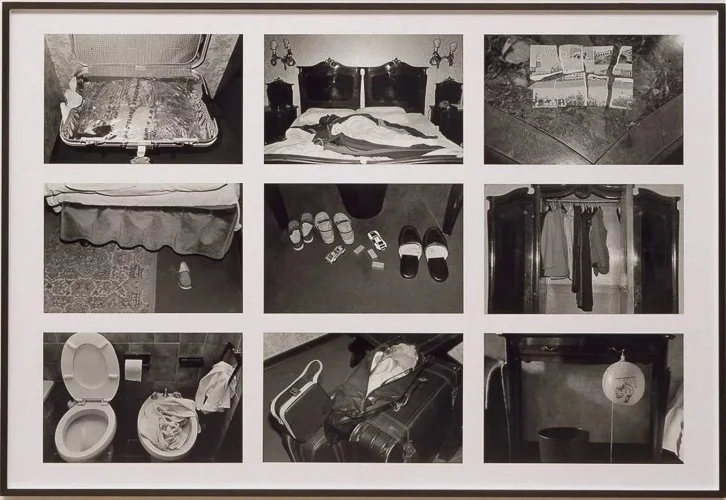
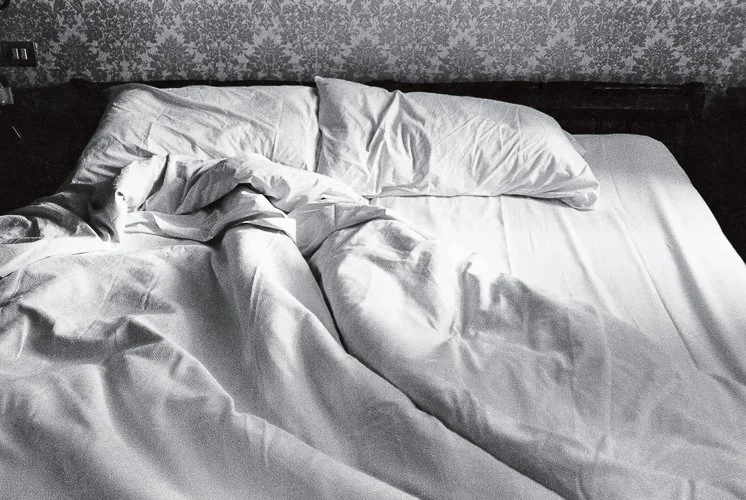
Sophie Calle (b. 1953) occupies an entirely distinctive position in the history of photographic storytelling, working in the borderland between photography, conceptual art, performance, and literature. Her practice consistently involves arbitrary but rigidly observed rules — constraints in the tradition of the Oulipo literary movement, with which her work is often associated — applied to situations of emotional and ethical complexity.
Suite Vénitienne (first published in 1979), in which she followed a stranger she had met at a party to Venice and documented her surveillance of him, combined photographs with precise, deadpan prose to create a work in which the images are not self-sufficient but are made meaningful by the accompanying text.
Her Des histoires vraies (published in various editions from the 1990s onward) extends this methodology to autobiographical material, constructing narratives about her own life from photographs and text in which neither medium is subordinate to the other. Calle's work challenges the convention that a photographic story is primarily visual: in her work, language and image are indissoluble, each making the other legible.
The Digital Turn & the Photo Project
The arrival of digital photography, the internet, and social media platforms created conditions that were simultaneously threatening to established forms of photographic storytelling and enabling new ones.
The threat was primarily to the institutional infrastructure that had sustained the photo essay in its classical form. Life magazine ceased weekly publication in 1972, a victim of television's ability to deliver moving images to the same mass audience it had served. Picture Post folded in 1957.
The collapse of print advertising revenue through the 1990s and 2000s accelerated the decline of the general-interest magazine and, with it, the photo essay's primary publishing platform. The economic model that had allowed W. Eugene Smith to spend three weeks with a country doctor before making a single image — a magazine willing to pay for time, access, and patience — was largely gone. Stock photography agencies, digital image banks, and the sheer proliferation of images on the internet drove down the economic value of individual photographs to near zero.
Against this, something else was happening. The photobook — the photographer's own authored publication, designed as an object, capable of imposing a sequence and a reading experience unavailable in the magazine spread — underwent a remarkable revival in the early years of the twenty-first century.
The rise of print-on-demand technologies, small independent publishers, online discussion communities, and specialist book fairs (particularly Paris Photo and the New York Art Book Fair) created an ecology in which photobooks could be produced, distributed, and discussed outside the mainstream publishing industry.
Work by practitioners including Alec Soth, Taryn Simon, Dayanita Singh, and many others found its primary audience through the photobook rather than through the magazine spread.
Instagram, launched in 2010, created a new kind of visual narrative space: the personal visual diary, assembled image by image and accessible to a worldwide audience. At its most superficial, the platform reduced photography to a stream of decontextualised images optimised for the rapid scroll.
The platform also enabled photographers to build audiences for sustained visual projects outside the conventional commercial or institutional frameworks, and — crucially — to develop the personal visual narrative as a genre in its own right. The photographer's feed, assembled over months and years, could function as a kind of autobiography in images: sequential, cumulative, and shaped by a sensibility that the viewer came to know through repeated encounter.
The photo essay in the digital era has not disappeared; it has migrated. Long-form visual journalism persists on platforms including the New York Times website, The Guardian, Time, and dedicated photojournalism outlets such as VII, Witness, and the major agencies.
Multimedia essays — combining still photographs with audio, video, and text — have expanded the grammar of the photo story in ways that the print magazine could not accommodate. The constraints have changed, but the impulse to construct sustained, multi-image narratives about the world has not.
Closing Thoughts
The three modes of photographic storytelling identified at the outset — the single decisive image, the edited group or sequence, and the sustained long project — have each evolved substantially from their origins, and each continues to find new practitioners and new contexts. But across all three, and through all the transformations of technology, economics, and cultural context that separate Eadweard Muybridge's motion studies from a contemporary photographer's Instagram feed, something remains constant: the recognition that a photograph, however powerful, is always, in some sense, incomplete.
It is a fragment of time, a record of one moment from one position, made by one person for reasons that are never entirely transparent even to the maker. The storytelling instinct in photography — the drive to give photographs a context that makes them meaningful, whether through a single perfectly chosen frame, a carefully edited sequence, or a lifetime's sustained engagement with a subject — is a response to this fundamental incompleteness.
What distinguishes photography's particular contribution to visual storytelling is not technical. It is not the camera, the lens, or the film, important as these are. It is the medium's irreducible commitment to what was actually there: to the specific quality of light on a specific afternoon, to the expression on a specific face at a specific instant, to the evidence of a world that existed before the photograph was made and continued to exist after the shutter closed.
Painting, illustration, and digital imagery can approach some of these effects; none can replicate them. The photograph carries, as Roland Barthes observed in La Chambre claire (1980), the trace of a ça-a-été — a "this-was" — that no other medium can match.
Every photographic story is, at its root, a story about time: about the moment that passed, the world that was, the human life that flickered for an instant in front of a lens and left its trace on a surface, to be seen and interpreted by strangers long after.