Canon EOS 620
The Canon EOS 620 is one of the most quietly historic cameras Canon ever made — the slightly more grown-up of the two SLRs Canon released to launch the entire EOS system and the new EF lens mount in 1987, and the start of a forty-year line of cameras and lenses that runs in an unbroken technical thread from this small black plastic-bodied SLR all the way to the modern EOS R5 and the latest L-series glass. It was launched in May 1987, two months after its slightly more basic sibling, the EOS 650, and was priced at 108,000 yen for the body alone or 146,000 yen with the standard EF 35-70mm f/3.5-4.5 zoom (Canon Camera Museum). In 1987, when Canon's existing FD-mount customers were watching their entire investment in lenses become an orphaned mount overnight, this was both an act of huge corporate confidence and — as it turned out — one of the most strategically successful product gambles in the history of photography.
I owned an EOS 620 from mid-1987, after going into the local camera shop on Boutport Street in Barnstaple (we had moved back to North Devon by then) and trading in my Canon T90 for it. The T90 was a wonderful piece of industrial design and an incredible camera in its own right, but autofocus felt like the obvious next step. I went for the 620 rather than the cheaper 650 specifically because it was the more capable of the two and felt like a more worthy replacement for the T90 — with a faster shutter, exposure bracketing, and multiple exposures. It also boasted the world's first electroluminescent backlit LCD on a camera: I can’t deny that the glowy blue coolness of that screen in the promotional photos played a bigger role in my purchasing decisions than it should have.
A short history of the EOS system
To understand what makes the EOS 620 historically significant, you have to understand the gamble Canon took to make it. By the mid-1980s, the photographic industry had decisively moved toward autofocus SLRs. Minolta's 7000 AF, released in February 1985, had been the first commercially successful AF SLR with a body-mounted focus motor driving lenses through a screwdriver-style mechanical coupling — within a year it had taken roughly 25% of the worldwide SLR market. Canon's first response, the T80 of 1985, had tried to add autofocus to the existing FD mount using a small set of specially-designed AC-series lenses with focus motors built into the lens; it had not sold well, and Canon's engineering team understood very quickly that retrofitting the FD mount with electronic communication was a dead end (PetaPixel).
On March 31, 1985 — fourteen days after Minolta launched the Maxxum 7000 — Canon's leadership held a global decision-making meeting at headquarters in Tokyo at which the engineers laid out their proposal. They wanted to abandon the FD mount entirely, design a new mount from scratch, and place the focusing motor inside each lens rather than in the camera body. The argument was simple: a fully electronic mount with no mechanical aperture linkage and no mechanical AF drive would allow the camera and the lens to communicate continuously and indefinitely, would let Canon design the optimum motor for each individual focal length and aperture combination, would scale cleanly from small wide-angles to enormous super telephotos, and would allow future evolution that nobody could yet anticipate. The downside was equally simple: every existing FD-mount Canon customer in the world would be told overnight that their lenses would not fit the new bodies. The development programme — internally codenamed the "Entirely Organic System" before being publicly renamed the "Electro Optical System" — was approved at that meeting and given two years to deliver a complete camera-and-lens system ready for sale (Canon Camera Museum).
Two years later, almost to the day, on March 1, 1987 — the fiftieth anniversary of Canon's founding — the EOS 650 went on sale in Japan with three accompanying EF lenses. The EOS 620 followed in May, alongside a second batch of EF lenses. By the end of 1987, there were thirteen EF lenses on the market, with the entire range developed and tooled in those two years from a standing start (FlynnGraphics). The new EF mount had a 54mm internal diameter (the largest of any 35mm SLR mount at the time), a 44mm flange focal distance, eight electronic contacts running between body and lens, no mechanical aperture lever, no mechanical AF coupling, no provision for adapting any earlier Canon lens, and (it would later turn out) extraordinary headroom for future expansion. Canon's customers who had invested in FD glass were furious. The trade press was sceptical. The engineering team was, by their own subsequent accounts, terrified. And then they sold the cameras and the lenses by the million (Wikipedia).
The strategic gamble was vindicated within five years. By 1992, the EOS system had become the best-selling 35mm SLR system in the world, the EF mount had been adopted by professional sports and news photographers in preference to Nikon's mechanical-AF F-mount, and Canon had begun introducing technologies — silent ring-USM focusing motors (1987), image stabilisation (1995), through-the-lens flash metering, eye-controlled focus point selection — that would take Nikon a full decade to catch up with. The same EF mount that the EOS 620 launched is still, in 2026, electronically and mechanically compatible with every EF lens Canon has ever made, an enormous catalogue that now numbers somewhere around 100 million lenses sold since 1987.
Inside the 620
The EOS 620 was developed alongside the EOS 650 as part of the same project and shares the same chassis, shutter mechanism, five-zone TTL autofocus sensor, and vertical-travel electronically controlled focal-plane shutter. Where it differs is in the upper-tier features that Canon held back to differentiate the two bodies at launch. The EOS 650 had a top shutter speed of 1/2000 second and a flash sync speed of 1/125; the 620 went to 1/4000 second and 1/250 flash sync, the fastest shutter Canon had ever put into a small-format SLR up to that point, and matching that of the Canon T90. The 650 had a standard non-illuminated top-plate LCD; the 620 had the world's first electroluminescent backlit LCD on a camera, a uniform-glow blue-green panel that lit up the entire display from edge to edge when you pressed the small illumination button. The 620 also added autoexposure bracketing of up to ±5 stops in 1/2-stop increments, multiple exposures of up to 9 frames per composition, and shiftable program AE (turn the main dial in program mode and the camera reselects an equivalent shutter/aperture combination at the same exposure value — the same Program Shift function that essentially every camera since has copied) (YouTube).
The metering system was a then-state-of-the-art six-zone evaluative meter (Canon's first proper matrix meter), switchable to 6.5% partial-area metering at the centre. The exposure compensation range was ±5 EV in 1/2-stop steps. Film speed range ran from ISO 6 to 6400, set automatically via DX coding from the film canister or manually via a button-and-dial combination. The viewfinder was a fixed eye-level pentaprism with 0.8× magnification and 94% frame coverage, a brand-new New Laser Matte focusing screen with seven user-interchangeable alternatives, and a digital display along the bottom showing shutter speed, aperture, AF confirmation, partial-metering circle, AE lock, flash readiness and exposure compensation (Mir EOS 620).
The autofocus system used a TTL phase-detection sensor mounted in the floor of the mirror box, picking up light reflected through a secondary mirror behind the main reflex mirror — the same fundamental architecture as every subsequent EOS film and digital camera. There were two AF modes — One-Shot (focus-priority, locks once acquired) and Continuous AF (release-priority, continues tracking) — selected via a button on the back of the camera. AF operating range was EV 1 to 18 at ISO 100, which was genuinely good for 1987 and meant the camera could autofocus reliably in light levels equivalent to a candle-lit room. Crucially, because the focus motor lived inside each EF lens rather than in the camera body, the speed and precision of autofocus on the 620 depended entirely on which lens was fitted. With the original 1987 lenses driven by Canon's compact Arc-Form Drive (AFD) motors, autofocus was fast and reasonably quiet. Fit a contemporary EF lens with a ring-type USM motor, and the same camera body becomes one of the fastest-focusing film SLRs you can buy today, easily on par with mid-2000s digital EOS bodies (PetaPixel, Gábor Ruff).
The body itself is a polycarbonate-clad metal chassis, 148 × 108 × 68mm, 700 grams without battery, in a finish that Canon at the time described (with some justice) as "design-led" — a deliberate move away from the squared-off, button-festooned look of the F-1 and A-series, and toward smooth curves, integrated grip and a single mode-and-control dial layout that would set the visual template for every EOS camera ever made. The body runs on a single 6V 2CR5 lithium battery in a chamber under the handgrip; battery life is rated at around 75 rolls of 24-exposure film at room temperature, dropping to about 8 rolls at -20°C — entirely typical for an electronically-driven AF camera of the period. Auto film loading, automatic DX-coded ISO setting, automatic film advance and automatic rewind were all built in: drop a film cartridge into the back, pull the leader to a red mark, close the back, and the camera advances to frame one without any further user action (Kamerastore).
The Controls
Considerable thought went into the design of the new EOS bodies, and the clean, minimalist control layout reflects this. The move away from traditional industrial design and towards ergonomic curves that began with the T90, had continued to evolve.
On the front of the camera, to the left of the lens mount (as viewed from the front), the handgrip conceals the battery compartment, and detaches via a large screw on the side. At the 11 o’clock position there’s the red LED that displays the self-timer countdown, with the shutter release visible next to it at the top of the handgrip. On the right of the lens mount, at the 3 o’clock position, the large black lens release button, and below it there are two buttons for Depth of Field Preview, and Manual Aperture Setting. On the grip side of the camera body, there’s the socket for the remote release, and above it, the large handgrip detachment screw that allows access to the battery compartment.
On the top plate, to the left of the prism housing, there are two control buttons for Mode and Exposure Compensation which you set by pressing while turning the command dial with your index finger. Holding them in combination sets Multiple Exposures (ME). Just behind these buttons is the Main Switch with settings for Lock (L), On (A), On-With-Noises, and a ‘green square’ setting for Full Auto. The hot shoe sits on top of the prism housing, and the right side of the top plate is dominated by the large LCD display. In front, lies the command dial designed to fall easily under your right index finger, and in front of that, the shutter button.
The back of the camera has only a few controls. Along the upper part, you can see the Main Switch to the left of the prism (as viewed from the back). Centrally the large viewfinder eyepiece, with detachable rubber eyecup. On the right, the moulded thumb grip, with two small buttons at the top: the smaller one on the left turns on the LCD panel’s cool blue glow, while the larger button on the right selects Partial Metering. The camera back film door hinges at the right, and the latch and release button are on the left edge of the body. There’s a film window at the left of the door. Along the bottom edge, a small hatch flips down to reveal four small buttons: a recessed film rewind button, and then buttons for selecting AF Mode, Film Advance Mode and Battery Check, with ISO and Auto Exposure Bracketing set using combinations of the buttons — all in conjunction with the command dial.
The base of the camera is entirely control-free and there’s only the central tripod mount to mention here.
The EF 50mm f/1.4 USM
The lens visible on the camera in the top-plate studio shot is the EF 50mm f/1.4 USM, identifiable by the gold "ULTRASONIC" lettering around the front of the barrel and confirmed by the f/1.4 aperture displayed on the camera's top LCD. This is one of Canon's longest-running EF lenses — introduced in June 1993, still in production over thirty years later in 2026, and the least expensive f/1.4 prime Canon currently makes (The Digital Picture).
Optically, it's a 7-element-in-6-group double-Gauss design with two high-refraction elements, an 8-bladed diaphragm and a minimum focusing distance of 0.45m. It uses a micro-USM focusing motor — a smaller, cheaper variant of Canon's ring-USM ultrasonic system that still delivers reasonably fast, quiet autofocus and supports full-time manual override (you can grab the focus ring at any time without switching modes). It weighs 290 grams, takes 58mm filters, and has a metal mount with the rest of the barrel in matte black plastic. On a 1987 EOS 620, it makes a particularly satisfying combination: six years newer than the camera body it's mounted on, but communicating with it over the same eight electronic contacts that have been the EF mount's only interface since the day the system launched, and demonstrating exactly the kind of forward-and-backwards compatibility that justified Canon's break from the FD mount in the first place.
Wide open at f/1.4, the lens has the classic dual-personality character that almost all fast double-Gauss 50s seem to share: a slightly soft, slightly glowing, low-contrast rendering at f/1.4 that hardens up dramatically by f/2.8 into proper sharpness with well-controlled chromatic aberration. It's prone to spherical aberration wide open, has a fairly busy bokeh under certain conditions, and has a focus ring notorious for stiffening with age. The micro-USM motor is delicate and is the part of the lens most likely to fail with rough handling. None of these is a dealbreaker, and on a clean working sample with a properly serviced focus mechanism, the EF 50mm f/1.4 is one of the most useful walking-around lenses anyone makes for any system. New copies cost around £350 in 2026; clean used examples can be found for £200-£250.
The EF 50mm f/1.8 STM
The lens mounted on the camera in the other two front three-quarter studio shots, with a 49mm filter thread, is the much more recent EF 50mm f/1.8 STM, introduced in May 2015. This is the third iteration of Canon's "Nifty Fifty". The original EF 50mm f/1.8 was launched in December 1987 as one of the very first lenses in the EOS system (a metal-mount design with a distance scale and an Arc-Form Drive motor). The EF 50mm f/1.8 II followed in December 1990, simplified to a plastic mount with no distance scale and a slightly cheaper construction to bring the price down further; and the STM version replaced it in 2015 with a stepper motor for smoother video focusing, a metal mount restored, seven rounded aperture blades (up from five), a closer minimum focus distance of 0.35m and a smaller 49mm filter thread (Ken Rockwell).
Strictly speaking, this is a slight anachronism on a 1987 body — a 2015 lens on a camera nearly thirty years its senior — but it's a deeply pleasing one, because it demonstrates the entire point of the EF mount in a single glance. The eight electronic contacts the STM lens speaks to are the same eight electronic contacts that were on the EOS 620 at launch; the camera and lens communicate perfectly, autofocus works flawlessly, and the lens behaves on the 620 exactly as it does on a modern EOS R7 with an RF-to-EF adapter, three generations of camera technology later.
Optically, the STM lens shares its six-element-in-five-group double-Gauss design with both the 1987 original and the 1990 II (Canon has reused the same fundamental optical formula across all three generations), but the seven rounded blades give noticeably nicer bokeh than the older five-blade designs. The closer minimum focus makes it considerably more versatile for the kind of close-up portrait or detail work that the original was always slightly too far away for. New, the STM lens costs around £130 in 2026 — still, dollar-for-dollar and gram-for-gram, one of the best photographic bargains anyone sells.
The EF 50mm f/1.8 II (the predecessor of the lens in these studio shots) had a slightly different sound — a quietly buzzing AFD motor that announced its presence audibly during focusing — and a notoriously fragile plastic mount that could crack if the lens was knocked while mounted. The STM version fixes both problems, and is the correct lens to buy in 2026 if you want a cheap, fast 50mm to put on any Canon EOS body, film or digital.
Westminster Lion, 1988
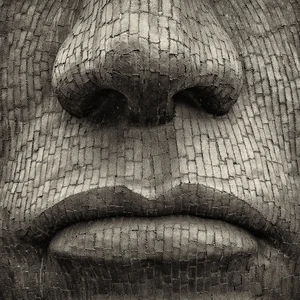
The example frame above was taken on a photo walk through Westminster in late 1988 or very early 1989, during my first year at King's College London. The college's main Strand campus is a short walk from Westminster Bridge, and the sort of black-and-white photo walks that I was doing in those days would routinely take me down to the river and out across one or other of the central London bridges and back. This particular afternoon, I had walked across Westminster Bridge to the South Bank and found myself, almost without noticing, standing directly below the magnificent South Bank Lion, a great pale Coade-stone statue that sits on the riverside parapet at the eastern end of Westminster Bridge near County Hall.
The Lion is a remarkable object in its own right. It was sculpted in 1837 by William Frederick Woodington and was originally one of two lions standing on top of the parapet of the Lion Brewery, a large Victorian brewery building that stood on the south bank of the Thames from 1837 until 1949 (Londonist). The brewery was demolished as part of the post-war redevelopment of the south bank for the Festival of Britain in 1951, but at the personal intervention of King George VI both lions were preserved — the larger one (the one in the photograph) was moved to its current position at the south end of Westminster Bridge in 1966, after a brief stay over the entrance to Waterloo Station in the intervening years. The smaller of the two now sits outside the Rowland Hill Memorial Gates at Twickenham Stadium.
What makes the lion remarkable, though, is what it's made of. It's cast not from stone but from Coade stone — a high-fired ceramic material developed in the 1770s by Eleanor Coade, a London businesswoman who ran a manufactory at King's Arms Stairs on the south bank from 1769 until 1840, producing architectural ornament for the great Georgian buildings of London (the Coade Lion uses Mrs Coade's own original formula). The material is essentially a stoneware ceramic — a mixture of china clay, ground quartz, ground flint, ground glass and crushed pre-fired Coade stone "grog" — that's pressed into moulds, fired in a kiln at around 1100°C for four days, and emerges harder than most natural stone and almost completely impervious to weather, frost, pollution and erosion. The recipe was lost when the Coade manufactory closed in 1840 and was not reconstructed until the 1990s. The South Bank Lion, sitting in the open London weather for nearly two hundred years and substantially exposed to a century and a half of industrial coal-smoke pollution, looks today essentially as it did when it left Mrs Coade's manufactory — sharp-edged, smooth-surfaced, unstained, unweathered — and weighs, as a single piece, about 13 tonnes (Wikipedia, Look Up London).
In the frame, the Lion is photographed from low and slightly to its left, looking up at it against a heavy grey winter sky. The 50mm focal length and the relatively close working distance have given the head a slightly forward-leaning monumentality, and the slightly underexposed sky and pushed shadows in the Tri-X 400 negative have given the print a dramatic, high-contrast look that suited the subject. The lens was the original EF 50mm f/1.8 — bought with the camera body, and the lens I used on the 620 for almost everything I shot during those years.
What it's like to own one now
The EOS 620 in 2026 is a quietly extraordinary thing — an absolutely modern-feeling autofocus SLR that just happens to have been built in 1987, that takes every EF lens Canon has ever made, that auto-loads and auto-rewinds film with a small whirr of motorised confidence, and that produces 35mm negatives with all the technical sophistication that the EOS system has accumulated over forty years. Used prices are extremely reasonable — clean working bodies are typically £40-£80 in 2026, well below the price of a similarly-specified used Nikon F-501 or Minolta 7000 AF, despite the EOS body being arguably the more capable of the three — and a complete kit with a working body and a clean EF 50mm f/1.8 II or STM can be put together for under £150 quite easily. The 2CR5 battery is still widely available; the rear-door light seal is the only consistent point of failure on otherwise clean cameras; and the electronics have proven extraordinarily robust over four decades.
If you buy one, check that the back closes cleanly and that the rear-door light seal hasn't crumbled (it usually has, on unserviced examples, and a new seal kit costs £8 and a steady hand to replace). Check that the top-plate LCD shows all segments clearly. Check that the EL backlight on the LCD still works — it's the world's first and is occasionally the first electronic system to fail on aged bodies. And check that the AF system locks confidently onto a textured subject in good light with whatever lens you're trying it with: dead AF sensors are rare but not unheard of on cameras this old. The shutter, the meter, the film transport and the electronic communications with the lens are all almost universally still in good working order on surviving examples — which, given the alternative of starting with a freshly-built modern camera from a manufacturer who is no longer making any new film bodies at all, is a properly remarkable thing.