Food Photography
Food is the subject around which the still life tradition in Western painting was constructed, and it arrived in photography almost with the medium itself. From the earliest experiments with light-sensitive materials in the 1820s to the billions of meal photographs uploaded to social media platforms every day, the history of food photography maps onto the history of photography as a whole with unusual fidelity.
It carries the full weight of the still life inheritance — the symbolic languages of abundance and transience worked out in oil paint across three centuries — and it simultaneously traces the development of commercial photography, the rise of the illustrated press, the transformation of advertising, the ambitions of photojournalism and social documentary, and the fine art pretensions of the studio.
No other photographic genre has been required to serve so many masters, or has done so with such consistent technical ingenuity. To read the history of food photography is, in a very real sense, to read the history of photography itself.
The Still Life Inheritance
Long before any photographer pointed a lens at a plate of fruit, the representation of food had generated one of the richest traditions in Western art. The Dutch Golden Age of the seventeenth century produced the pronkstilleven — the ostentatious banquet piece — in which painters such as Pieter Claesz (1597–1660), Willem Claesz Heda (1594–1680), and Jan Davidsz de Heem (1606–1684) arranged pewter platters, crystal goblets, half-peeled lemons, broken bread, and overflowing fruit onto cloth-draped tables with a virtuosity that combined technical mastery with a dense web of symbolic meaning.
These were not merely depictions of appetite. The wilting flower, the fly on the apple skin, the guttered candle, the scattered coins: each object participated in the vanitas tradition, the meditation on the transience of earthly pleasures and the inevitability of death. Abundance and decay were simultaneously present in the same canvas.
Caravaggio's Basket of Fruit (c. 1599, Pinacoteca Ambrosiana, Milan) is an early landmark of a different kind. Painted probably as a gift for Cardinal Federico Borromeo, it is unusual in depicting food without the ostentation of the banquet piece, and without human figures to contextualise the arrangement.
The basket sits at the edge of a neutral surface, a spray of leaves browning at the edges, a worm-hole visible in one of the apples. Caravaggio brought to this subject a directness and specificity that would prove extraordinarily generative: the willingness to represent actual, imperfect food rather than an idealised version of it anticipates something central to the entire photographic tradition.
Jean-Baptiste-Siméon Chardin (1699–1779) modulated the genre in a different direction. His kitchen still lifes — The Ray (1728, Louvre), the celebrated sequences of copper pots and game, the domestic provisions arranged on stone shelves — traded the lavish symbolism of the pronkstilleven for a quieter, more intimate attention.
Chardin was interested in the light falling across a copper pot, the texture of a loaf of bread, the specific weight and materiality of ordinary domestic objects. His influence on the photographic tradition is more diffuse than Caravaggio's, but recognisable: the natural-light food photography of the late twentieth century, with its linen cloths, worn wooden boards, and emphasis on the texture of real food, owes something to his sensibility even across the intervening centuries.
What photography inherited from this tradition was substantial, but what it changed was equally significant. The painted still life could idealise its subjects: Heda could render a lemon with a continuous, perfect strip of peel; de Heem could paint grapes with a bloom and translucency that no actual grape can quite sustain.
Photography cannot do this. The lens records the bruise on the peach, the condensation ring on the tablecloth, the asymmetry of the actual arrangement. This fidelity to the imperfect real was, in the early decades of photography, often experienced as a limitation. It would eventually come to be understood as the medium's greatest strength in the food context.
The First Food Photographs
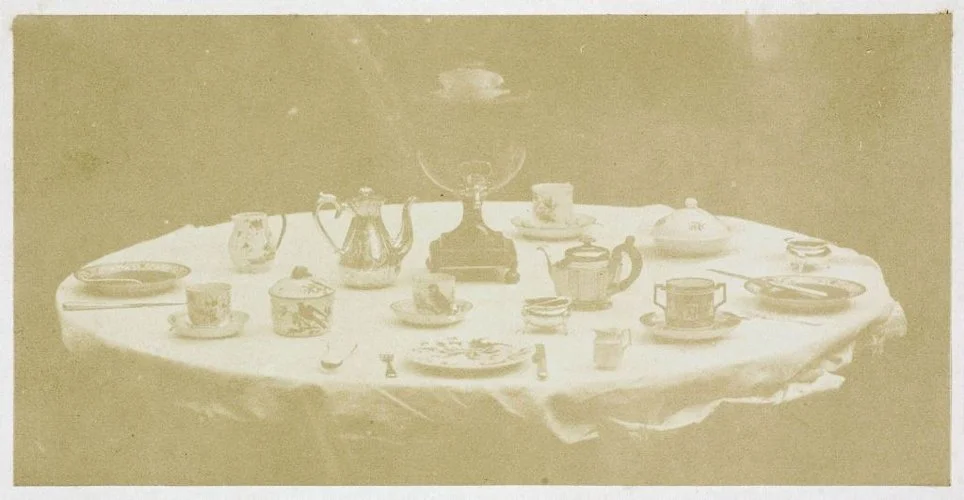
The question of when the first food photograph was taken is not straightforward. Joseph Nicéphore Niépce (1765–1833), the French inventor who developed the heliographic process using bitumen of Judea on pewter plates, produced the first surviving photograph made with a camera obscura in 1826 or 1827 — a view from the upper window of his estate at Le Gras in Saint-Loup-de-Varennes, showing the courtyard, outbuildings, and surrounding landscape. This is View from the Window at Le Gras, now held at the Harry Ransom Center, University of Texas at Austin, and it is emphatically not a food photograph.
The claim sometimes encountered in food photography histories that Niépce made a photograph of a set table, between 1827 and his death in 1833, requires careful handling. While Niépce produced more than twenty heliographic plates and prints between 1825 and 1829, many of which survive in public and private collections, the specific identification of a table photograph from this period has not been firmly established in the primary literature.
The subject matter that his process could practically render — requiring extraordinary exposure times of many hours or even days — would naturally favour architectural and landscape subjects rather than the transient arrangements of food. However, it should be noted that the items pictured in La Table Servie - bowl, wine bottle, cutlery, loaf of bread etc, would have remained static over an exposure of several hours. Any such attribution should be treated with appropriate caution until primary sources can confirm it.
The first firmly documented food photograph in the photographic canon is William Henry Fox Talbot'sA Fruit Piece (before June 1845), a salted paper print made from a paper negative — the calotype process Talbot had patented in 1841. The Metropolitan Museum of Art holds a print of this work, catalogued as a depiction of fruit in a domestic arrangement.
Talbot (1800–1877) was by this point already four years into the production of The Pencil of Nature (1844–46), the first commercially published book illustrated with actual photographs, which had included several still life studies of domestic objects arranged at Lacock Abbey. The choice of fruit as subject was entirely natural: it was still, it was familiar, it participated in the visual vocabulary of the painted tradition Talbot was working to address, and it was available in the gardens of his estate.
The calotype process, however, was monochromatic, softly focused by comparison with the daguerreotype, and produced images with a characteristic warm, diffuse quality that modern eyes associate with a kind of antiquarian tenderness. The specific imperfections of actual fruit — unlike the painted ideal — were present but softened by the tonal properties of the salted paper.




The constraints of early photographic processes shaped the nascent genre profoundly. Daguerreotypes required highly polished silver-coated copper plates and mercury-fume development; they were unique objects, not reproducible, and their surface was so reflective that they had to be viewed at an oblique angle to see the image at all.
Early calotype and salted paper processes required long exposures and produced images with a significant grain. Both processes were monochromatic, and both depended on the subject remaining perfectly static. None of these constraints were hospitable to the ephemeral, light-sensitive, necessarily imperfect character of actual food as it might be served at a table.
The food that appeared in early photographs was invariably treated as a still life in the strict sense: an arrangement made for the camera, not a record of eating. Whether this constituted imitation of the painted tradition or something genuinely new is a question the photographs themselves answer equivocally. The compositional conventions were clearly inherited; the factual specificity — the particular peach, the actual straw basket — was new.
Among the other identifiable early works in the genre is Charles Philippe Auguste Carey'sStill Life with Waterfowl (1850s), which brought to photographic still life a naturalistic directness comparable to the Chardin tradition. Carey's approach treated game and produce as subjects worthy of the same documentary attention that photographers of the period were directing at landscape and architecture.
The Rise of Commercial Food Photography
The transition of food photography from an adjunct of fine art and portraiture to a commercially driven discipline with its own conventions, hierarchies, and professional practitioners was the defining development of the late nineteenth and early twentieth centuries. It was driven by several convergent forces: the growth of the illustrated press, the expansion of the food-processing and branded goods industries, and the emergence of domestic science and recipe culture as subjects of mass-market publishing.
Paul Strand (1890–1976) represents a bridge figure between artistic seriousness and the food subject. In the summer of 1916, working at the cottage his family rented at Twin Lakes, Connecticut, Strand gathered crockery and fruit from the kitchen and made a series of close-up abstract compositions on the porch — Bowls (1916), Pears and Bowls (1916), Still Life, Pear and Bowls (1916).
These were among the first photographs intentionally constructed as abstractions, and Strand himself was explicit that he was exploring the structural principles he had absorbed from the Cubist paintings at Stieglitz's 291 gallery. The food and domestic objects in these images are stripped of their symbolic and allegorical freight; what matters is the geometry of tonal planes and the interplay of curved surfaces in raking light.
Eleven of these photographs were published in the final double issue of Alfred Stieglitz's Camera Work (Numbers 49–50, June 1917), which was devoted entirely to Strand's work and is generally regarded as the most significant single publication in the history of art photography. Strand would return to food subjects throughout his career — Parmesan, Luzzara (1953) is a strikingly direct close-up of cheese in a worker's hand — but his contribution to food photography was less a style to be imitated than a proof of the subject's aesthetic seriousness.
The commercial development of food photography was driven not by art photographers but by the intersection of two industrial revolutions: the industrialisation of food processing, and the industrialisation of print.
By the 1910s and 1920s, American companies including General Mills, Crisco (introduced 1911), Aunt Jemima (trademarked 1888), and the Coca-Cola Company were spending unprecedented sums on print advertising, and the illustrated press — Ladies' Home Journal, McCall's, Woman's Home Companion, Good Housekeeping — had reached circulations of several million copies.
Food photography was not yet colour photography, but it was acquiring its characteristic conventions: the carefully staged arrangement, the pristine tablecloth, the gleaming serving vessel, the slice removed from the cake to show the interior. These conventions were entirely legible within the painted still life tradition, but they were now in the service of selling a brand rather than meditating on mortality.
The figure who most decisively defined the aesthetic of mid-twentieth-century American commercial food photography was Nickolas Muray (1892–1965), a Hungarian-born photographer who had arrived in the United States in 1913 and established himself during the 1920s as a celebrity portraitist for Vanity Fair and Vogue. In 1935, Muray won a commission from McCall's magazine to create colour photographs for their homemaking and food pages — the first sustained commercial application of colour photography to food subjects. The process he used, the three-colour carbro, was among the most technically demanding procedures in the photographic repertoire.
The carbro (a contraction of "carbon-bromide") process begins with three separate black-and-white negatives exposed through red, green, and blue filters respectively — the principle of additive colour separation that James Clerk Maxwell had demonstrated in 1861.
From each negative, a bromide paper print is made; each print is then placed in contact with a sheet of pigmented gelatin tissue soaked in a chemical sensitiser. The silver in the bromide print triggers a bleaching reaction in the sensitiser, which migrates into the gelatin and hardens it in proportion to the density of the silver image — a process of gelatin tanning or "carbroing." The hardened gelatin holds the pigment permanently while the unhardened gelatin washes away in warm water, producing a relief image in cyan, magenta, or yellow pigment respectively.
The three pigment reliefs are then transferred, one at a time, in precise registration, onto a final paper support to build the full colour image. The process was extraordinarily labour-intensive and demanded exceptional skill in registration, but it produced prints of remarkable longevity and vibrancy: because the image consists entirely of stable organic pigments with no silver halides, it is resistant to the fading that afflicts most other early colour processes. Muray's carbro prints from the 1930s and 1940s retain their colour with a saturation that has astonished subsequent generations of photographers.


Muray's food work for McCall's and other advertisers through the 1950s established many of the conventions that would define American commercial food photography for decades. His compositions featured heavily styled, abundantly laden tables — the spectacular set piece of glazed ham, iced drinks, elaborate layer cake, and elaborate supporting cast of condiments, flowers, and tableware that came to be called the "cookbooklet" aesthetic.
This was not food to be eaten but food to be aspired to: an image of postwar American domestic prosperity that bore the same relationship to ordinary domestic meals as Hollywood set design bore to ordinary domestic architecture.
To achieve the hard, direct lighting required by the carbro process while maintaining the appearance of food, photographers and food stylists employed a battery of artificial interventions. Beer foam was replaced with soap bubbles; the milk in cereal photographs was replaced with white glue, which photographed more crisply and did not sink the cereal; ice cream was represented by lard or mashed potato, which did not melt under the studio lights; dishes were hair-sprayed or varnished to sustain their sheen. The conventions of food styling as a distinct professional discipline were essentially codified during this period.
Colour & the Appetite
The first demonstration of colour photography as a principle was made on 17 May 1861, when the Scottish physicist James Clerk Maxwell (1831–1879) delivered a lecture at the Royal Institution, London, and projected onto a screen three black-and-white glass slides, each photographed through a different colour filter (red, green, and blue), in register through matching filtered projectors.
The resulting projected image of a tartan ribbon was the first demonstration that additive colour mixing could produce a colour photograph. The photographs themselves were made not by Maxwell — who was a physicist, not a photographer — but by Thomas Sutton (1819–1875), inventor of the single-lens reflex camera and editor of Photographic Notes. Maxwell's contribution was the theory; Sutton's was the technical execution.
The image most commonly reproduced as "Maxwell's tartan ribbon photograph" requires a significant qualification. Maxwell's original glass positives survive at the museum at 14 India Street, Edinburgh, the house where he was born, but these are monochromatic glass slides, not a colour print.
The colour print that appears in reproduction was made circa 1933 by Dr D. A. Spencer using his own Vivex process — a variant of the three-colour carbro process — working from Maxwell's original positives. Spencer's print is held in the Victoria and Albert Museum.
The 1861 demonstration itself produced a projected image that, as subsequent analysis has established, was not a fully accurate colour reproduction: the photographic emulsions of Sutton's era were insensitive to red light, and the apparent success of the red component in the demonstration is now believed to have been the result of ultraviolet reflectance from the red dye rather than a true red-filtered exposure. Maxwell himself noted the inadequacy of the results at the time.
The journey from Maxwell's 1861 demonstration to commercially viable colour printing was long and technically complex. Colour photography as a practical process for the illustrated press did not become commercially viable until improvements in colour printing technology in the 1930s brought the cost and technical demands within reach of magazine publishers.
The Lumière Autochrome plate, introduced in 1907, was the first genuinely popular colour process, using a mosaic of dyed potato-starch grains as a colour screen, but its granular texture and transparency format made it unsuitable for direct reproduction in print.
The advent of Kodachrome film in 1935 — manufactured by Eastman Kodak and providing a chromogenic colour transparency with the warm, saturated palette that would define mid-century visual culture — gave photographers a practical colour tool; but translating colour transparencies into colour printing remained expensive and technically demanding through the 1940s.
The psychological argument for colour in food photography is unusually direct. Food colour functions as a primary signal in the assessment of ripeness, freshness, and palatability: the redness of a tomato, the golden-brown of a crust, the vivid green of a fresh vegetable are not merely decorative but carry evaluative information that is deeply embedded in human sensory response.
Black-and-white photography could convey form, texture, and arrangement; it could not convey this evaluative dimension. The arrival of colour printing in the food press was not merely a technical development but a transformation in the communicative power of the food photograph: it could now address not only the viewer's aesthetic appreciation but their appetite directly.
The progression of colour processes through the mid-century followed a technological trajectory from the carbro and its variants, through dye-transfer printing (which replaced the carbro's gelatin-tanning mechanism with dyed matrix films), to the chromogenic processes of the 1960s and beyond.
Dye-transfer printing — the technology used by Penn for his food work — offered perhaps the finest quality colour reproduction of any photographic process: the dyes could be precisely controlled and corrected, the colour gamut was wide, and the prints were physically stable. Chromogenic processes, although they displaced dye-transfer commercially through sheer economy and speed, sacrificed some of this quality in exchange for accessibility.
Irving Penn & the Fine Art of Food
Irving Penn (1917–2009) occupies a position in the photographic canon that is defined primarily by his fashion and portrait work for Vogue, which he began in 1943 and continued for more than sixty years. His fashion photographs — the women in the corner, the series shot against plain painted backdrops, the extraordinary portraits of trade workers — are among the most technically accomplished and compositionally rigorous images in twentieth-century photography. It is against this background that his food work must be understood.
Penn's series Frozen Foods, New York (1977) is one of the most consequential bodies of work in the history of food photography, and one of the least expected from its maker. The subject is commonplace to the point of deliberate provocation: blocks of frozen supermarket vegetables — string beans, peas, corn, carrots — removed from their packaging, arranged with architectural precision, and photographed in the studio against a neutral backdrop as they slowly melt under the studio lights.
The images were published in Vogue in July 1977 (titled "Iced Soups: Flash Foods") and have subsequently appeared in editions printed as dye-transfer prints, a number of which are held in major museum collections including the Art Institute of Chicago, the Smithsonian American Art Museum, and others.
The technical challenge was formidable. The surfaces of the frozen vegetables had to be photographed at the precise moment when the frost bloom was intact — neither too freshly removed from the freezer, which risked condensation obscuring detail, nor too long under the lights, which would cause the frost to melt and the vegetables to begin wilting. Penn's characteristic precision — the same precision that produced his fashion masterpieces and his Worlds in a Small Room environmental portraits — was required here at a molecular level: the image had to be captured within a narrow window of a few minutes.


The significance of Frozen Foods lies in what it asserts about the relationship between the commercial and the fine art photograph. These are objects that any consumer might have in their freezer; the arrangement is artificial, the setting is stripped of any domestic context, and the scale — Penn printed these works at dimensions of 40 by 30 inches and larger — elevates them to the monumental.
Penn brought to supermarket peas the same compositional intelligence and the same insistence on technical excellence that he brought to a Balenciaga gown. In doing so, he posed a question about the hierarchy of photographic subjects that food photography has been working through ever since: if the frozen vegetable block can be as arresting, as compositionally rich, and as technically demanding as the fashion plate, then the distinction between "commercial" and "fine art" food photography is a distinction of convention and context rather than of intrinsic value.
The Cookbook Revolution & Natural Light
The history of cookbook photography can be divided, with some simplification, into two eras separated by a shift in aesthetic sensibility that was as much ideological as it was technical.
The first era, roughly from the 1950s through the late 1980s, was defined by the conventions of the studio: the fully styled set, the supplementary lighting to eliminate shadow and maximise colour saturation, the food stylist's interventions to make dishes look more perfect than any home cook could reproduce, and the overall visual language of abundance and aspiration. Backgrounds were typically plain or included formal tablecloths; props were coordinated; the food was impeccably placed.
The second era began in the 1990s with a counter-movement that rejected the artificiality of the studio aesthetic in favour of natural light, location shooting, visible imperfection, and what might be called the aesthetics of the kitchen rather than the aesthetics of the table. This shift was driven by several forces: changing consumer sensibilities that placed authenticity above idealism, a publishing culture increasingly influenced by food writers whose public personas were tied to informality and accessibility, and the specific aesthetic capabilities of new generations of professional photographers who had trained in documentary and reportage traditions rather than studio work.
The defining practitioner of this shift is David Loftus, whose collaboration with Jamie Oliver (born 1975) produced what is arguably the most commercially successful body of food photography in publishing history. Loftus first met Oliver when the latter was an "up-and-coming young chef from the River Cafe" about to sign a television and book deal, and photographed him for the Saturday Times magazine.
The collaboration that followed has continued for more than twenty-five years and has encompassed more than one hundred cookbooks — all but one of Oliver's internationally published titles — which have sold in excess of thirty million copies. In 2010, Professional Photographer magazine named Loftus the 65th most influential photographer of all time.


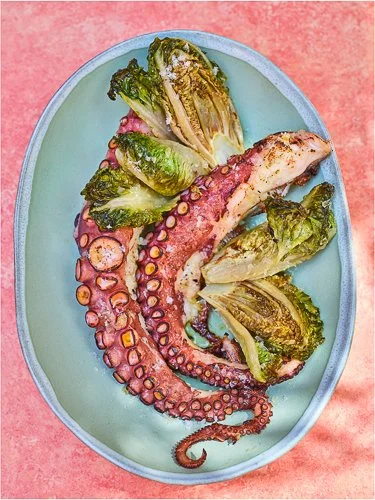

Loftus's approach — natural window light or carefully managed ambient light, minimal artificial supplementation, shooting on location rather than in the studio, allowing the surface of the food to show its actual texture and imperfections rather than correcting them stylistically — was not merely an aesthetic preference but a deliberate argument about what a food photograph was for.
The Oliver cookbooks were not aspirational lifestyle documents in the manner of the mid-century American model; they were addressed to home cooks who were meant to believe that the food in the photographs was achievable in an ordinary kitchen under ordinary conditions.
The apparent effortlessness of Loftus's images is, paradoxically, the result of considerable technical skill: managing ambient light to produce consistent results across an entire book shot in multiple locations across multiple seasons requires a precise calibration of exposure, white balance, and compositional control that belies the casual surface.
Documentary & Social Commentary
While commercial food photography was constructing its elaborate apparatus of aspiration and appetite, a parallel tradition of documentary work was using the food subject to different ends entirely: as a vehicle for social analysis, class commentary, and the examination of inequality. This tradition has deep roots in the social documentary photography of the twentieth century, but its most significant recent practitioners have approached food not as something to be made appetising but as something to be made legible — as evidence of the social and economic conditions under which people live and eat.
Martin Parr (1952-2025) is the central figure in this tradition within British photography, and his relationship with food as a subject is both longstanding and self-consciously analytical. A member of Magnum Photos since 1994, Parr built his reputation on a distinctive visual style — hard, direct on-camera flash, close-cropped compositions, aggressively saturated colour — that he directed at the peculiarities of British and international popular culture.
Food was a recurrent subject from early in his career precisely because it is so densely coded with class, aspiration, and identity. His remark that junk food is more interesting to photograph than "posh" food — that the service station sausage roll is a more revealing social document than the restaurant tasting menu — encapsulates his method: food as symptom rather than food as pleasure.
Real Food, published by Phaidon in 2016, gathers photographs taken throughout Parr's career from more than thirty-six countries, comprising two hundred images of food in its actual social contexts: from a gelatinous dessert in Tijuana to cream tea in England, from cruise ship buffets to street vendors' carts.
The book makes no concession to appetite. The flash is frontal, the food is frequently unlovely, and the effect is of a systematic taxonomy of eating habits around the world that is simultaneously comic, affectionate, and uncomfortable. Parr has described his method explicitly as a response to the propaganda of food marketing, the omnipresent commercial imagery that presents food as perpetually beautiful, abundant, and accessible, when the material reality of what most people eat most of the time is considerably more ambiguous.


A more systematically comparative documentary approach was taken by photographer Peter Menzel and writer Faith D'Aluisio in Hungry Planet: What the World Eats, published in 2005. The project involved photographing thirty families in twenty-four countries during a typical week, with each family's weekly food supply laid out around them in a single image — a comparative portrait of global food consumption that was as empirical in its organisation as it was striking in its visual impact.
The families depicted ranged from a Bhutanese village household whose weekly food budget was the equivalent of a few US dollars to an American suburban household surrounded by processed and packaged goods. Exhibitions of the work were held at the Nobel Peace Centre in Oslo and at the United Nations headquarters in New York, recognising the project's contribution to the documentation of global food inequality.
Hungry Planet represents food photography operating at the intersection of documentary practice, journalism, and advocacy, using the image of food not to stimulate appetite but to address questions of food security, agricultural practice, and the radical inequality of global food systems.
White Heat & the Kitchen as Drama
Before the mid-1980s, the photography of professional cooking was largely confined to the finished dish: the plated result, composed and lit as a still life. The kitchen itself — the physical space of professional cooking, with its heat and noise and physical intensity — was not a photographic subject. The publication of White Heat in 1990 changed this.
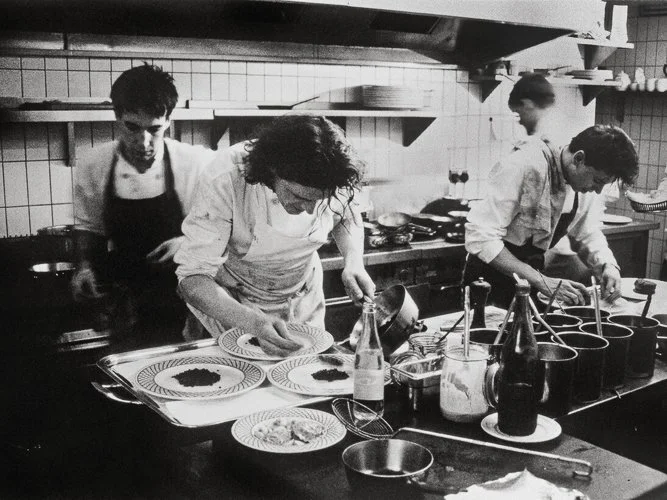
White Heat is a collaboration between the chef Marco Pierre White (born 1961) and photographer Bob Carlos Clarke (1950–2006), published in October 1990 by Pyramid Books (subsequently reissued by Mitchell Beazley). Clarke's photographs document White's kitchen at Harvey's restaurant in Wandsworth, South London, during the period when White was establishing himself as one of the most technically accomplished and personally volatile chefs in Britain.
Clarke, who had made his reputation in fashion and automotive photography — fields whose visual conventions emphasised drama, physical energy, and the primacy of the subject's presence — brought those conventions into a kitchen context that was almost entirely without precedent in food publishing.
The photographs are in black and white, and they are not photographs of food in any conventional sense. They are photographs of the act of cooking: White in motion, the steam rising from a pan, the intensity of concentration and physical effort that professional cooking at the highest level demands.
The dishes appear, but as details in a larger drama rather than as the subject. The kitchen at Harvey's — cramped, intense, operating at the limits of its capacity — is the real subject, and the photographic language Clarke used to render it owes as much to photojournalism and portraiture as it does to food photography.
White Heat anticipated celebrity chef culture by several years, and its visual grammar — the chef as protagonist, the kitchen as theatre, cooking as performance — became the dominant mode of the genre that subsequently developed. Clarke's background in fashion and automotive photography was directly relevant: both fields had developed sophisticated techniques for making action and movement legible within a still frame, for isolating the moment of maximum dramatic tension, and for constructing the subject as a figure of glamour and power. Applied to a restaurant kitchen, these techniques produced images that were simultaneously documentary and mythologising.
The Social Media Era
The transformation of food photography since the early years of the twenty-first century has been unlike any previous development in the genre's history, because it has involved not the emergence of a new professional aesthetic or a new technical process but the collapse of the distinction between professional and amateur practice.
The smartphone, and in particular the camera technologies embedded in smartphones from approximately 2007 onwards, put in the hands of hundreds of millions of people a device capable of producing food photographs of sufficient technical quality to be shareable, and the social media platforms that emerged in the same period — Instagram (launched 2010), Pinterest (launched 2010), Facebook's image-sharing functionalities — provided the infrastructure for distributing those images at global scale.
Andrew Scrivani (born in New York) had been working as the primary food photographer for the New York Times Food Section since 2002, documenting the paper's dining coverage and recipe photography at a time when the section was beginning its expansion into what would become one of the most commercially successful sections of the paper and eventually a standalone subscription product, New York Times Cooking.
Scrivani's work — direct, technically accomplished, relying primarily on natural or managed daylight rather than formal studio lighting — represents the professional end of the spectrum, the tradition of newspaper documentary photography applied to food subjects with a seriousness of intention that the social media era has both amplified and challenged.
The "food porn" phenomenon — the term, borrowed from general usage of the compound, entered mainstream discourse in the early 2010s to describe the practice of photographing restaurant meals and home cooking for social media — created a new mass genre that bore a complex relationship to professional food photography.
At its most considered, smartphone food photography drew on and democratised the visual conventions developed by professional practitioners: natural-light composition, overhead angles, minimal styling, the emphasis on texture and colour that had developed through the Loftus school. At its least considered, it produced the vast archive of dimly lit, slightly blurred restaurant plates that has become the visual record of an epoch's eating habits.


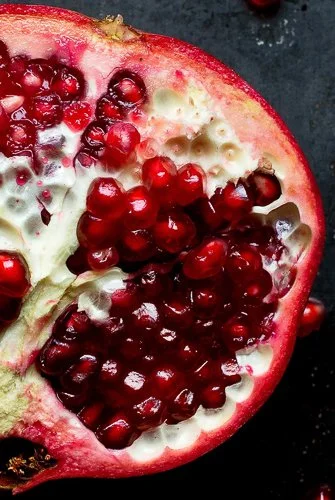
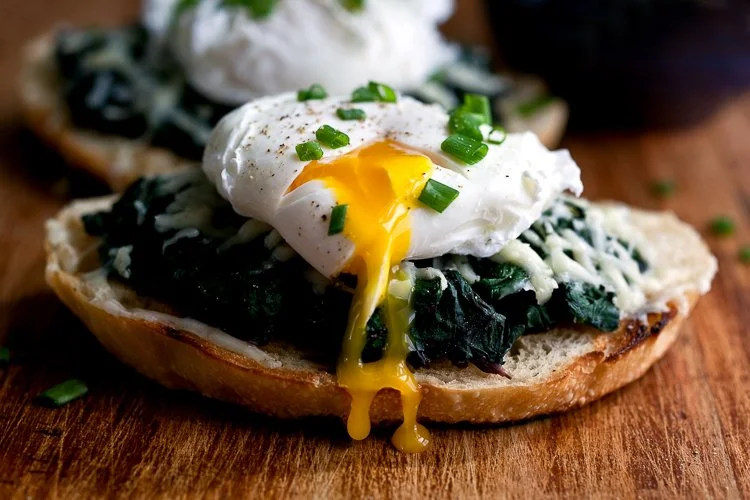


Wolfgang Tillmans (born 1968), the German photographer who won the Turner Prize in 2000, represents a figure who operates across the boundary between the casual and the formally considered in food photography as elsewhere. Tillmans's practice has always included photographs of food — photographed with the same attention, and in the same formats, as his fashion work, his abstract darkroom experiments, and his political imagery.
The food photographs are sometimes formally composed still lifes; sometimes they are the record of a meal in progress, a plate half-eaten, a glass ring on a table. This studied refusal to distinguish between the significant and the incidental is characteristic of Tillmans's practice generally, but in the food context it makes a specific argument: that the meal, the kitchen, the shared table are as worthy of sustained photographic attention as any other subject.
Among contemporary specialists, the field has diversified considerably. Sophie Harrington has built a body of work that draws on natural history and still life traditions, emphasising the botanical origins of food ingredients.
Kimberly Espinel, whose practice extends to food photography education, has developed a distinctive approach to colour and light that bridges the commercial and the expressive.
Stephen Conroy has brought a fine art sensibility to commercial food photography, treating the brief as an opportunity for compositional seriousness rather than a constraint to be accommodated. These figures, among many others, represent a generation of practitioners working in a field that is simultaneously more commercially demanding and more aesthetically self-conscious than at any earlier point in its history.
The contexts in which food photography now operates have multiplied far beyond the magazine, the cookbook, and the newspaper. Meal kit delivery services — HelloFresh, Blue Apron, and their equivalents — require photography that communicates the ingredients and the process rather than solely the finished dish.
Restaurant delivery platforms require food photography at a scale and speed that would have been unimaginable to the studio photographers of the carbro era. Social media platforms require content that is immediately legible at small screen sizes, often in scroll-interrupted conditions.
These new contexts have produced counter-movements: the return to minimalism and negative space as a response to visual saturation, the emphasis on process documentation (the hands at work, the ingredient in transformation) as a response to the static perfection of styled dishes, and the deliberate roughness and imperfection of some contemporary commercial food photography as a signal of authenticity in a genre whose conventions are so widely known as to have become readable as artifice.
There are six categories through which contemporary food photography is generally analysed:
product photography (individual food items against neutral backgrounds, for packaging and catalogue use)
advertising photography (food within a broader brand narrative)
editorial photography (food in the context of journalism and criticism)
lifestyle photography (food as part of a broader image of how people live)
documentary photography (food as social evidence)
recipe photography (food as instruction)
They represent not distinct disciplines but overlapping practices that a single photographer may move between in the course of a career. The conventions of each category have their own history, their own technical requirements, and their own aesthetic hierarchies, but the genre as a whole is best understood as a single tradition with multiple functional registers rather than as a set of separate genres.
Closing Thoughts
The enduring paradox of food photography is that it is simultaneously the most commercially driven of all photographic genres and among the most intimate. Photography has been applied to war, to landscape, to the nude, to architecture, to science: in all of these contexts, the photographic tradition is substantial, contested, and rich. But none of these subjects is as immediately and universally shared as food. Every person who has ever lived has eaten; food is where culture and memory and family and daily life converge in a form that is at once sensory, social, economic, and symbolic.
The food photograph, however commercial its purpose or however casual its making, participates in that convergence. From Niépce's window at Le Gras to Talbot's basket of peaches to Muray's carbro confections to Penn's melting frozen beans to the photograph of tonight's dinner taken on a smartphone and posted before the meal is eaten, the food image has always been about more than what is on the plate.It is about who we are, what we have, what we want, and what we share — and the history of food photography is, at its deepest level, the history of those questions asked through a lens.