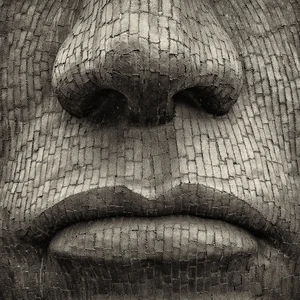
The statue at Wurmhowl Spikes
A statue of Jora stands at the top of Wurmhowl Spikes, cut in white stone, hair loose, cloak trailing behind her. The plinth is dusted with snow. Behind her, the Shiverpeaks recede into a bruised blue night, and the flakes come down in slow diagonals. She is looking north, in the direction the norn migrated from a century and a half ago, when the country up there became uninhabitable.
The story Jora belongs to is older than the game she stands in now. She first appears in Eye of the North, the last expansion for the original Guild Wars, published in 2007: a norn hunter cursed by the Bone Dragon Kalisstrand into a bear-form she could not shed and could not control. She kills the dragon, and in doing so becomes the ideal the norn hold up to their young — a hunter who refused to let the shape of a thing decide what she was.
Two hundred and fifty years later, in the Guild Wars 2 timeline, the norn keep her in bronze and stone across Hoelbrak and the country around it. Braham Eirsson, one of the game's principal characters, is the son of her direct spiritual descendant. The statue at Wurmhowl appears small in a wide zone, but it is doing important work: it is what a norn character sees on the road north, just before the country turns properly cold.
Where the country begins
Wayfarer Foothills is the norn starter zone, tucked into the southern edge of the Shiverpeak Mountains, immediately east of Hoelbrak. It is the landscape a new norn character strides out into as they emerge from the tutorial. It runs from a temperate valley in the south — of pine and birch, grass, meadow flowers, and warm-toned rock — up through progressively snowier ground to a permanent winter along its northern edge, where Jormag's influence has held for a century.
The zone covers levels one to fifteen and connects to Hoelbrak on the west via a portal, to Snowden Drifts at the northwest corner, to Frostgorge Sound in the north through Solitude Vale, and to Diessa Plateau in the northeast through Dolyak Pass. Twenty-seven named areas fit inside it, along with ten renown hearts, seven waypoints, nineteen points of interest, twelve vistas, six skill challenges and one jumping puzzle. All of it launched with the game on 28 August 2012 and has been left effectively untouched since.
The Great Hunt
A new norn steps out of the Hunter's Hearth into Snowlord's Gate to be greeted by Thora Griffonbane, a huntmaster in fur and leather who explains the country in the way huntmasters do: without small talk, with the assumption you already know the animals. She sends the recruit south into the trees to kill a dire boar, then back, trophy in hand, to Ido the Tanner at the gate itself. Then, up the road east and north with Eir Stegalkin. Eir is famous — the sculptor-huntress of Hoelbrak, later revealed as a founding member of Destiny's Edge — but at this point in the timeline, she is a mentor with an assignment.
The countryside here is not yet winter. The road descends into the valley through birch and pine woodland into a broader river country, with the peaks banked in mist and warm autumnal light on the trees. Meadow flowers grow along the banks. The map calls the valley Wolf's Crossing, and it is the first proper open ground a norn character sees. The river runs down from the higher country in a series of shallow braids, and if the light is right, the far peaks stand in silhouette against a haze that is more Iceland than Norway.
Up the stairs of Hangrammr Climb, Eir has an assignment for the recruit: a great wurm, Issormir, threatens the shrines of the Spirits of the Wild in the lands below. The recruit is not really needed for the fight — Eir does the work and the wurm falls. What remains is a rib cage the size of a small barn, half-buried in snow at the top of the climb, and it stays there; the game has never cleaned it up. Norn characters who level past this point come back to Hangrammr for years and find Issormir still lying where Eir left him. It functions as one of the zone's peculiar monuments, a demonstration by the local hero, preserved as a landmark.
Below Hangrammr, in Borealis Forest and the surrounding valley, the country is quiet. Trees, meadow, low hills, a scattering of predators, and the shrines of the four Spirits of the Wild — Bear, Wolf, Raven, and Snow Leopard — each with a heart-quest and a small tutorial. Shaman Velja has lost snow leopard cubs to a dredge raiding party. Bear's shrine is under attack by jotun who do not much care about theology. Raven's statues in the northern trees ask riddles. Wolf's shrine sits in the trees at the south of the valley. The country is being defended from four directions at once, at low intensity, and the recruit is asked to pitch in wherever they can.
Origin, dragon, and the walk south
The norn are not from Wayfarer Foothills. They are refugees.
Their homeland lies further north, in the Northern Shiverpeaks — the region that currently hosts Bjora Marches and the sealed remains of Jormag's old sanctuary. In 1078 AE, a norn named Svanir began to hear a voice speaking to him from the ice. What he was hearing was Jormag, the Elder Dragon of Ice and Persuasion, one of the world's original six. Waking after fifty centuries below the northern glacier and reaching outward for followers, Jormag’s voice was amplified through his champion, Drakkar, a lesser dragon buried in the ice of a frozen lake.
Svanir was one of the strongest hunters of his generation, brother to Jora — the same Jora whose statue stands at Wurmhowl. Jormag's whispers turned him, first into a champion of the dragon and then into something monstrous, and Jora, still cursed with the bear-form she carried out of an older war, killed him. That did not end the dragon's reach; Svanir's followers survived him.
In 1165 AE, Jormag became fully woke, even changing his pronouns to they/them. The north became uninhabitable — glaciers advancing, storms not ending, the country's animals turning against the people who had hunted them for generations. The norn migrated south, into the southern Shiverpeaks, and settled at a wide green foothill valley below the peaks. The founder of that settlement, Asgeir Dragonrender, fought Jormag at the retreat and came away with one of the dragon's fangs. He drove it into the ground at the centre of the new settlement and built the Great Lodge around it. That fang is still there, and the settlement grew into the city of Hoelbrak. Knut Whitebear, current head of the Great Lodge, is Asgeir's descendant.
The valley the norn walked into is Wayfarer Foothills. It is not simply a starter zone, but the lands the norn adopted when they were forced out of their own. The southern half — Snowlord's Gate, Borealis Forest, the shrines — is green because the norn made peace with it. The northern half is cold and hostile because Jormag's influence followed them south. The road up through the zone is a walk across that history.
The Spirits of the Wild
The four Spirits at the southern shrines are not gods in the human sense — the norn do not pray for intervention. They are ancestral beings, closer to the exemplary animals of a hunting culture, and the norn model themselves on them. Bear stands for endurance and blunt force. Wolf stands for loyalty and the pack. Raven stands for cunning and knowledge. Snow Leopard stands for stealth and independent movement. Every norn has an affinity for one, and the choice is offered explicitly at character creation: which Spirit did you honour in your rite of adulthood?
Two other Spirits are known but not present in the same way: Wolverine and Ox. Others, sometimes Eagle, sometimes Owl, appear in the older norn stories, but they were lost, dispersed, or fell silent centuries before the game's timeline begins. The four in the southern shrines are the ones who still speak. The Great Hunt at Hangrammr is, in a sense, a service to all of them: a young hunter proving to the land that they are prepared to defend the shrines.
The road north
North of Snowlord’s Gate, the road turns west and climbs through Breakneck Pass, a broken gully cut through a scree slope, and then comes out at a junction. To the east is Taigan Groves, a snow-scattered, wooded country still in the temperate south. Its river runs east into Darkriven Bluffs — a small norn settlement built above the water, with a waypoint at its edge. To the west, up the slope from Breakneck, is the Osenfold Shear: a place of jotun ruins, ancient walls of the giant-kind who lived in these mountains long before the norn came, and the citadel of Haivoissen Kenning at the top of it. Linnea, a huntress based at Hangrammr, will ask the recruit to help her hunt yeti through the Shear on their way to the Kenning.
The junction country is a hinge. The road can be walked either way, and both ways lead eventually to the same place. Taigan and Darkriven give the wooded, water-cut approach. Osenfold gives the higher, colder approach past the jotun. In practice, the pine and birch of Taigan are what most characters remember: warm ground turning slowly cold as the road climbs north.
Further along the western road, before the country turns properly snowy, the road cuts through The Shadowhorns — a clustering of steep cliffs threaded with hot springs. At Zelechor Hot Springs, a handful of small pools terrace the rock, steam rising off the water into the cold air. The pools are open and communal. Norn from Twinspur Haven walk down here to soak. A pink-blossomed tree stands beside the largest pool. Burrisson the Blue, a norn who has decided the springs are his, will fight anyone who claims otherwise, and the recruit can oblige if they want the skill point. The Shadowhorns is a small region, but it is one of the zone's best pieces of scenery: cliffs, steam, a snowline just above, and a set of pools that could be in the volcanic country of southern Iceland.
The Icesteppes and the frozen lake
Beyond the Shadowhorns, the road climbs into the Icesteppes, the wide, high, snowy centre of the zone. Twinspur Haven sits at the southern edge of this country: a Lionguard fortress with a waypoint, a merchant or two, and the last reliable stop before the north. The Lionguard here are running a long, patient effort to keep the road through the Icesteppes open. Albin Chronicler is trying to trade with the jotun tribe up the slope. Neither task is going well, and both are heart-quests the recruit can help with. The landscape here is snow, black rock, thin pines, and long sightlines — the visual signature of the zone, and the one players remember when they think of Wayfarer Foothills.
Off the road to the east lies Hunter's Lake, frozen at its centre, forested at its edges, with camps clustered on the low hills above it. On a rise above the ice, a small camp of hunters keeps watch. The lake in winter reads as pale blue-white below the trees, with the sky milk-thick above it and the peaks blueing out into the distance. Krennak's Homestead is here — a norn crafters' hamlet — and so is Vendrake's, further along the shore.
The frozen lake is also the site of The Frozen Maw. Somewhere on the lake and in Frusenfell Creek, just east of it, a Sons of Svanir cell has been running an ice-shaman ritual for years. The event runs on a timer, roughly every two hours, and calls on any character in the country to help Scholar Brogun investigate: fight ice elementals through the trees, break totems, and finally corner and kill the Champion Svanir Shaman Chief himself at the totem at the heart of the ritual. He falls; the ritual breaks; the land recovers, briefly. Two hours later, the timer resets and starts again.
Off the road to the west, up the slope from the Icesteppes, is Halvaunt Snowfield — a broad, high, treeless country of snow and rock, with the outpost of Crossroads Haven at its edge and Edenvar's Homestead further in. Halvaunt is where the Icesteppes give up their trees and become a proper snowfield.
The northwest arm: Dawnrise and Snowden Drifts
At the northwestern edge of Halvaunt, the landscape opens into Dawnrise Pass, a broad, snowy corridor ending at the portal to Snowden Drifts. Snowden is a level fifteen to twenty-five zone, still Shiverpeak country, and the road out of Wayfarer is a road most new norn characters take at least once; it is the natural next zone if they are levelling northward through the mountains rather than heading east through Diessa Plateau. Dawnrise itself is a barren place of snow-laden pines and dredge-worked tunnels, and the light there is the same milk-white light the Icesteppes have, but with more of it: fewer trees, more sky.
Dolyak Pass, Cragstead and the road east
At the northeastern edge of Halvaunt, the road climbs eastwards into Dolyak Pass — a wide, sloping expanse of ice-scoured rock, with the portal to Diessa Plateau on its far eastern side. Diessa is a charr zone, home of the Iron Legion, and the fact that the norn built a road straight through to it says something about the terms of the current peace. The pass itself is level thirteen country, thinly populated, and mostly used as a corridor.
Above Dolyak Pass to the north sits Cragstead, a small norn hamlet that was added to the zone in the Flame and Frost living-world release of early 2013. Braham Eirsson — later a principal cast member of the personal story and the Icebrood Saga — has his family home here. Most of Cragstead is instanced, so the open-world version is quiet: a few buildings, a smith, a well, and an open space. When the game wants the hamlet to matter, it lifts the player out of the open world and drops them into the story version, where the buildings are burning, and Braham is making a stand.
North of Dolyak Pass, the road runs on toward Solitude Vale, which is the portal country for Frostgorge Sound. Frostgorge is a level seventy to eighty zone, so the portal is a marker as much as a route: it is the direction the character’s path eventually takes, but not for a norn who is still levelling. Solitude Vale itself is a quiet strip of high country with a waypoint, a shrine, and long sightlines north.
Svanir's Dome
At the very north of the zone, above Solitude and reachable up a rock climb, is Svanir's Dome. It is not a natural feature. The Sons of Svanir have been building it for decades — a huge domed shrine of ice and stone, corrupted with Jormag's influence, and defended by champions of the cult. The Assault on Svanir's Dome is the zone's second major event, and unlike The Frozen Maw, it is a chain rather than a single fight: capture the outer ground, capture the centre, then kill the corrupted leader in a group-scaled encounter.
The land around the Dome is the coldest and highest in Wayfarer, and it reads as the visual endpoint of the zone: the norn walked south from Jormag's realm to Hoelbrak, and here at the top of Wayfarer the dragon's followers have built themselves a piece of that country in miniature, at the northern edge of the lands the norn now call home.
Fourteen years in the foothills
Wayfarer Foothills launched with the game in August 2012 and has been left almost entirely alone since. The map is unchanged. A single heart — Assist Grimarr Molesmasher — was removed in the September 2014 New Player Experience revision. Cragstead was added in early 2013 as part of Flame and Frost. Otherwise, the zone is exactly as it was at launch: the Great Hunt at the top of Hangrammr, the shrines in the southern valley, Issormir's carcass lying where Eir left it, Zelechor's pools steaming below the Shadowhorns, the Icesteppes running through the centre, Hunter's Lake with its Sons of Svanir ritual, and Svanir's Dome brooding at the top.
Jormag was killed in 2021, in the closing acts of the Icebrood Saga — a decade after the game launched. The Sons of Svanir persist, The Frozen Maw still runs on its two-hour cycle, and Svanir's Dome is still corrupted ground. Killing the dragon did not, as it turned out, undo the country's damage.
The zone works because of that gap between the story and the landscape. The overarching plot has moved on. The zone has not. A recruit who steps out of the Hunter's Hearth in the late summer of 2026 walks into the same map a recruit walked into in 2012, and the country still tells the same story: this is where the norn came to, when they could not stay where they were.