Light Trail Photography
Every light-trail photograph contains a small philosophical puzzle. The image shows something that no human eye ever witnessed: a streak of coloured light suspended in darkness, tracing the arc of a moving source across a frame of time. The source itself — a car headlamp, a fairground ride, a torch carried by a performer — was always there, real and physical, emitting photons in all directions. But the streak is the camera's invention, not nature's.
What we are looking at when we admire these images is a record of accumulated duration, a kind of temporal averaging that the eye cannot perform. The human visual system refreshes constantly; it sees motion, not the trace of motion. Only a camera, held open against the dark, can gather those individual moments into a single visible thing.
This is what makes light-trail photography philosophically interesting quite apart from its visual appeal. It sits at an unusual intersection: simultaneously a record of real physical events and an abstraction. The photons that produced those streaks were genuine, their paths through space as actual as any object in the frame. And yet the resulting image bears no resemblance to what a bystander at the scene would have seen.
The streaks are, in a precise sense, invisible — they are the camera's way of making time visible, of collapsing duration into a single plane. Photography has always been about freezing moments; long-exposure photography is its opposite and its complement, a technique for dissolving moments into something larger.
The practice has a history considerably longer than the form's current popular associations suggest. Light-trail and long-exposure photography did not begin with motorway bridges and firework displays, nor with the advent of digital cameras and their programmable slow-shutter modes. Its origins lie in the late nineteenth century, in physiological science, in the systematic study of movement, and in the work of researchers who were attempting to understand how living bodies behave in time — and who discovered, in the process, that the camera could reveal things about the physical world that the unaided eye could never perceive.
Marey, Muybridge & the Chronophotograph
The late nineteenth century produced an unusual convergence of scientific curiosity and photographic ambition. Physiologists, engineers, and physicians found in the camera a tool that could do something no microscope or measuring instrument could manage: capture the precise geometry of rapid motion and make it available for analysis.
The central question driving much of this work was locomotion — how do humans and animals actually move? The eye, it turned out, was not reliable. Motion above a certain speed became blur, and the intuitions of artists and anatomists about the positions of limbs during movement were frequently wrong. Photography, with its ability to arrest time, offered the possibility of a definitive answer.
Étienne-Jules Marey (1830–1904) was a French physiologist who became one of the most significant figures in the history of both science and photography, though his reputation in photography has always been somewhat overshadowed by his more famous contemporary.
Born in Beaune, Burgundy, Marey trained as a physician and developed an early and enduring interest in the mechanics of the human and animal body. His 1873 book La Machine animale established him as the leading scientific authority on locomotion and gave him an international reputation. But it was his adoption of photography as a scientific instrument, from the early 1880s onwards, that produced work whose implications extended far beyond physiology.
In 1882, working in Naples where he spent part of each year, Marey developed the fusil photographique — the photographic gun. The device was modelled on the appearance of a sporting rifle, with the operator holding it to the shoulder and pointing it at moving subjects; a clockwork mechanism rotated a circular or octagonal glass plate behind the lens, capturing twelve successive images per second at an exposure of 1/720th of a second each.
The fusil was designed for birds in flight, and Marey used it extensively at his Station Physiologique, the research facility he established in the Parc des Princes area on the western edge of Paris, adjacent to the Bois de Boulogne. The station was funded partly by the French state, which had an interest in understanding human biomechanics for military purposes following the defeat of 1870.
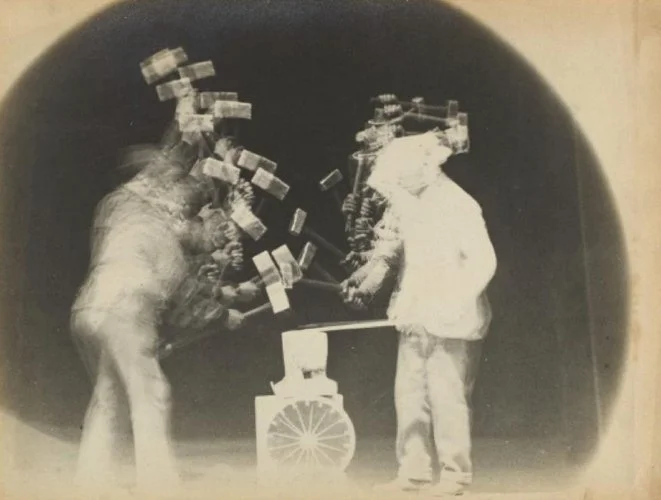
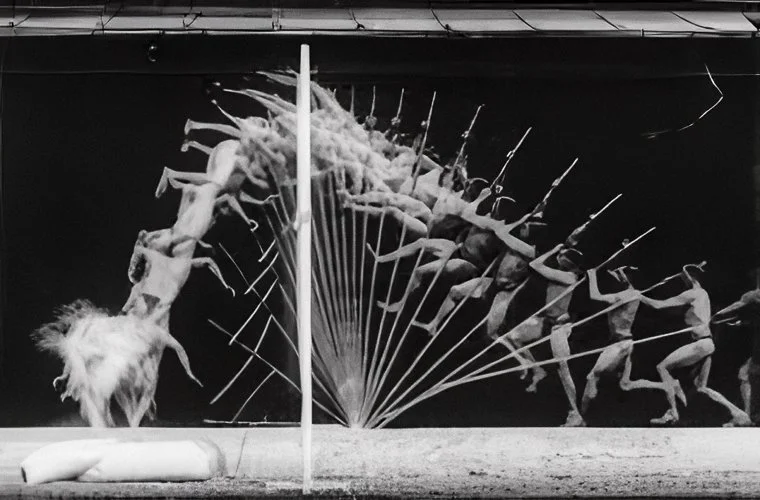
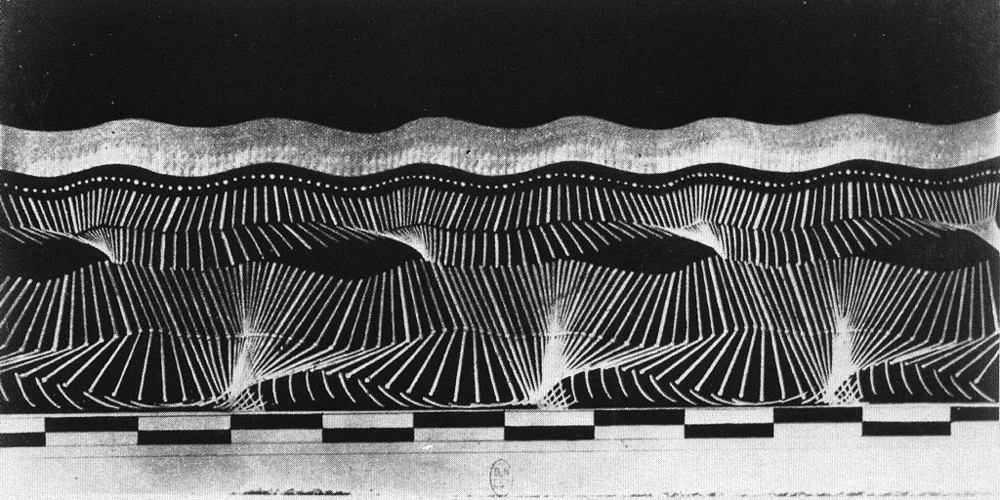
It was at the Station Physiologique that Marey developed the technique most directly relevant to the history of light-trail photography. Working from late 1882 with his assistant and collaborator Georges Demeny (1850–1917), Marey perfected what he called geometric chronophotography.
A subject dressed entirely in black would move in front of a black velvet background, rendering the body almost invisible. White lines and points placed along the limbs and at the joints produced, on a single fixed photographic plate, a series of overlapping skeletal trajectories — a ghost geometry of movement extracted from the moving body. The image was not a sequence of pictures but a single superimposition: all phases of the movement inscribed simultaneously on one frame, each position of the body merging into the next.
In 1889, Demeny developed this technique into something that has a strong claim to be the first deliberate light-trail photograph. Using incandescent electric bulbs attached to the joints of a dark-suited assistant, he created the image known as Pathological Walk From in Front — a work in which the movement of the human body through space was traced as a constellation of luminous arcs and points against a field of absolute black. The assistant is invisible; only the light sources remain, describing the joints' trajectories through time and space with a precision that no other method of the period could have achieved.
The intention was purely diagnostic — Marey was analysing pathological gait for medical purposes — but the resulting image anticipated, by several decades, a mode of aesthetic expression that photographers would later claim as their own.
Marey's broader chronophotographic output included extensive studies of birds in flight, horses, athletes, and even fluid dynamics. His images of birds are particularly remarkable: the superimposed wing positions on a single plate produce something that looks less like a scientific diagram and more like a Cubist painting, all simultaneity and fractured geometry.
He was also among the first to work with flexible film rather than glass plates, presenting his first chronophotographic film in a paper to the Académie des sciences in October 1888. His work on fluid motion — water around obstacles, smoke rising from a heated plate — remains aesthetically extraordinary. None of it was made with aesthetic intention, and that indifference to the artistic is perhaps part of what makes the images so arresting.
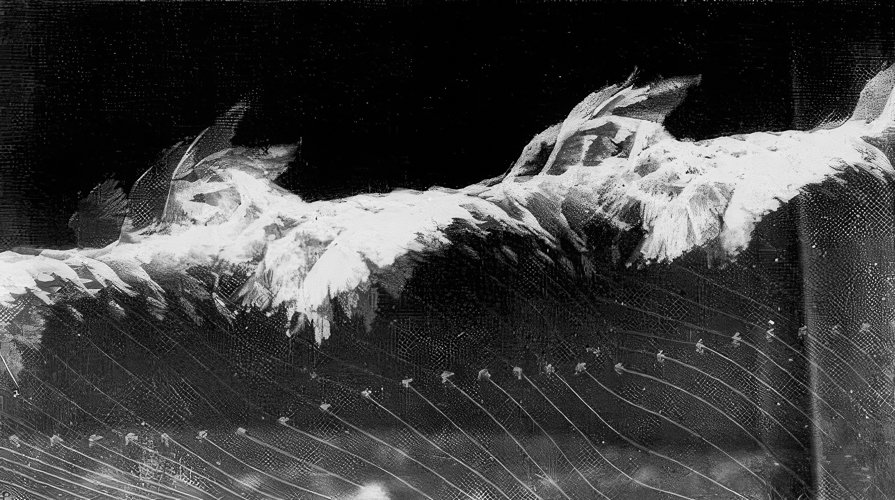
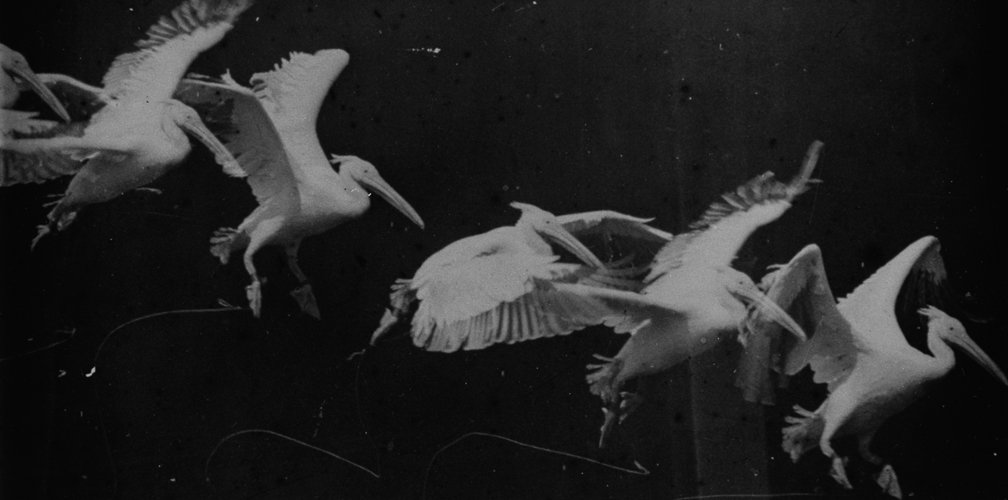
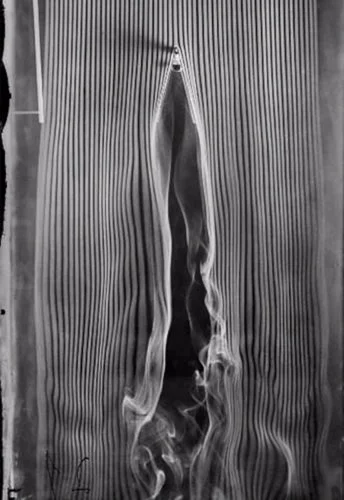
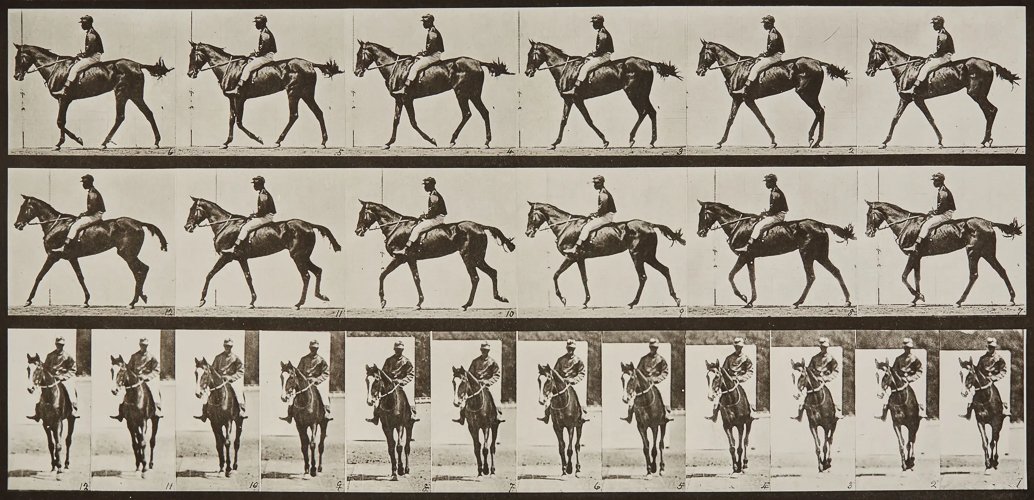
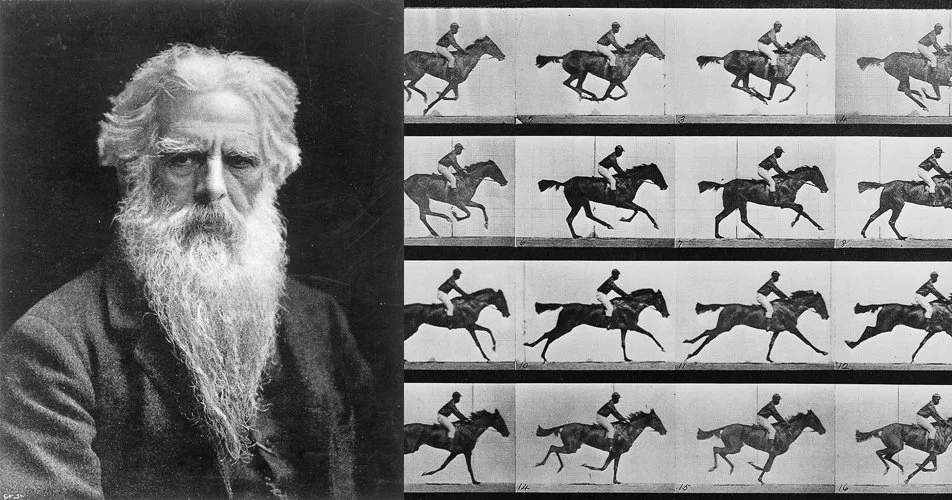
Eadweard Muybridge (1830–1904) was approaching the same problems by a different route. British-born but long resident in California, Muybridge was commissioned by Leland Stanford — the railway magnate and racehorse breeder — to resolve the question of whether a galloping horse ever has all four hooves simultaneously off the ground.
The initial experiments began in 1872, but it was in June 1878, at Stanford's Palo Alto Stock Farm, that Muybridge produced the definitive answer. Using twelve cameras arranged along a racetrack, each with a shutter tripped by a wire stretched across the path of the horse, he captured twelve sequential images of Stanford's trotter Abe Edgington at a speed of approximately 1/1,000th of a second per exposure. The photographs confirmed unsupported transit: there are moments in a horse's stride when all four feet leave the ground simultaneously, though the position — with legs gathered beneath the body — was quite different from the traditional 'flying gallop' of equestrian art.
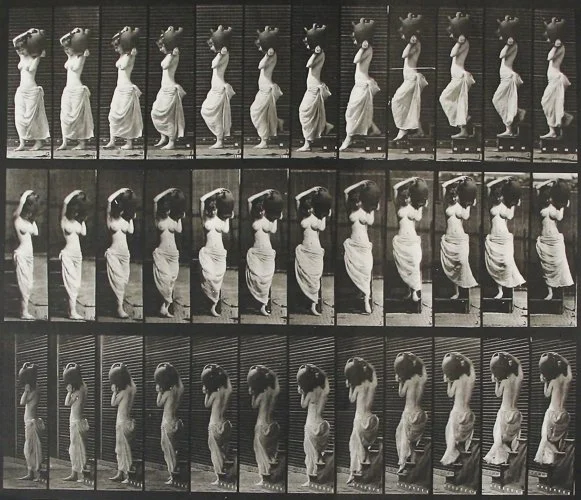
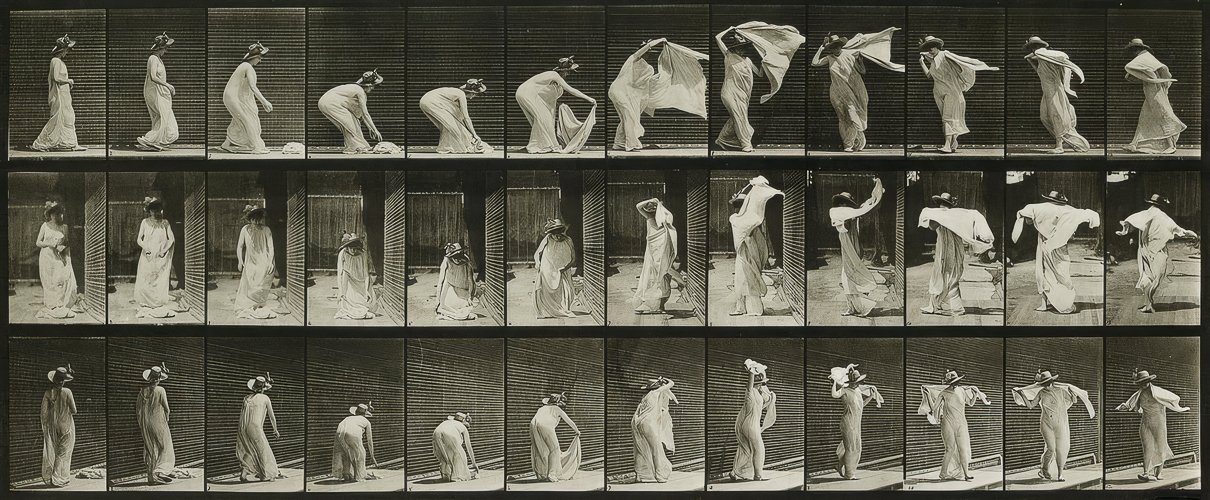
Muybridge's subsequent Animal Locomotion series (1887) extended this systematic approach to hundreds of subjects and thousands of plates, producing a monumental record of human and animal movement that became an indispensable reference for artists and anatomists alike.
His approach differed fundamentally from Marey's: where Marey used a single camera and multiple exposures on a single plate, producing a composite image of simultaneous movement, Muybridge used multiple cameras and sequential images, producing a series of discrete stills arranged for comparison. Both methods were ancestral to the light-trail technique — Marey directly, through the accumulation of traces on a single frame; Muybridge indirectly, through the systematic study of motion as a subject for the camera — but Marey's geometric superimpositions are the more obvious precursor.
Muybridge was also responsible, through his zoopraxiscope (1879–1880), for demonstrating that sequential photographs could be projected in rapid succession to recreate the appearance of movement — an invention that anticipated the cinema by more than a decade, though the technical problems of projection would not be fully resolved until the Lumières' work of 1895.
The influence of chronophotography on the visual arts was rapid and significant. In Italy, the Futurist movement, which emerged formally in 1909 with Marinetti's founding manifesto, was deeply engaged with motion, speed, and the representation of time in art.
The painters Giacomo Balla and Luigi Russolo absorbed the lessons of Marey and Muybridge directly: Balla's Dynamism of a Dog on a Leash (1912) is an explicit translation of chronophotographic technique into paint, depicting a dachshund's legs as a blur of overlapping positions in a manner that could have been lifted from one of Marey's plates. A more technically rigorous engagement came from Anton Giulio Bragaglia (1890–1960), a Roman theatre director and photographer who, working with his brother Arturo, developed what he termed Fotodinamismo Futurista — Futurist Photodynamism.
The essay of that title was written in 1911, and between 1911 and 1913 the Bragaglias produced long-exposure photographs of figures in motion in which the blurred intermediate positions of the body between two fixed points created what Bragaglia described as an attempt to capture the 'spiritual essence' of movement. These images were expelled from official Futurism in 1913, largely through the influence of Umberto Boccioni, but they represent a conscious and theoretically articulate engagement with long exposure as an aesthetic instrument, distinct from Marey's purely scientific purposes.
Street, City & Night
The emergence of urban electric lighting at the end of the nineteenth century transformed the possibilities of night photography. Gas lighting, with its low intensity and warm colour, had made extended nocturnal exposures difficult and tonally monotonous; electric arc lights and, from the 1880s onwards, incandescent bulbs produced sources intense enough to register within practical exposure times and sufficiently varied in character — the different quality of a shop window, a street lamp, a vehicle light — to make the night city a subject of genuine compositional interest.
Night photography became, during the first decades of the twentieth century, a recognised mode of artistic practice, with its own techniques, its own aesthetic conventions, and its own thematic preoccupations: solitude, mystery, the city as organism, the human figure in darkness.
Brassaï (1899–1984), born Gyula Halász on 9 September 1899 in Brassó — now Brașov, in what was then part of Hungary and is now Romania — adopted his working name from the town of his birth, a common practice among Hungarian intellectuals of his generation. He studied painting in Budapest and Berlin before moving to Paris in 1924, initially working as a journalist.
Paris in the mid-1920s was the undisputed capital of the European avant-garde, and Halász arrived to find himself at the centre of an extraordinary concentration of artistic and intellectual life. He observed it at first as an outsider and a writer, accompanying photographer friends on assignments and beginning, in 1929, to borrow a camera to photograph the city himself.
What Brassaï saw in Paris, and what he set out to record, was not the Paris of guidebooks and postcards but the city at night — the Paris that appeared after the tourists and the respectable went home, the Paris of rain-slicked cobblestones and reflected lamplight, of figures in doorways, of cafés and brothels and the embankments of the Seine in fog.
Over the following three years, he roamed the streets systematically, mastering the technical demands of low-light photography: the long exposures required, the management of halation around bright sources, the judgement of how long an empty street needed before its atmosphere was fully accumulated on a plate. The resulting book, Paris de Nuit, published in 1932 with sixty photographs and a short text, was an immediate critical success. It defined a mode of urban night photography that has remained the dominant aesthetic ever since: the city as a place of simultaneous beauty and unease, its surfaces made luminous by reflected light, its inhabitants glimpsed rather than shown.
Brassaï's use of long exposure was not systematic in the manner of Marey — he was not attempting to record motion. But the extended shutter speeds required for low-light conditions produced, in his images of traffic on wet streets or figures passing lamps, exactly the kind of blurred traces that Demeny had produced deliberately in his photophysiological experiments.
The difference is of intention rather than technique. In Brassaï's images, the light trails of vehicles are incidental — part of the texture of the nocturnal scene rather than the subject — but they are present, and they contribute to the distinctive quality of temporal compression that characterises the best night photography.
He became central to the literary and artistic life of Paris between the wars. His friendship with Pablo Picasso, which began in 1932 when the art critic Tériade invited him to photograph Picasso's studio and sculptures for the first issue of Minotaure, became one of the most documented and mutually respectful relationships in twentieth-century art.
Picasso, notoriously suspicious of photographers, found in Brassaï an observer whose intelligence matched his own; the friendship lasted until Picasso's death in 1973 and was later recorded in Brassaï's book Conversations with Picasso (1964). Henry Miller, who dubbed Brassaï 'the eye of Paris', was another close companion; the two men shared a fascination with the city's lower registers, its bars and alleys and night figures, and Miller wrote about Brassaï's work with the enthusiasm of someone recognising a kindred method.
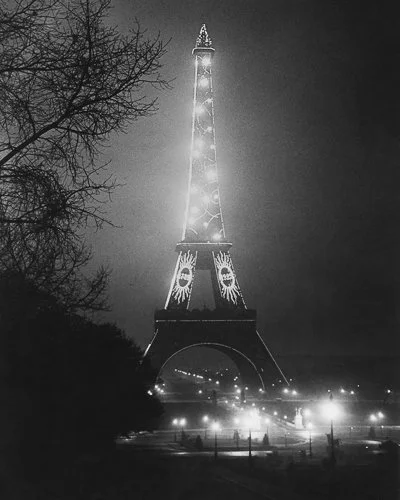
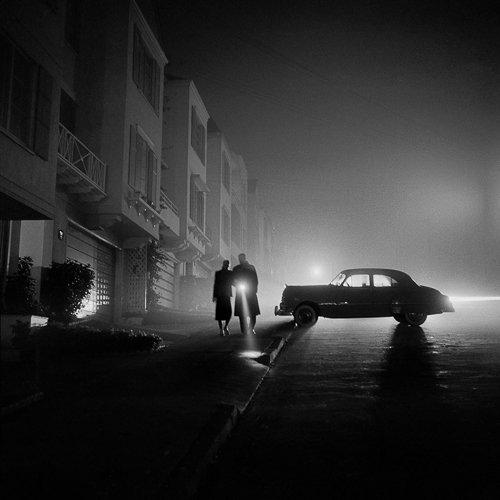
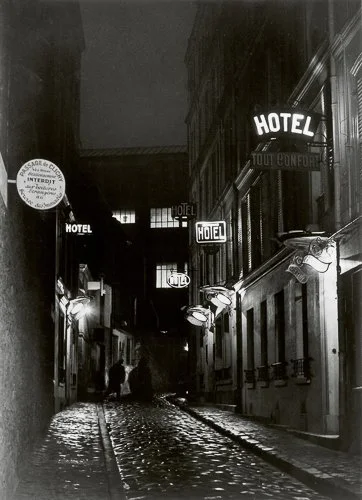
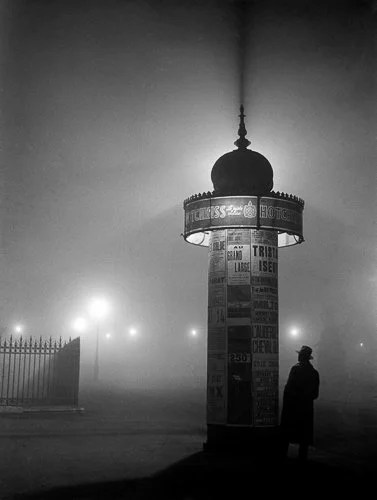
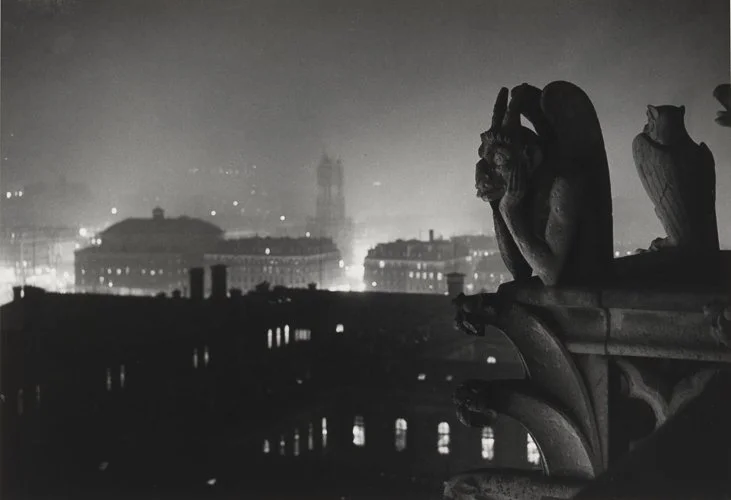
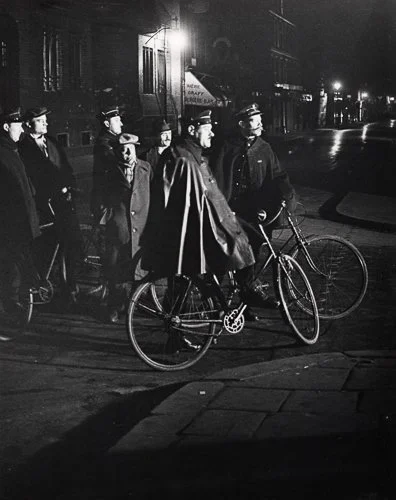
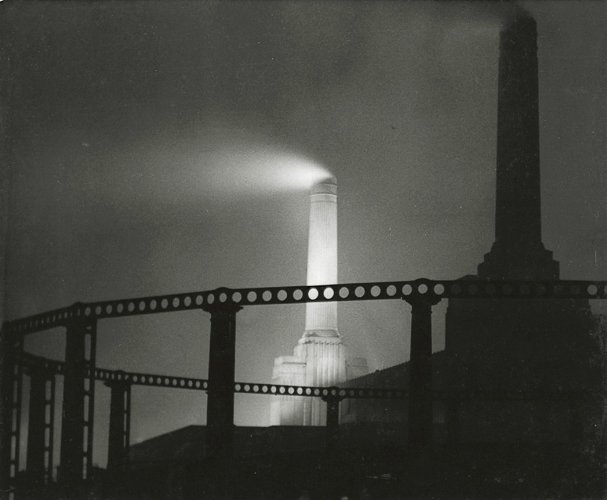
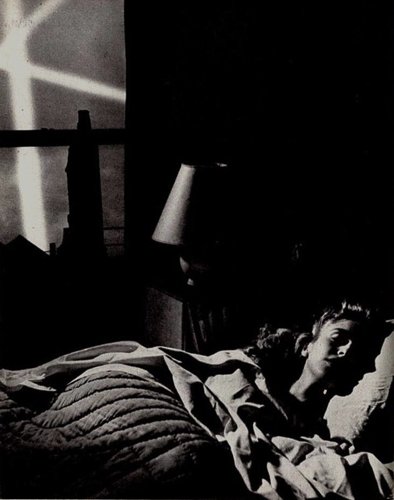
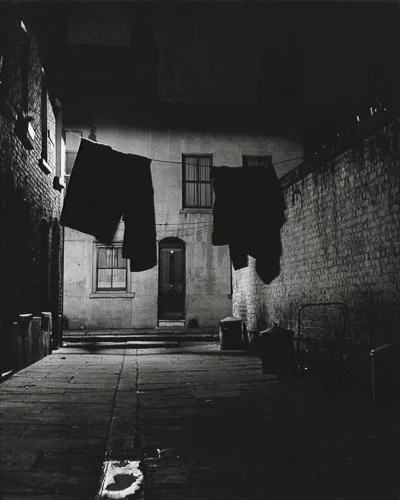
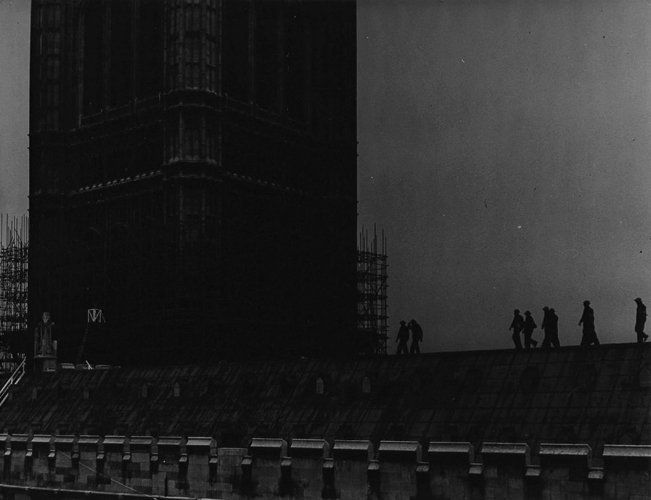
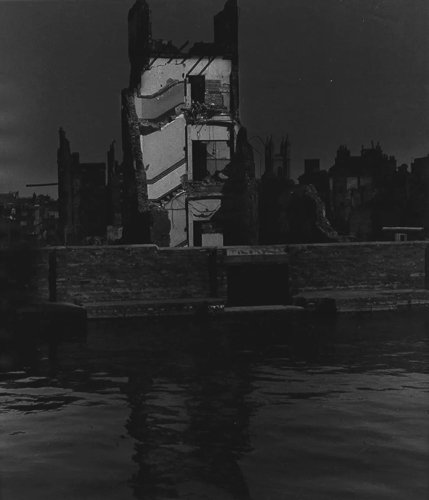
Brassaï's influence on subsequent generations of night photographers is difficult to overstate. Michael Kenna has described Paris de Nuit as the book that established the model for nocturnal urban photography. Bill Brandt's A Night in London (1938) was explicitly conceived in response to it. The long-exposure nocturne as a genre — the rain-slicked street, the single figure under a lamp, the city made strange by darkness and reflected light — is substantially Brassaï's invention.
Bill Brandt (1904–1983) was born in Hamburg to a British father; he grew up in England and trained as a photographer in Paris in the late 1920s in the studio of Man Ray, an experience that left a permanent mark on his approach to formal composition and the manipulation of tonal contrast.
His pre-war career produced two books that established his reputation: The English at Home (1936), a documentary study of British class distinctions that used formal staging and deep social observation in roughly equal measure, and A Night in London (1938), which was directly inspired by Brassaï's Paris de Nuit and applied the same nocturnal flaneur's method to London.
A Night in London is formally constructed around the arc of a single night, moving from dusk to dawn through the city's different social and geographical strata. Brandt used long exposures to render the streets with the quality of slightly vertiginous stillness that characterises the best of his night work: figures frozen mid-motion against blurred backgrounds, architecture held sharp while the world around it shifts. The images have a film noir quality — not as pastiche but as genuine precursor, since A Night in London appeared before Hollywood had fully developed the visual conventions of that mode.
Brandt's wartime work extended his engagement with night photography in ways he could not have anticipated. Commissioned by the Ministry of Information in 1940 to document the London Underground shelters during the Blitz, he produced photographs of a peculiar and affecting power: hundreds of civilians sleeping on platform floors and in alcoves, lit by the reduced illumination of the wartime Underground, the long exposures required turning the sleeping figures into something between documentary record and allegorical image.
A second series made during the Blackout — the city at night with all illumination extinguished, lit only by moonlight — produced images of an almost abstract severity, the familiar urban landscape rendered as a geometry of pale surfaces and absolute black shadows. What had been a documentary aesthetic became, under the pressure of wartime circumstances, something more psychologically complex: a record of endurance in which the long exposure was not merely a technical necessity but a form of witness.
Colour, Motion & the Poetic Long Exposure
The introduction of Kodachrome transparency film in 1935, and its gradual adoption by editorial and amateur photographers throughout the late 1930s and 1940s, transformed the possibilities available to anyone working with long exposure and urban night. Black-and-white night photography had its own coherent aesthetic, in which the tonal range between a lit window and the surrounding darkness became a formal element in its own right.
Colour introduced an entirely different set of possibilities: the deep amber of sodium street lighting, the varied blues and reds and yellows of neon, the warm incandescence of a car's headlamps against the cool blue-white of its tail lights. The night city in colour was not the same subject as the night city in monochrome; it was louder, more emotionally complex, and more obviously beautiful in ways that demanded a different kind of restraint from the photographer.
Ernst Haas (1921–1986) was the photographer who most decisively exploited these new possibilities. Born in Vienna in 1921, Haas took up photography after the Second World War and was initially known for black-and-white documentary work — most notably his 1947 series on Austrian prisoners of war returning home, which was published in Life magazine and brought him international attention. At Robert Capa's invitation, he joined Magnum Photos in 1949, becoming one of the few European photographers in an agency then dominated by its founding generation. He moved to New York in 1951, and the city became both his subject and his laboratory.
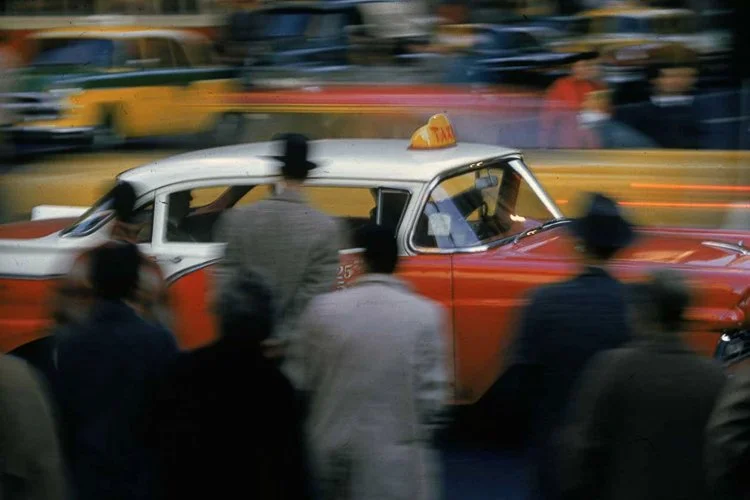
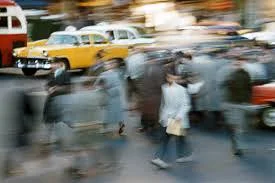
The Life magazine essay of 1953 was a pivotal event in the history of colour photography. The essay, covering twenty-four pages of the magazine — the largest colour feature Life had published to that point — presented Haas's New York in terms of motion, colour, and temporal blur that had no real precedent in editorial photography.
Working with slow shutter speeds and deliberate camera movement, Haas produced images in which the city's taxis, pedestrians, neon signs, and shop windows merged into painterly fields of colour and light. The vocabulary was Impressionist, but the method was purely photographic: the camera doing what the camera could do and nothing else, recording the world as accumulated light across time rather than as a frozen instant.
Life's editors were initially uncertain; the images were not photographs in any recognisable editorial sense. But the response from readers was strong enough that the essay is now regarded as one of the defining documents in the transition of colour photography from commercial novelty to serious artistic medium.
Haas continued this investigation for the rest of his career. His book The Creation (1971), in which he used colour photography to illustrate a meditation on the natural world, demonstrated that the painterly approach he had developed in Manhattan could be applied equally to landscape, wildlife, and abstraction. His Magnum association gave him access to major editorial commissions throughout the 1950s and 1960s, but his most significant contribution was aesthetic rather than documentary: the demonstration that slow shutter speeds and deliberate blur were not failures of technical control but legitimate artistic choices, capable of producing images with an emotional range unavailable to the instantaneous photograph.
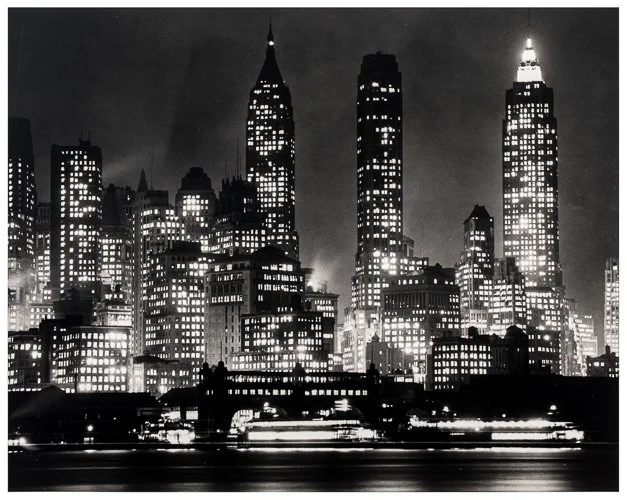
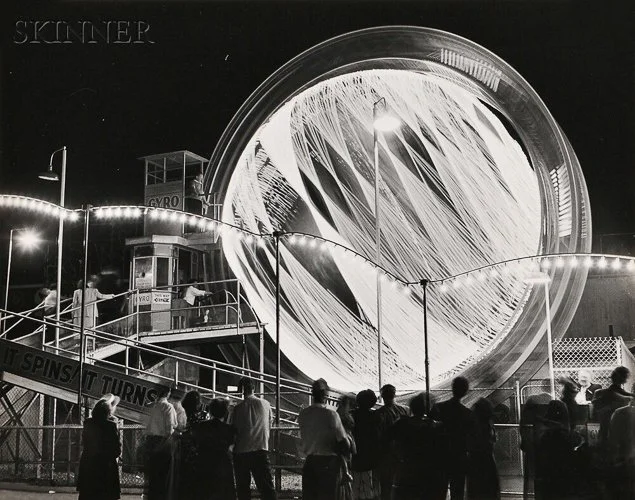
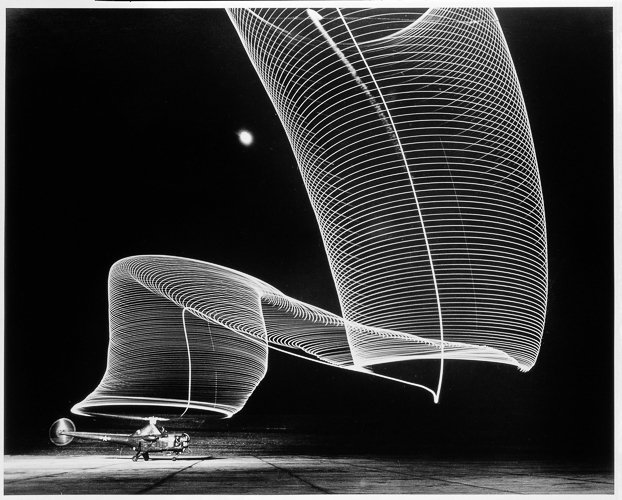
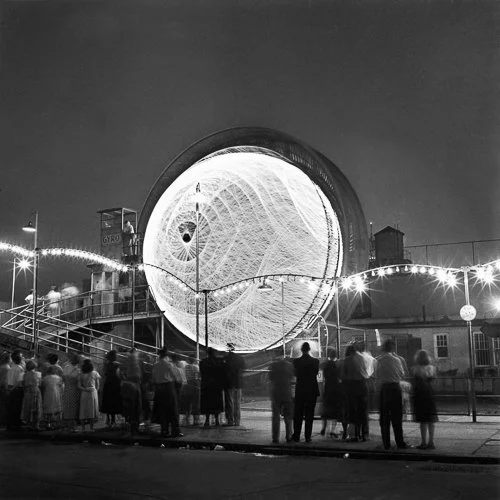
Andreas Feininger (1906–1999) brought a rather different temperament to the same terrain. Son of the Bauhaus painter Lyonel Feininger, he was trained in architecture at the Weimar Bauhaus before turning to photography in the early 1930s. He emigrated to the United States in 1939 and joined the staff of Life magazine in 1943, where he remained for twenty years.
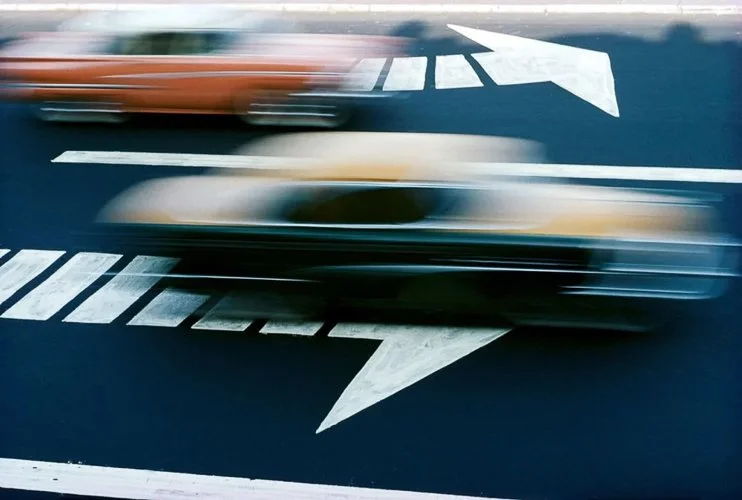
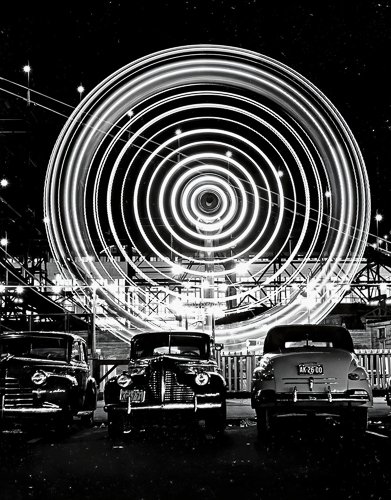
His work for Life included some of the most technically accomplished images of mid-century American urban life: his 1951 photograph The Photojournalist, showing a figure almost hidden behind an enormous telephoto lens, became one of the iconic images of the magazine era. His New York street and traffic studies, made from elevated positions overlooking the city's major arteries, used long exposures to transform moving vehicles into rivers of light streaking through architectural canyons.
The compositions are precise and legible — Feininger understood the geometry of his frame — and the light trails function as compositional elements, guiding the eye and conveying the relentless kinetic energy of the city.
Feininger was also, unusually, a prolific writer on photographic technique. His books — The Complete Photographer, in various editions from the early 1960s onwards, along with numerous more specialist volumes on optics, darkroom technique, and photographic seeing — were standard references for a generation of amateur and professional photographers.
His statement that 'the camera can see more, and often ten times better, than the human eye' was a position he substantiated in his own work: the long-exposure traffic photographs were, in part, demonstrations of the principle. Feininger's technical writing codified the long-exposure technique for a mass audience in a way that Marey's scientific publications never could, giving precise guidance on the exposure times, apertures, and vantage points required to produce well-structured light-trail images.
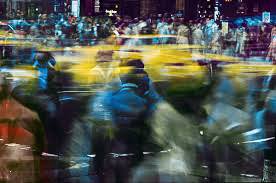
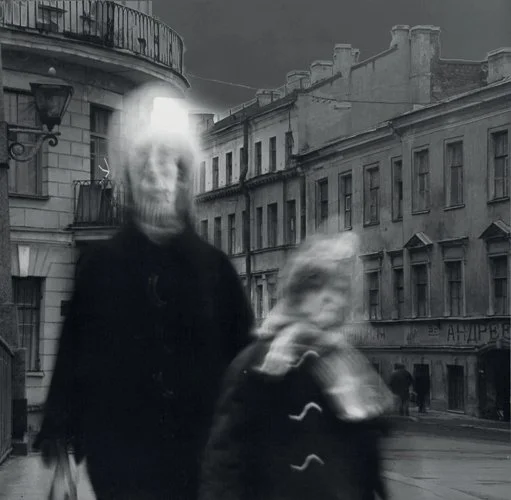
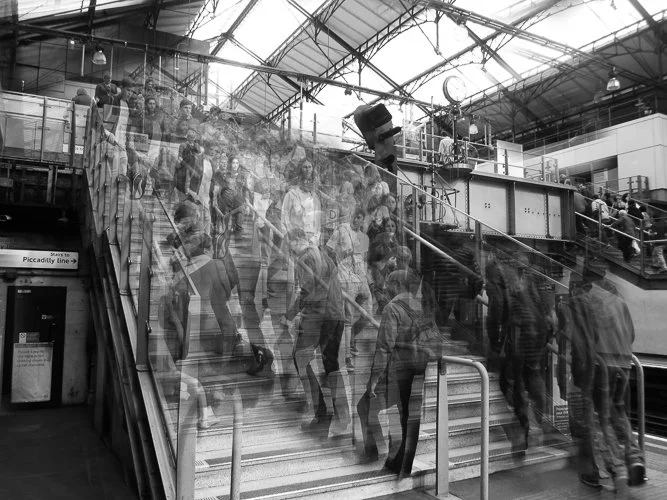
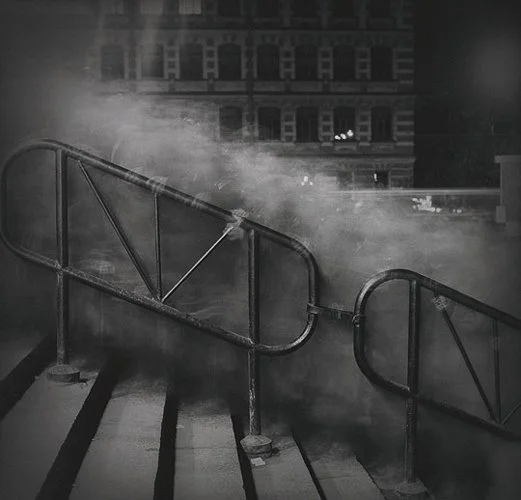
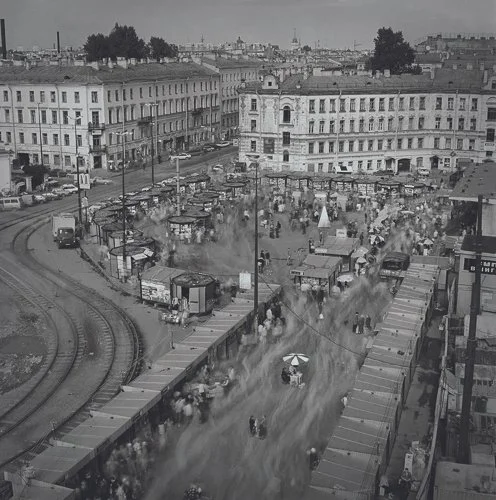
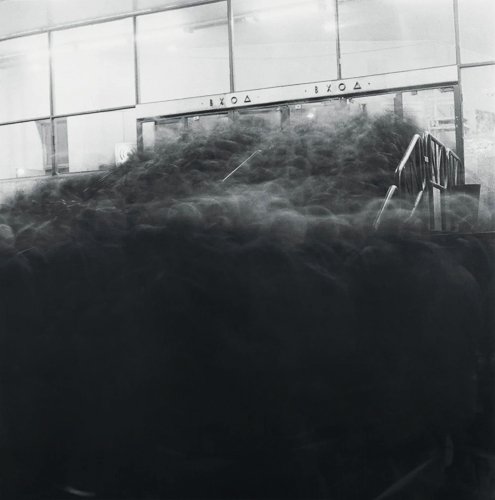
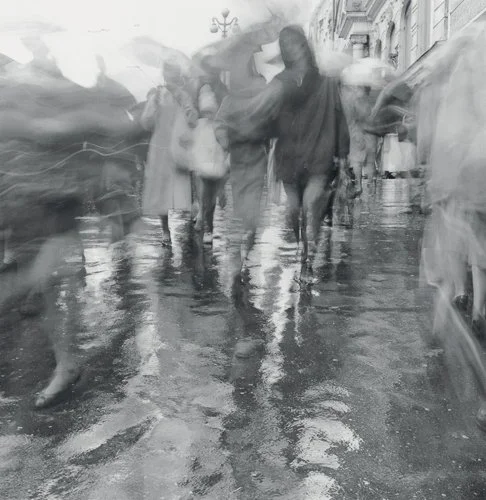
Alexey Titarenko (born 1952) represents the most politically resonant application of long-exposure technique in photographic history. Born and trained in Leningrad — now once again St Petersburg — Titarenko worked within the constraints of Soviet photography throughout the 1970s and 1980s, before the collapse of the USSR created both the conditions and the material for the work on which his international reputation rests.
His City of Shadows series, made between 1991 and 1994 in the streets of a city being rapidly unmade by political and economic transformation, uses exposures of between one second and several minutes to turn the crowds of Soviet citizens moving through public spaces into ghostly, smeared forms — figures without individual identity, masses without faces, the human reduced to motion and duration.
The technique is simple and its results devastating. Titarenko set up his camera on a tripod, typically on a metro platform or in a crowded public square, and made exposures long enough to register the movement of the crowd as a continuous stream rather than a collection of individuals. Static elements — the architecture, a lamppost, an occasional figure who happened to remain still — remained sharp, providing a framework against which the blurred masses moved like smoke or water.
The contrast between the architectural solidity of the city and the spectral quality of its inhabitants produces images that function simultaneously as documentary evidence and as political allegory. 'The Soviet people, human beings deprived of their individuality by a criminal regime', Titarenko wrote, 'began transforming from smiling and happy-looking "signs" into wandering shadows.' The aesthetic is not merely illustrative of that condition — it enacts it, making the dissolution of individuality into mass visible at the level of photographic technique.
Titarenko subsequently extended the City of Shadows approach to New York and Havana, where similar techniques produced images of a quite different character: the crowds of a capitalist metropolis rendered as differently spectral, differently purposeful, differently dehumanised. The series as a whole constitutes the most sustained argument in the history of photography that the long-exposure technique is not merely a way of making interesting images of moving lights, but a method capable of bearing significant moral and political weight.
The Long Exposure as Fine Art
From the 1970s onwards, long-exposure photography began to find its way into gallery contexts — not as documentary evidence or editorial illustration, but as fine art objects intended for sustained contemplative attention.
This transition was part of a broader movement in which photography established itself as a medium equally capable of the sustained aesthetic ambition previously reserved for painting and sculpture. For long-exposure work specifically, the gallery context created new demands: images needed to repay extended looking, to sustain meaning beyond the initial visual impact of the technical effect, and to find a relationship to the traditions of art history that could justify their presence in the same spaces as canonical works.
Michael Kenna (born 1953) was born in Widnes, Lancashire, and attended St Joseph's College in Upholland before studying painting and photography at Banbury School of Art in Oxfordshire (1972–73) and then the London College of Printing (1973–76). It was at the London College of Printing that his approach to photography was fully formed under the influence of Bill Brandt, whom he has cited as a decisive early influence. Kenna left England for San Francisco in the late 1970s and began the long-exposure landscape work that has defined his career.
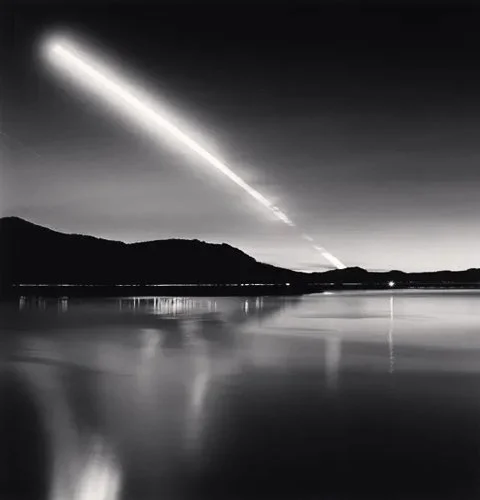
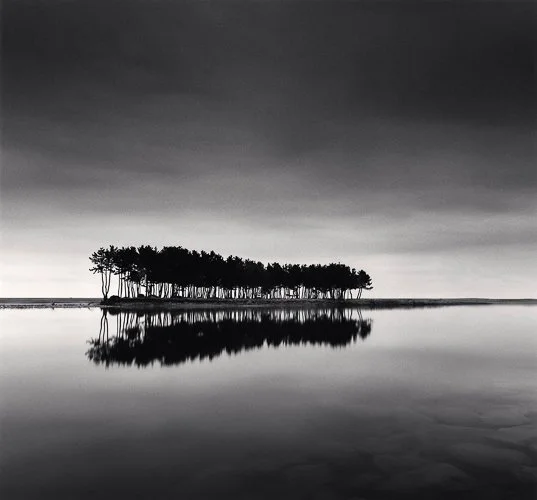
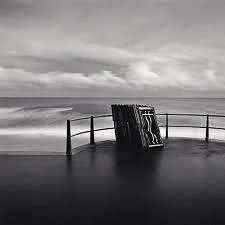
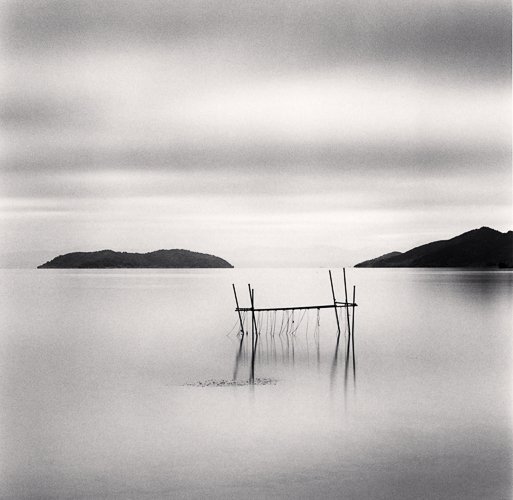
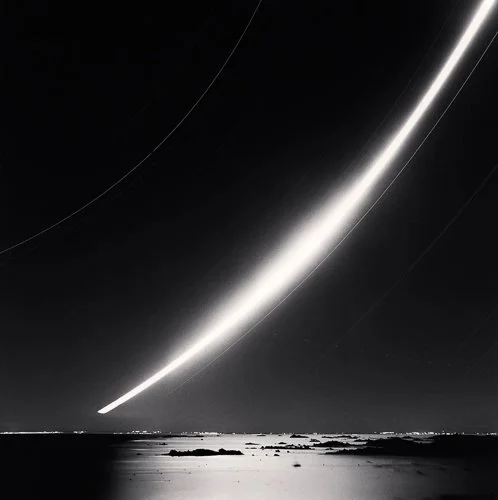
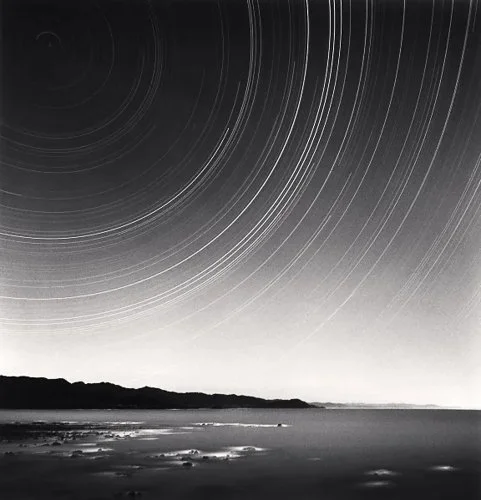
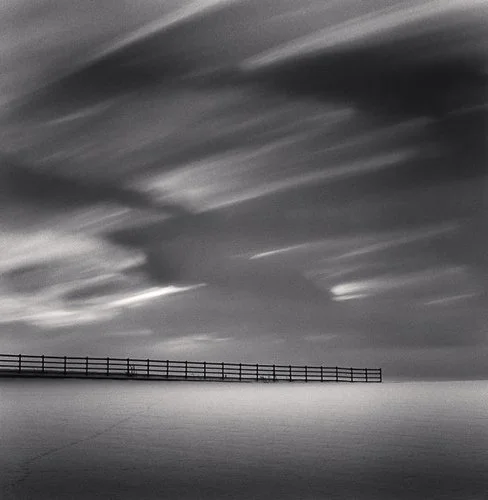
What distinguishes Kenna's approach from almost every other long-exposure practitioner is the duration of his exposures. Where most photographers working at night or in low light might work in seconds or minutes, Kenna regularly exposes for hours — sometimes for the better part of a night, sometimes for eight hours or more.
The effect of these extreme durations on the resulting image is quite unlike anything achievable with shorter exposures: clouds become smooth gradients of tone rather than textured forms; water loses all surface detail and becomes a mirror or a field of grey; stars trace arcs across the sky; the quality of the light itself changes as dawn approaches. The images reduce the world to elemental forms — water and sky, a single tree, a jetty reaching into still water, an industrial structure against a pale horizon — and the long exposure contributes to this reduction, stripping away the transient and leaving only what persists.
Kenna works exclusively in black and white, using medium-format film cameras — he has expressed a consistent and principled resistance to digital capture. The decision is not nostalgic but aesthetic: the tonal range and grain structure of medium-format film, combined with his meticulous darkroom printing technique, produce prints with a quality of surface that he finds impossible to replicate digitally.
His Night Walk series, made in various locations across Europe and America, presents a sustained investigation of urban environments at night from which all evidence of modernity has been stripped; his Japanese landscapes, particularly those made near Hokkaido and on the island of Rebun, have a stillness and formal severity that place them in an explicit relationship with Japanese aesthetic traditions of ma (negative space) and mono no aware (the pathos of transient things).
Kenna's influence on subsequent landscape photographers working with long exposure has been pervasive and, occasionally, problematic — his aesthetic has been imitated so widely that a genre of 'Michael Kenna pastiche' is now distinguishable in art photography, identifiable by its low-contrast grey tonality, its elimination of human presence, and its preference for isolated structures in minimalist environments. The existence of the pastiche does not diminish the original; it merely testifies to the degree to which Kenna's vision has colonised a particular area of photographic imagination.
Hiroshi Sugimoto (born 1948) is a Japanese artist and photographer whose relationship to long-exposure technique is perhaps the most philosophically developed in the history of the medium. Born in Tokyo, Sugimoto studied at Saint Paul's University in Tokyo before earning a degree in art and economics from Pomona College in California and settling in New York in 1974. He has described his practice as a sustained enquiry into the nature of time, perception, and the photographic record, conducted through a series of long-running projects, each employing extended exposure as its central method.
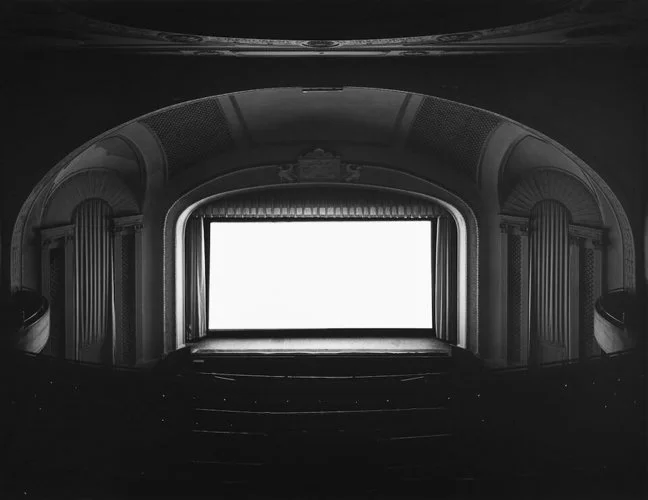
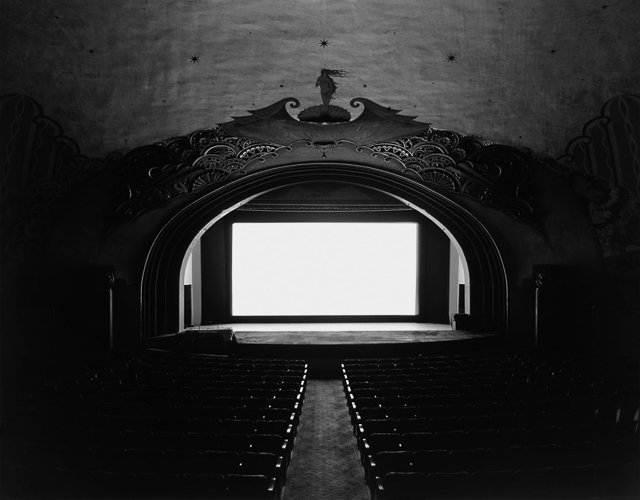
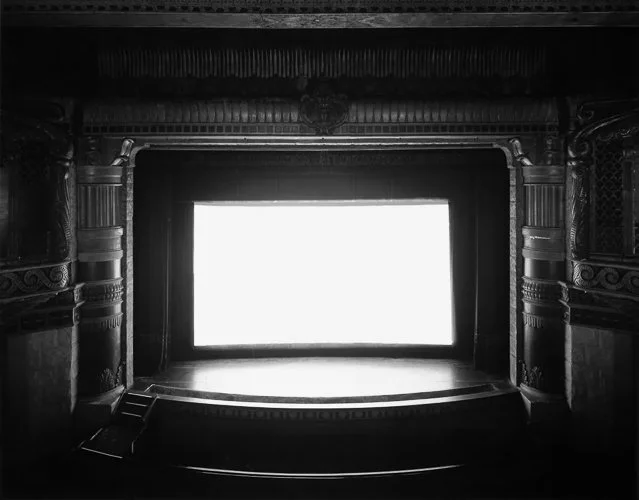
The Theaters series, which Sugimoto began in 1976 and to which he has continued to add for nearly five decades, is his most celebrated work. The concept was developed during a visit to the American Museum of Natural History, where Sugimoto had what he describes as a 'near-hallucinatory vision': if one were to photograph a cinema screen during an entire film screening — holding the shutter open from the first frame to the last — what would appear on the film?
The answer, which he confirmed by walking into a cinema in Manhattan's East Village with a large-format camera and attempting the experiment, was a glowing white rectangle. The accumulated light of the entire film, projected over two hours, produced on a single frame of large-format film a featureless white screen in which nothing of the film's content could be discerned. The surrounding cinema auditorium, its decorative plasterwork and tiered seating, appeared in perfect detail; only the screen — supposedly the locus of meaning and narrative — was blank.
The first completed images in the Theaters series were made in 1978. Sugimoto subsequently photographed cinema screens across America and beyond — from gilded 1920s movie palaces to roadside drive-ins, from functioning cinemas to abandoned ruins — and the series expanded over decades into one of the most sustained meditations on time and the cinema in the history of art.
The philosophical implication of the white screen is multiple: it suggests that everything which makes a film a film — its narrative, its performances, its duration — is precisely what the camera cannot record; that photography and cinema are, at their deepest level, incommensurable. It also suggests something about the nature of long exposure itself: the camera, accumulating light across time, does not synthesise or interpret what it gathers; it merely adds. The result is not a compressed narrative but an erasure.

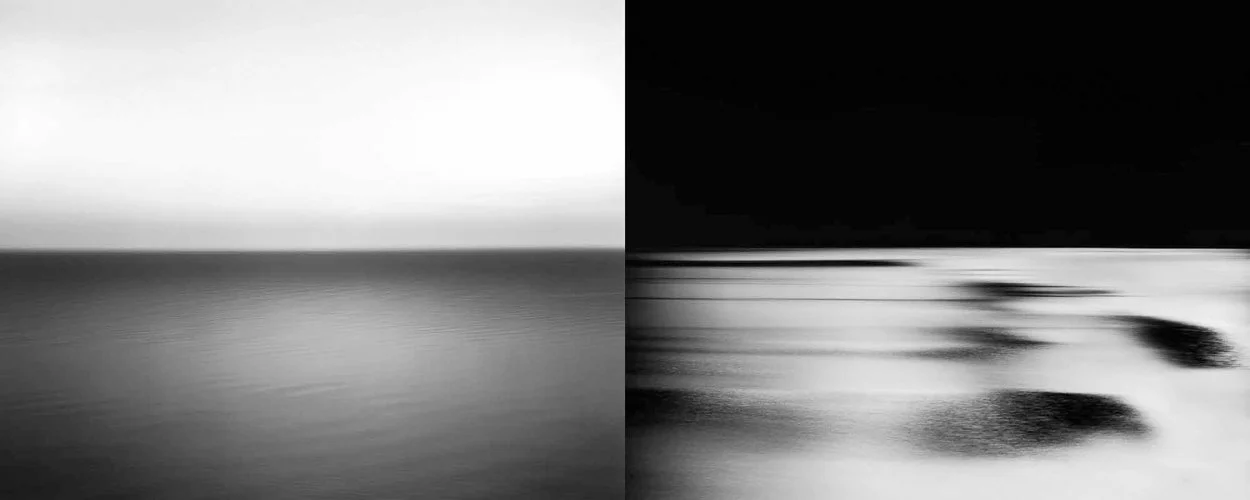
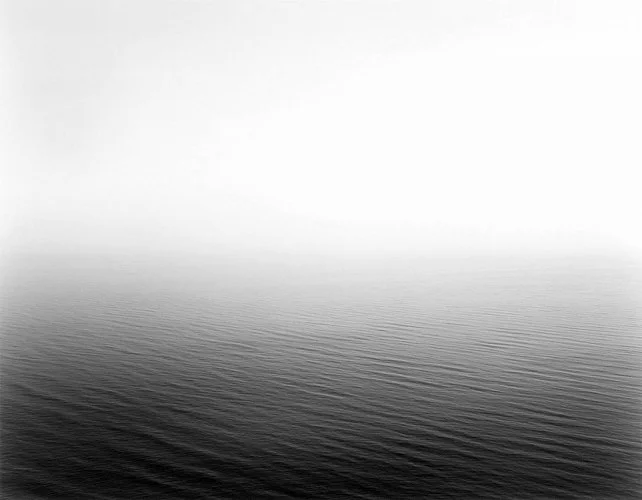
Sugimoto's Seascapes series, begun in 1980, approaches similar questions from a different angle. The concept is aggressively simple: the same composition — a horizon line bisecting the frame, an equal proportion of sea below and sky above — repeated across dozens of locations and decades.
Each image uses a long enough exposure to smooth the sea's surface and average out the movement of clouds, so that the result is not a record of any particular sea on any particular day but something closer to the idea of the sea: its essential geometry, its relationship to sky and light, stripped of all temporal specificity.
Sugimoto has described these images as attempts to see what a prehistoric human consciousness might have seen standing at the ocean's edge — a perception not yet encoded by cultural conditioning. Whether or not that claim is sustainable, the images achieve something genuinely unusual in photography: they feel timeless not through the manipulation of content but through the manipulation of time itself.
His other major series — Dioramas, in which natural history museum installations are photographed with an exposure calculated to reveal the constructed nature of the representation; Architecture, in which famous modern buildings are photographed with exposures long enough to make them dissolve into their own light — all share this characteristic engagement with duration as subject matter. Sugimoto's relationship to Zen Buddhism and to the history of science is well documented; his work inhabits the space between aesthetic object and philosophical argument with more consistency and rigour than that of almost any other photographer working with long exposure.
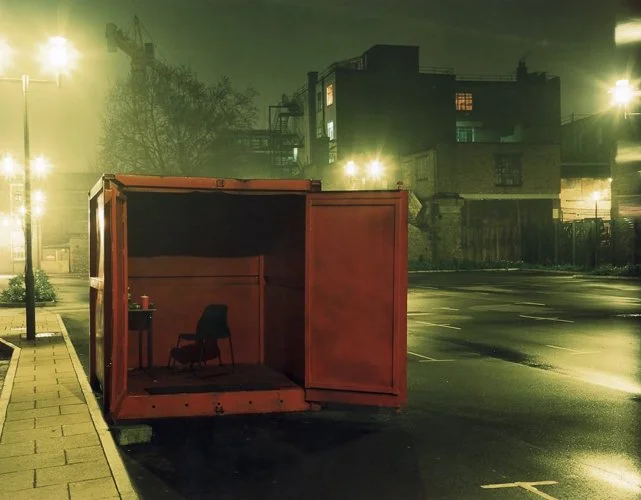
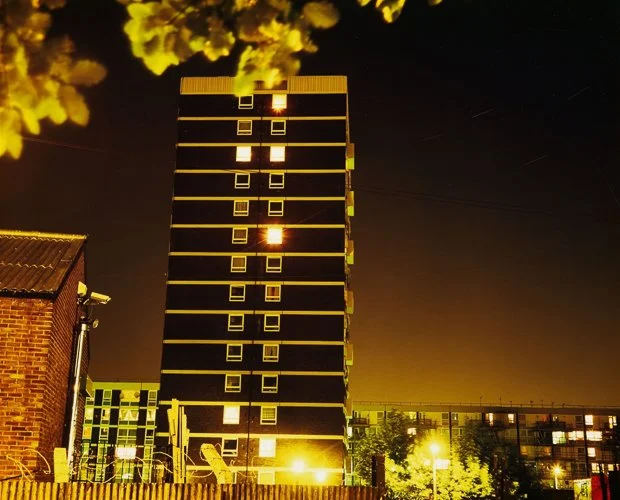
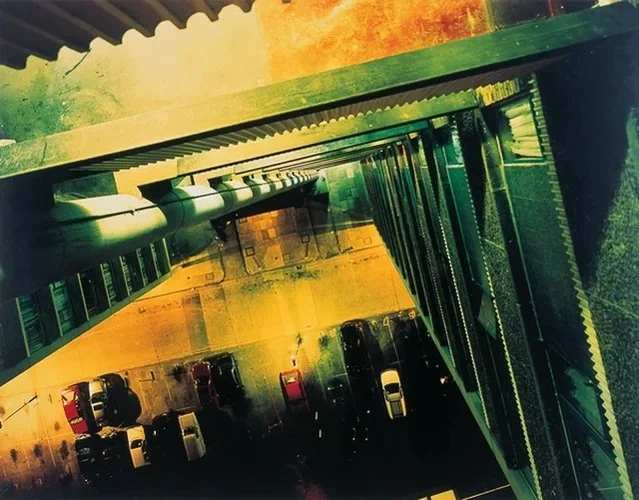
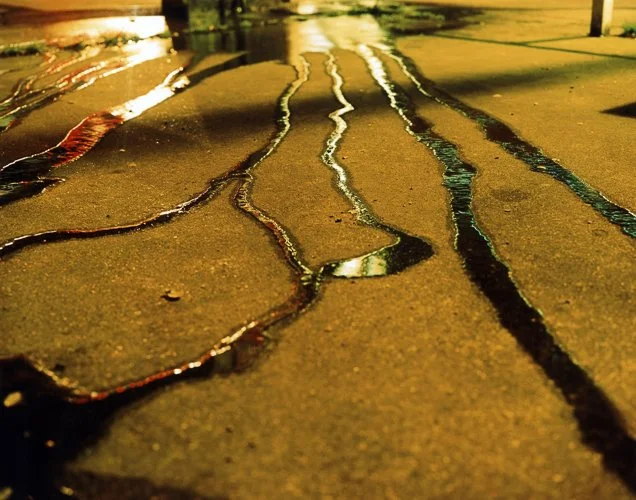
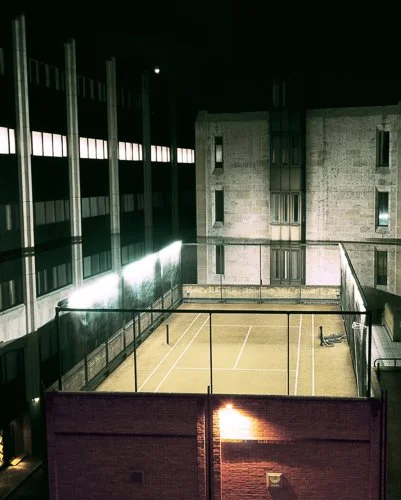
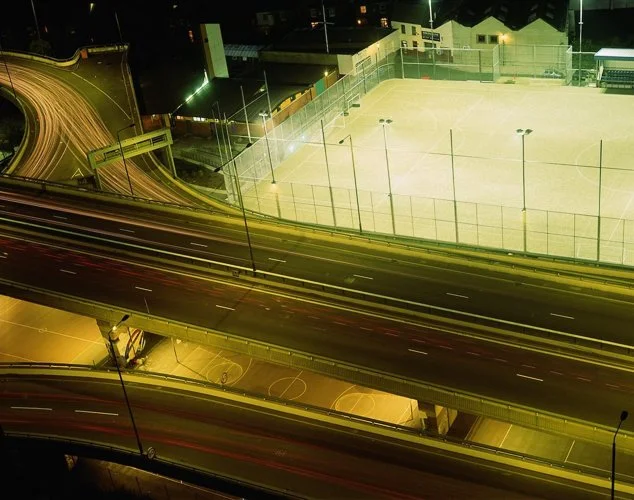
Rut Blees Luxemburg (born 1967) is a German artist based in London who has spent three decades making large-scale colour photographs of urban spaces at night. Born in Germany and settled in London since the early 1990s, she works primarily with large-format cameras and ambient light sources — the sodium street lamps, office windows, and illuminated shop fronts of the city — using exposures that transform the orange-yellow tones of sodium lighting into fields of warm gold and amber that make London's prosaic infrastructure appear both beautiful and slightly unreal.
Her series Liebeslied (1995) established the visual and conceptual terms in which her subsequent work has operated: the city at night as a space of hidden intimacy and overlooked beauty, its surfaces made strange and beautiful by long exposure.
Water features consistently in her work — the Thames, puddles, rain-soaked pavements — as a material that multiplies and complicates the light sources already present, producing compositions of considerable depth and luminosity. Her photograph Towering Inferno, depicting a London council tower block transformed by reflected light into something unexpected and even magnificent, became the cover art for The Streets' album Original Pirate Material (2002) and brought her work to an audience considerably wider than the art world.
Blees Luxemburg's theoretical writing, which accompanies her practice, engages with the concept of Heimlichkeit — a German term meaning something like 'homeliness' or 'intimacy', but also invoking Freud's Unheimliche (the uncanny) — as a way of describing what long exposure reveals in urban space: the sense that the night city, stripped of its daily rush, becomes momentarily intimate, a space that belongs to anyone who cares to look.
Her influence on a generation of British photographers working with urban night has been significant, though it operates through a visual sensibility rather than a technique: the warm tones, the interest in reflective surfaces, the refusal of drama in favour of sustained attention, are all traceable to her example.
Contemporary Practice
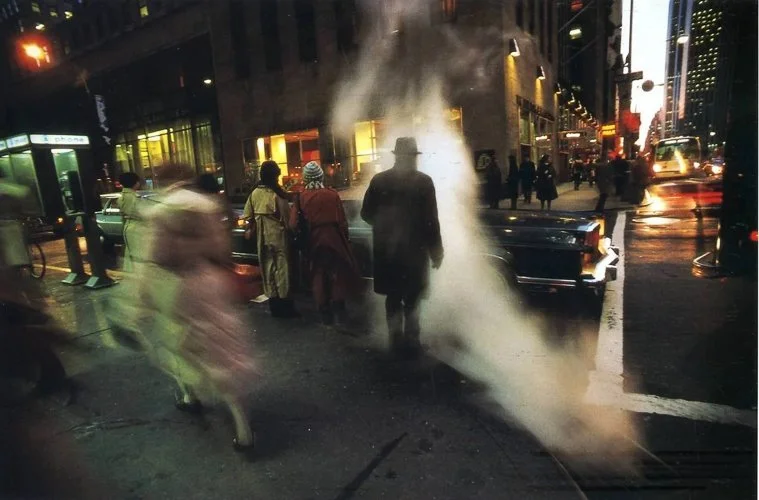
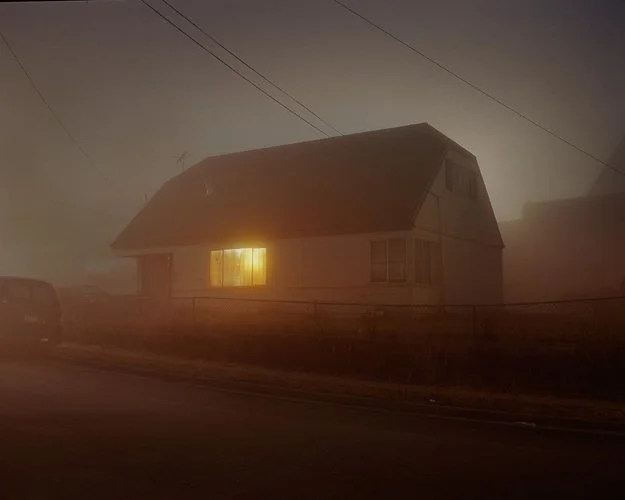
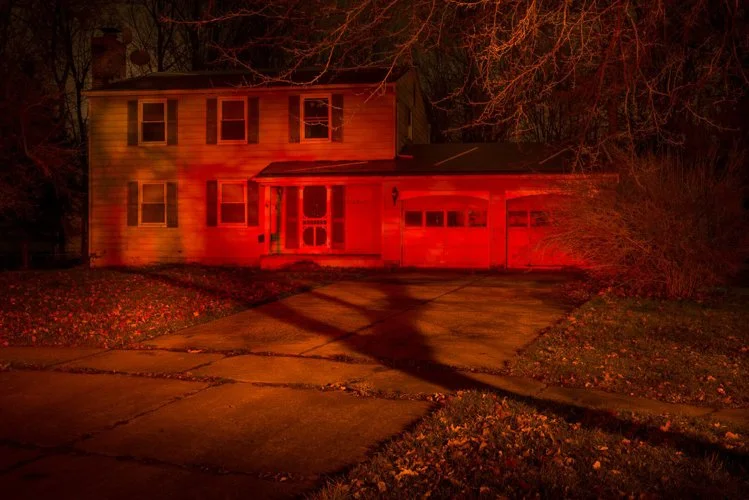
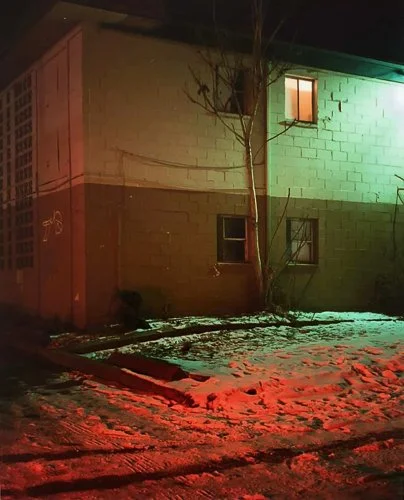
Todd Hido (born 1968) photographs the American suburb at night from the road. His House Hunting series, begun in the mid-1990s, presents isolated suburban dwellings glimpsed from a car's window: the house visible in the middle distance, its interior lit from within, a warm yellow rectangle against a background of dark trees and darker sky. Hido works entirely on film, using only the existing illumination — streetlights, interior light spilling through windows, the ambient glow of suburban darkness — and his long exposures transform the ordinary materials of American residential life into scenes of a quiet and persistent unease.
The lit interior seen from the outside in darkness is a privileged position of observation: the viewer sees what the residents cannot see about themselves, the quality of the illuminated interior as it appears to someone excluded from it. Light trails from passing vehicles appear in these images as incidental elements, brief horizontal interruptions in the deep vertical of tree and house and sky, and they contribute to the sense that the scene is not frozen but caught — that life is passing through it even as the camera waits.
The uncanny quality of Hido's work has been widely noted, and the references to Edward Hopper's nocturnal paintings and David Lynch's suburban films are accurate but slightly reductive: Hido's images are not staged in Hopper's sense, nor do they aspire to Lynch's explicit surrealism. They are genuinely documentary — real houses on real streets — and their strangeness is not superimposed but discovered. The long exposure is the instrument of that discovery: it finds in the ordinary American suburb something that the snapshot cannot see.
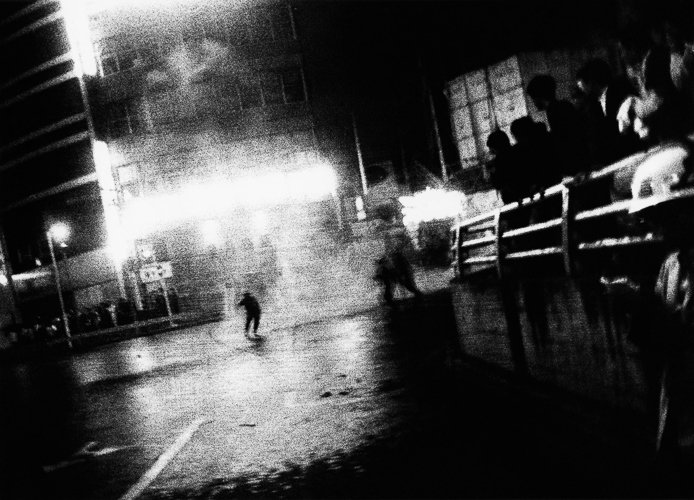
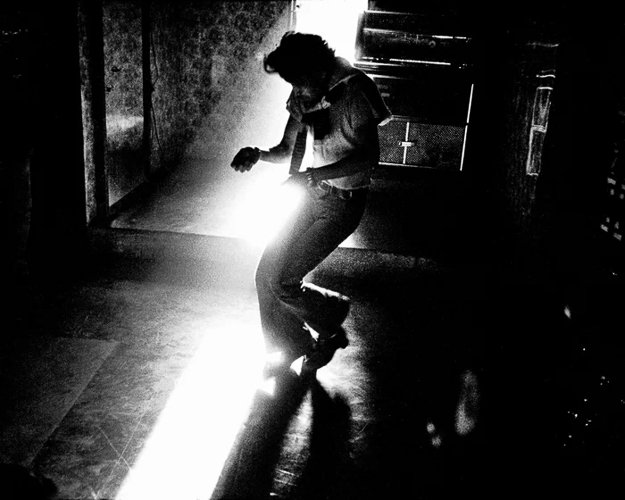
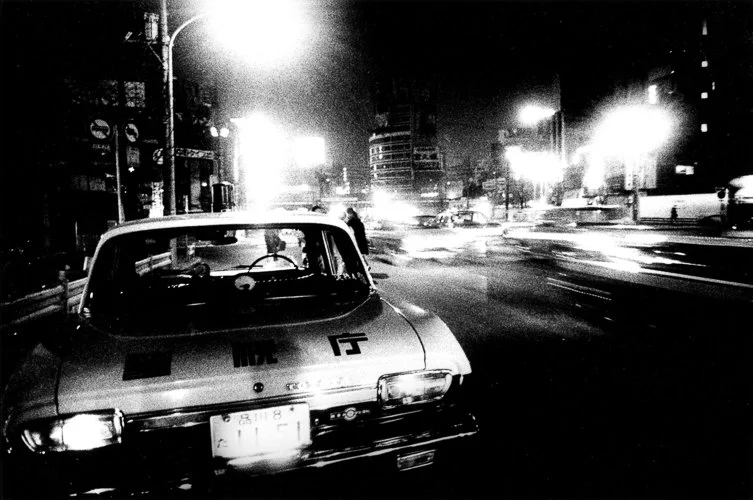
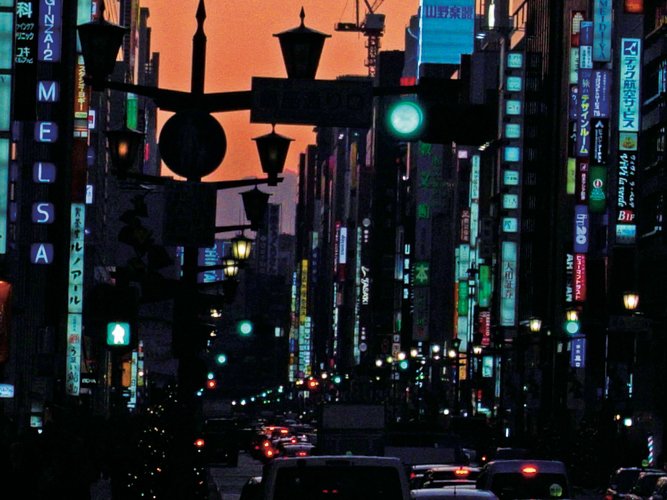
Daido Moriyama (born 1938) has spent more than six decades documenting urban life, principally in Tokyo's Shinjuku district, in a manner that regards technical imperfection as a moral position. His work belongs to the tradition of are, bure, boke — rough, blurred, out-of-focus — an aesthetic developed by and around the Provoke magazine group, of which Moriyama became a member with the second issue.
Provoke was founded in 1968 by the photographer Takuma Nakahira, the critic Koji Taki, the photographer Yutaka Takanashi, and the writer Takahiko Okada; it ran for three issues, published in November 1968, March 1969, and August 1969, each in an edition of 1,000 copies. It had a profound effect on Japanese photography, out of all proportion to its print run.
The are, bure, boke aesthetic was a deliberate rejection of the technical perfectionism that dominated both commercial and art photography of the period. Blur, grain, harsh contrast, and accidental framing were not errors to be corrected but expressive tools, appropriate to the experience of the urban environment — its speed, its noise, its refusal of contemplative attention.
Moriyama's long-exposure and motion-blur work in the neon-lit streets of Shinjuku operates within this aesthetic: the streaking lights, the blurred figures, the over-saturated colour are not accidents but choices, a way of capturing the experience of being in the city rather than the appearance of the city as a composed object. His photographs are, in this sense, phenomenological rather than documentary.
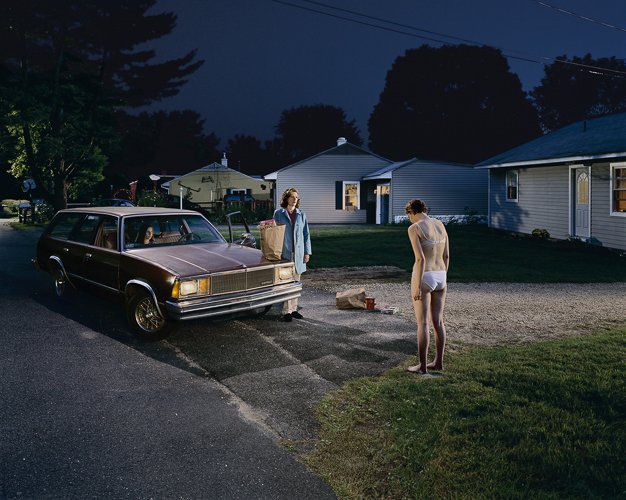
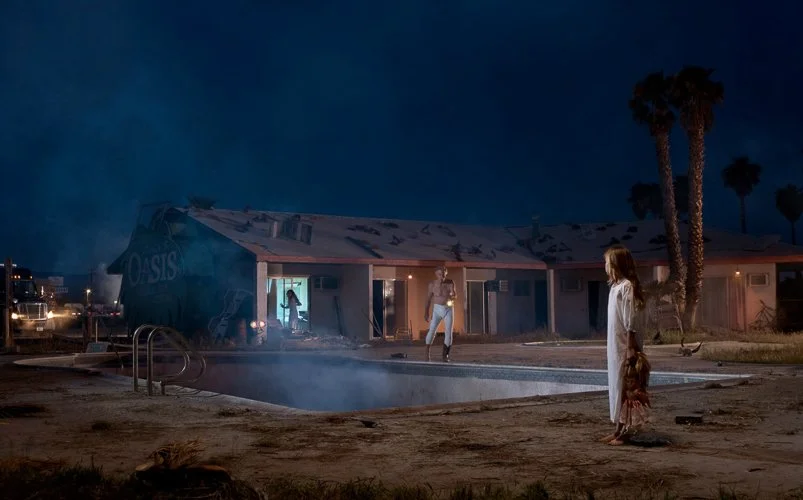
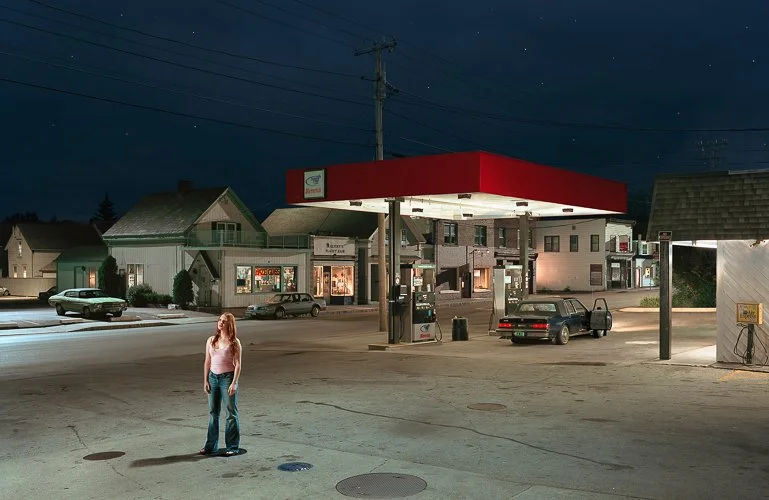
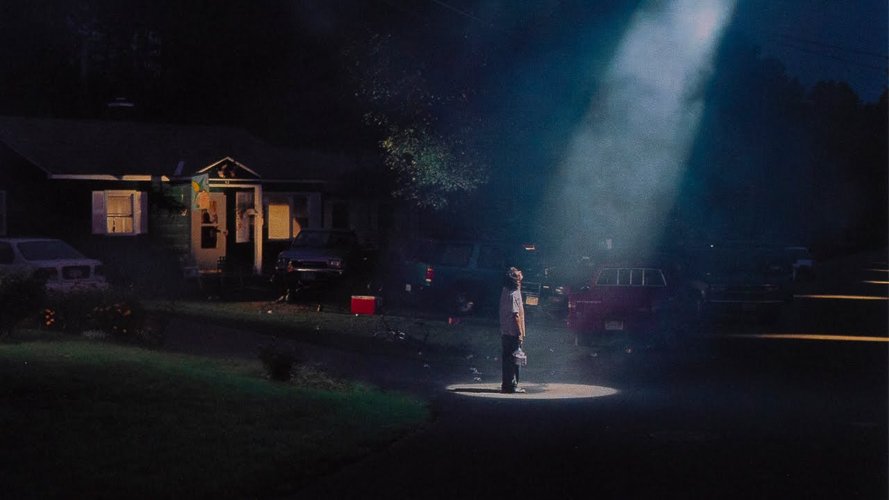
Gregory Crewdson (born 1962) works at the opposite extreme of photographic production: his large-format, film-production-scale staged photographs of American suburban and rural scenes require months of planning, a crew of dozens, and lighting rigs of cinematic scale. Each image — there are relatively few of them — is the result of a process more closely analogous to directing a film than to making a photograph.
Crewdson typically shoots during the blue hour of twilight, taking multiple exposures to account for different focus planes and lighting conditions, then selecting and compositing the final image.
The relationship to long-exposure and night photography is oblique but real. Crewdson's images evoke the quality of artificial light at night — the way a floodlit street meets the surrounding darkness, the colour temperature of sodium against tungsten against the deep blue of a winter sky — with an accuracy that suggests sustained observation. His theatrical staging allows him to control these qualities with a precision that no ambient-light photographer could achieve: the light trails of passing vehicles, the glowing windows, the isolated street lamps are all placed where they are required to be, doing exactly what they are required to do.
The relationship to Edward Hopper's nocturnal paintings — Nighthawks (1942), Gas (1940) — is one that Crewdson has acknowledged; like Hopper, he finds in the lit interior surrounded by darkness a figure for the isolation of American suburban life.
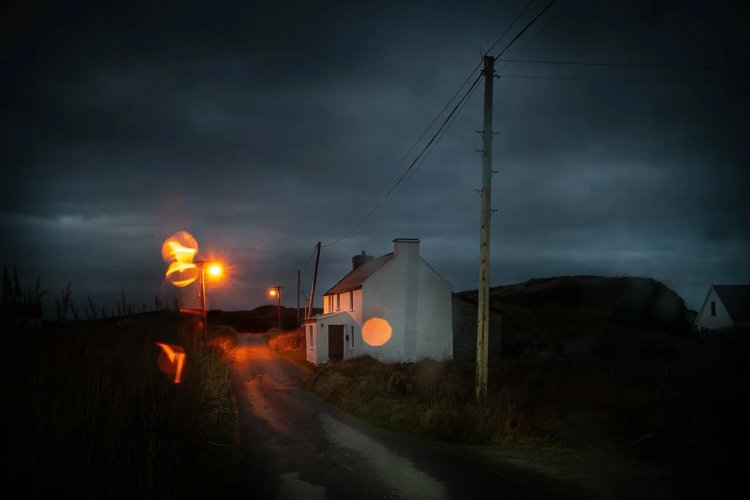
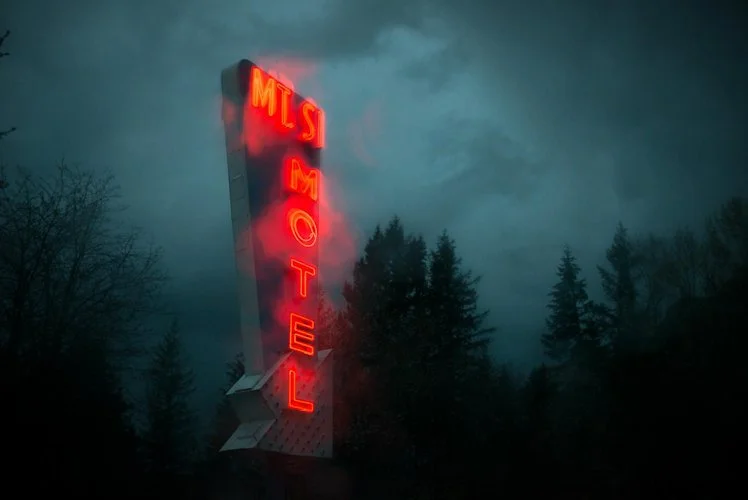
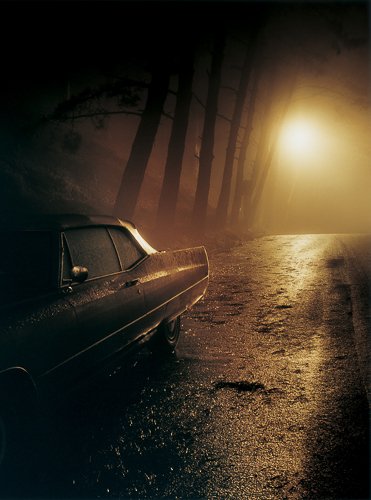
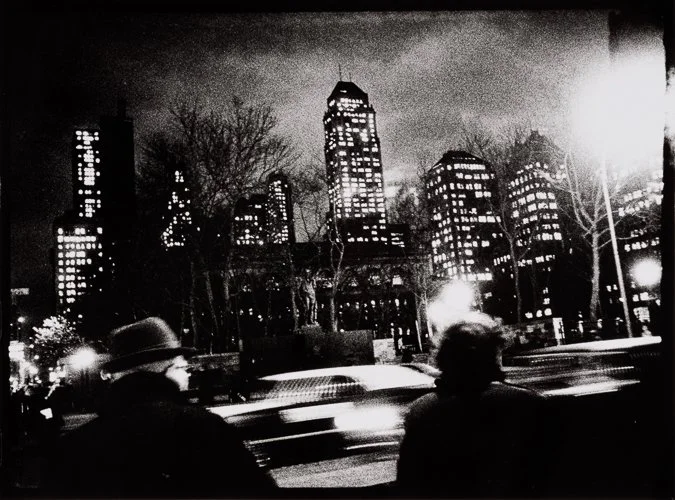
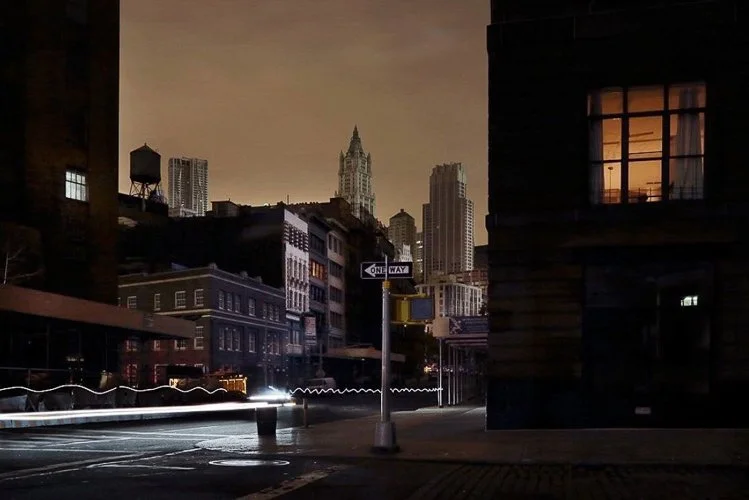
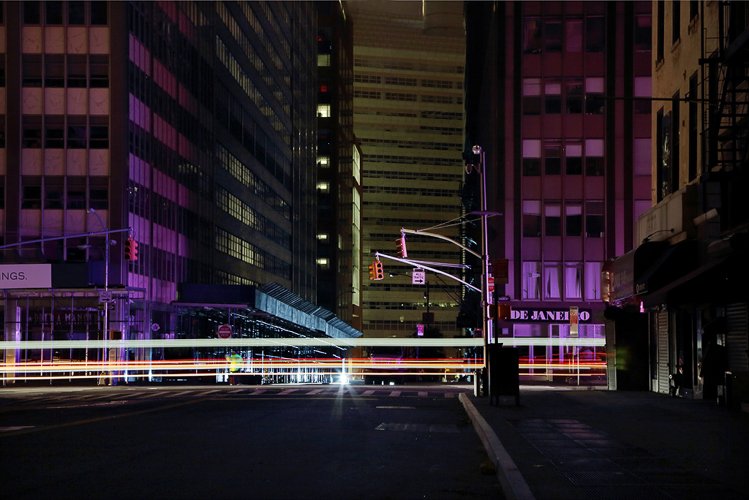
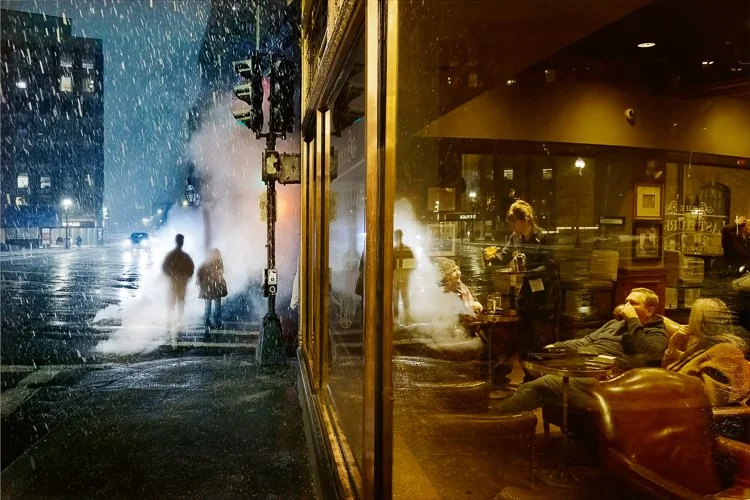
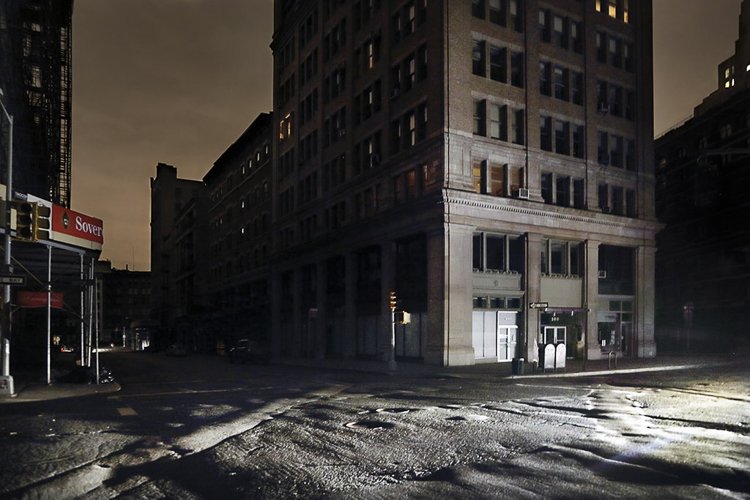
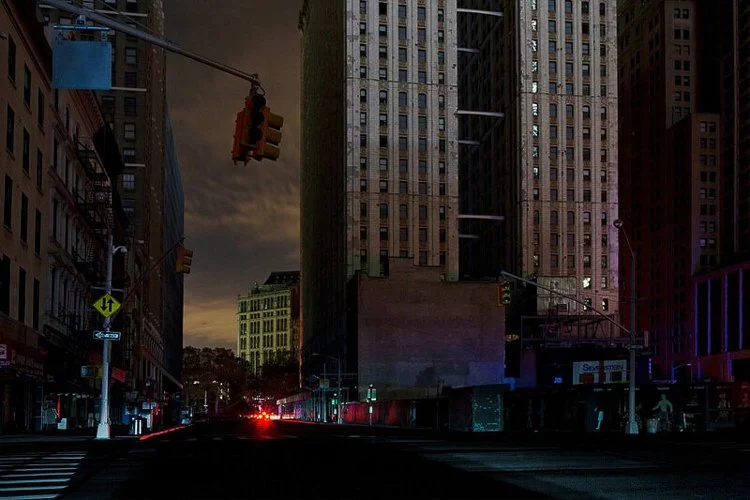
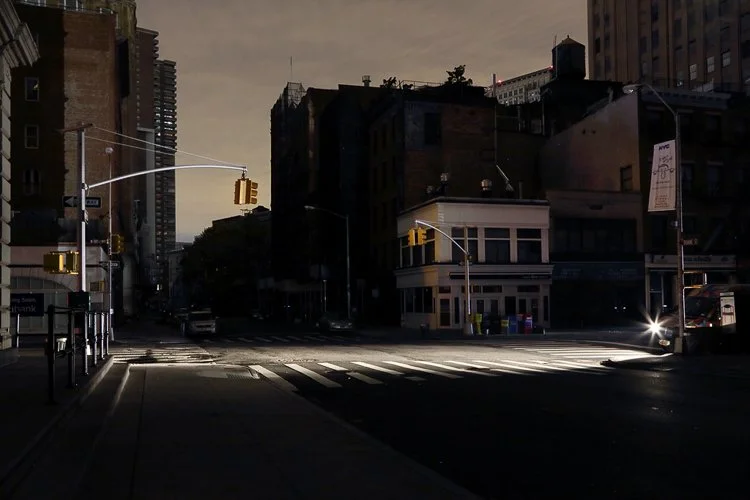
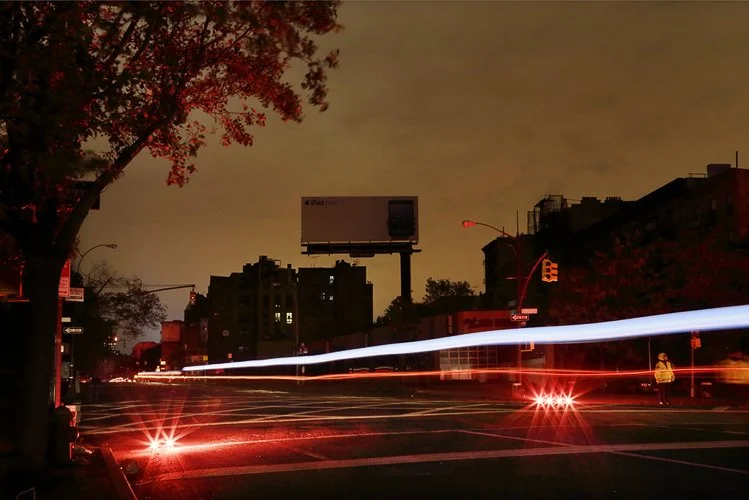
Christophe Jacrot (born 1967) is a French photographer whose practice has centred on a paradox: the adverse weather conditions that most photographers avoid are precisely the ones he seeks. His Bad Weather series and his studies of New York, Hong Kong, and Tokyo in rain and snow use long exposures to integrate the incidental effects of precipitation — droplets on a lens, the haze of fog, the doubling of light sources in wet pavements — into images of considerable atmospheric density.
The long exposure, in Jacrot's work, is not merely a means of recording light trails but a way of making the weather visible: rain, which the eye perceives as movement, becomes in the long exposure a texture, a field of oblique lines that transforms the quality of the entire image.
His urban night work in wet conditions has a romantic, melancholic quality that is simultaneously honest about the photographic process — these are not manipulated images — and frankly aesthetic in its ambitions. Jacrot has spoken of his aim to 'sublimate' his subjects, to find the beauty hidden within conditions that are experienced as obstacles. This is, in effect, a precise description of what long-exposure photography has always done: it finds in the world as it actually is, given time and patience, something that the instantaneous glance cannot perceive.
Closing Thoughts
From Demeny's luminous joint-markers in a Parisian park in 1889 to a smartphone's computational slow-shutter mode on a rainy urban street today, the technical means of producing a light-trail image have changed almost beyond recognition. The glass plates, the darkrooms, the tripods weighing several kilogrammes, the careful calculation of reciprocity failure under low-light conditions — these are no longer prerequisites.
What remains constant is the underlying transaction: a light source moves through the camera's field of view during an extended exposure; the camera records not a moment but a duration; the result is an image in which time has been made visible. The camera waited, the lights moved, and what appeared on the sensitive surface was not the world as the eye sees it, but the world as only the camera can — a record of passage rather than presence, of duration rather than instant, of the invisible made, at last, visible.