Panoramic Photography
There is a particular dissatisfaction that strikes any thoughtful photographer standing before a great landscape or a crowded city skyline — the recognition that no single rectangular frame can contain what the eye is actually experiencing. The human visual field extends roughly 180 degrees horizontally and 130 degrees vertically, yet we perceive the world not as a single frozen image but as a continuous, scanning survey of our surroundings.
The standard photographic frame, whatever its proportions, is an abstraction: a window cut from the flow of looking. Panoramic photography has always been an attempt to remedy this — to capture not merely what was in front of the camera at a given instant, but the full sweep of it, the accumulated breadth of a place that the eye constructs over several seconds of scanning. That impulse is as old as photography itself.
The paradox at the heart of the panoramic photograph is worth stating plainly. Such images are simultaneously more faithful to the experience of being somewhere than a conventional photograph and more artificial. More faithful, because we do not perceive the world through a square window; we inhabit a space that surrounds us, and a wide image that extends far to either side comes closer to recreating that sense of immersion. More artificial, because the eye never takes in a panoramic sweep all at once — it scans, rests, and scans again, constructing the experience of breadth from a sequence of focused glances.
A panoramic camera, whether rotating mechanically or stitching together dozens of digital frames, records everything simultaneously, which is precisely what the eye cannot do. The resulting image is not, therefore, a more accurate record of perception; it is a different kind of fiction, one that trades temporal honesty for spatial ambition.
The history of panoramic photography is a history of technical invention in pursuit of an essentially impossible goal. Each advance — the curved daguerreotype plate, the rotating-lens camera, the long strip of roll film, the colour transparency, the digital sensor and stitching algorithm — collapsed a different limitation whilst introducing constraints of its own.
The progression is not straightforwardly one of improvement but of negotiation: each technology enabled certain kinds of panoramic image and foreclosed others. What unites the daguerreotypist bending a copper plate into a curve in 1845 and the contemporary photographer running stitching software on a rack of overlapping RAW files is not the technology but the intention — the refusal to accept that a single, standard frame is sufficient.
The Panorama Before Photography
The word itself arrived before the photographic technology that would eventually define it. In 1787, the Irish-born painter Robert Barker devised a form of large-scale representational art for which no existing term was adequate, and so he coined one: panorama, combining the Greek pan (all) and horama (view). Barker received a patent for his system of circular painted display, which he initially termed La Nature à coup d'œil — "Nature at a glance."
His first exhibited work depicted Edinburgh from Calton Hill (1788), painted on a curved canvas and displayed in a specially designed circular interior. In 1793, Barker relocated his enterprise to Leicester Square in London, where he constructed the world's first purpose-built panorama rotunda — a cylindrical building designed specifically so that visitors, standing at its centre, would be surrounded by the painted image on all sides, with no wall visible that was not canvas.
The painted panorama proved to be an enormously successful form of popular entertainment through the early decades of the nineteenth century. Purpose-built rotundas appeared across Europe and the United States, exhibiting vast circular or semi-circular paintings of notable battles, foreign cities, famous landscapes, and significant historical events.
The best of these works were technically extraordinary achievements: some measured over 100 feet in circumference, painted by teams of artists from detailed field sketches and were lit from above through a concealed skylight to prevent any sense of the picture's edge. Audiences accustomed to conventional paintings, in which a frame explicitly marks the boundary between depicted world and gallery wall, found the experience of standing inside a panorama genuinely disorienting in the most pleasurable sense. The ambition was total immersion.
The painted panorama was in decline well before photography had matured sufficiently to challenge it directly, its novelty spent and its production costs prohibitive, but the intellectual appetite it represented — the desire to record the full extent of a view, to capture not a portion of a landscape but its entire circumference — transferred directly into photographic culture the moment the technology permitted.
The photographers who first attempted panoramic images in the 1840s were consciously inheriting a tradition. They understood that their medium could do something painted panoramas could not: record the world mechanically, without the selective interpretation of a painter's hand. That precision, combined with the panoramic ambition of total coverage, was the promise that drove four successive generations of camera designers and practitioners.
The First Panoramic Photographs
When photography emerged as a practical technology in 1839, the panoramic impulse was almost immediately apparent. The daguerreotype process, for all its extraordinary tonal quality and resolution, exposed images one at a time, on a plate of fixed dimensions.
Photographers wishing to capture a wide view had little choice but to make sequential exposures and arrange the resulting plates side by side, accepting that the joins would be imperfect and that any movement in the scene between exposures — the ripple of water, a pedestrian crossing from one frame into the next — would produce inconsistencies.
The results were physically awkward, their seams visible, and the technical demands considerable. Nevertheless, the impulse to make them persisted from photography's earliest years.
Friedrich von Martens (1809–1875) represents the first serious attempt to solve the problem mechanically. Born in Frankfurt and working principally in Paris as an instrument-maker and photographer, von Martens approached the panoramic challenge as an engineering problem rather than a compositional one. His solution — the Megaskop-Kamera, for which a patent was granted on 11 June 1845 — was among the most ingenious optical instruments of the early photographic period.
The camera employed a swing-lens mechanism, operated by a handle and a system of gears, in which the lens rotated through an arc whilst, behind it, a curved daguerreotype plate — measuring approximately 12 cm × 38 cm (4.7 × 15 inches) — advanced in synchrony. Because the plate was curved to match the arc described by the swinging lens, the focal distance remained constant throughout the exposure, producing a single, seamless image with a field of view of approximately 150 degrees.
A later version of the camera used curved wet-plate glass emulsions rather than daguerreotype plates. The exposure mechanism's gear-driven consistency addressed one of the central technical problems of swing-lens panoramic photography: uneven panning speed, which causes differential exposure and the banding artefacts that plagued cruder attempts.
Von Martens produced a series of panoramic daguerreotypes of Paris, principally from the quays of the Seine, in 1845 and 1846. Eleven large plates depicting views of the Parisian quayside, including the Pont Neuf and the buildings lining the river, survive and are now among the earliest photographic records of the city.
Exhibited at the Paris Salon and, in 1851, at the Great Exhibition in London (where von Martens received the Council Medal), these images demonstrated that photography could accomplish something the painted panorama had never convincingly managed: the mechanical, uninterpreted record of a city across a wide arc of view. The Seine quays in these images are rendered with the daguerreotype's characteristic silvery precision — the reflections in the water, the stone balustrades, the distant rooftops sharp and exact. They are extraordinary documents, and they survive.
The San Francisco harbour panorama of 1851 — commonly known by its colloquial title "Forest of Masts" — occupies an equally important position in the history of panoramic photography, though its authorship remains uncertain.
Made from multiple daguerreotype plates (five survive; the original panorama is believed to have comprised eleven), the image depicts the waterfront of San Francisco at the height of the Gold Rush, its harbour crowded with the masts of ships whose crews had abandoned them to seek their fortunes in the Sierra Nevada. The city visible beyond the waterfront is in the process of transformation, its skyline that of a place being built faster than it can be documented.
The original daguerreotypes no longer exist; a gelatin silver reproduction print made by Martin Behrman in 1910 is the best available record of the complete work. As a historical document, "Forest of Masts" is remarkable for what it captures at an exact moment of rupture — the instant before San Francisco ceased to be a modest port town and became something considerably stranger and more consequential.
The daguerreotype's particular tonal quality, its silvery precision and its susceptibility to highlights give the image a slightly otherworldly quality entirely appropriate to its subject.
George N. Barnard (1819–1902) approached panoramic photography from a different direction: not the scenic grandeur of European cities or the Gold Rush harbour, but the operational requirements of modern warfare. Barnard served as the official photographer to the Military Division of the Mississippi during the American Civil War, and his panoramic work was conceived primarily as a tool for military intelligence.
His technique involved multiple exposures on wet-plate glass negatives with a conventional camera, rotated between shots; the resulting albumen prints were then joined together to create wide-field records of terrain, fortifications, and devastated urban landscapes.
His 1864 panoramic views of Atlanta, Georgia — made before Sherman ordered the city burned — provided military strategists with a topographic overview of the kind that no single-plate image could supply. His album Photographic Views of Sherman's Campaign (1866) collected this work into a bound publication of 61 large albumen prints that stands as one of the first major photographic books — a deliberate act of documentary record, and a formal argument for photography's capacity to serve history rather than merely illustrate it.
The Dedicated Panoramic Camera
The hand-joined panorama, however skillfully executed, was constrained by obvious limitations. Sequential exposures required the scene to remain static between them — a requirement impossible to meet in any environment containing people, water, foliage, or clouds. The joins between plates, however carefully managed, remained visible to the attentive eye. The solution was a class of camera specifically engineered for panoramic work: one capable of recording a wide arc in a single, continuous exposure.
The fundamental operating principle of the rotating-lens panoramic camera is deceptively simple. The lens swings mechanically through a horizontal arc — typically between 120 and 180 degrees — whilst behind it the film or plate advances across a curved plane at a rate precisely matched to the lens's rotation.
Because the film moves in synchrony with the lens, each point on the film receives the same exposure regardless of where in the arc the lens happens to be when that section of film passes the aperture. The result is a single, seamless exposure that records a wide field of view without the tonal inconsistencies inherent in joined sequential exposures.
The curved film plane is essential: a flat plane would produce a progressively elongated image at the edges, since the distance from lens to film increases as the lens angle increases. The curve corrects for this, maintaining a constant lens-to-film distance throughout.
The Cirkut camera — patented by William J. Johnston in 1904 and manufactured initially by the Rochester Panoramic Camera Company beginning in 1905, subsequently by the Century Camera Company and then by the Folmer Graflex Division of Eastman Kodak — represented the most successful commercial realisation of this principle in the film era.
The Cirkut differed from swing-lens cameras in a significant respect: rather than pivoting only the lens, the entire camera body rotated on a geared tripod head, whilst a roll of film advanced across a flat film plane behind a narrow vertical slit aperture. This arrangement allowed effectively unlimited horizontal coverage — a Cirkut could record a full 360 degrees if required, and some operators took panoramas of considerably more than 360 degrees to ensure overlap.
The camera was produced in several models designated by the maximum film width they could accommodate: Nos. 5, 6, 8, 10, and 16. The largest, the No. 16, could produce panoramic negatives up to eighteen feet in length, with an area exceeding twenty-four square feet and an information content approaching the gigapixel range. The Cirkut remained in production until 1949, a run of over four decades that testifies to the durability of both the design and its market.
It was used extensively for military surveys, large group photographs, school and regimental records, and landscape work, its distinctive long, narrow proportions becoming the visual signature of a particular era of commercial and documentary photography.
The professional medium-format panoramic cameras of the mid-to-late twentieth century represented a different approach: fixed-lens, wide-angle instruments producing images on large-format roll film rather than rotating to encompass a wide field.
The Linhof Technorama — introduced in the 1970s — established the 6×17 cm format as a professional standard, producing images approximately three times wider than tall on 120 roll film.
The Fuji GX617, introduced in 1993, brought this format to something approaching perfection. A 6×17 cm medium-format camera with interchangeable lenses (90 mm, 105 mm, 180 mm, and 300 mm), producing a 3:1 aspect ratio image of outstanding resolving power, the GX617 became the instrument of choice for serious landscape panoramic work through the 1990s and 2000s.
Its relative accessibility — expensive and specialised by consumer standards, but not the province of research institutions or military survey departments — placed serious panoramic photography within reach of dedicated practitioners for the first time. Many of the contemporary photographers profiled below made or make significant use of it.
The more accessible end of the market was served by swing-lens 35mm cameras such as the Soviet-manufactured Horizon (and its derivative, the Russian Horizon Kompakt), and the Japanese Widelux, produced from the late 1950s until the 1990s and capable of a 140-degree field of view on a standard 35mm frame.
These cameras brought the swing-lens panoramic image — with its characteristic curved horizon and slightly distorted peripheral rendering — into the hands of photographers who could not afford medium-format equipment, and produced a visual aesthetic quite distinct from both the stitched digital panorama and the large-format wide-angle shot.
Iconic Panoramas & their Photographers
The San Francisco Harbour, 1851
The image known as "Forest of Masts" was made in 1851 by an unidentified photographer — or possibly a team of photographers — working with daguerreotype equipment at a waterfront transformed by the Gold Rush. San Francisco in 1851 was one of the fastest-growing cities in the world, its population having increased from approximately 800 in 1848 to perhaps 25,000 by the time the panorama was made.
Ships arrived from every direction carrying prospectors, merchants, and opportunists; many were simply abandoned when their crews departed for the goldfields, their hulls eventually pressed into service as improvised warehouses and premises along the waterfront.
The panorama captures this moment of extreme dislocation: a harbour crowded with masts like a felled forest, a city being thrown together behind it at a speed that no planned urban development could have achieved. Five of the original daguerreotype plates survive, reproduced by Martin Behrman as a gelatin silver print in 1910; the original panorama is believed to have comprised eleven plates.
The daguerreotype's silvery, slightly spectral tonal range is peculiarly appropriate to the scene's quality of provisional chaos — a city that was, in a very real sense, still deciding what it was.
Friedrich von Martens' Paris Panoramas (1845–1846)
The Seine quay panoramas produced by von Martens with his Megaskop-Kamera in 1845 and 1846 are among the most technically remarkable photographs of the nineteenth century's first decade, and among the earliest surviving records of Paris as a physical city.
Their subject matter — the stone embankments of the river, the bridges crossing it, the buildings lining the quays — is in one sense unremarkable; Paris in 1845 was a subject that many photographers would subsequently address. What distinguishes the von Martens images is precisely their width: the sweep of river and city that no conventional daguerreotype frame could contain is here resolved into a single, seamless silver image.
The eleven surviving plates document the quayside from the Pont Neuf westward and represent, for all their tonal delicacy, an act of urban intelligence — the desire not merely to record a building or a street but to record the extent of a place. That desire is the same impulse that would, one hundred and sixty years later, produce gigapixel composites of inauguration crowds. The technology changed entirely; the motive did not.
George Barnard's Civil War Panoramas (1860s)
Barnard's panoramic work during Sherman's campaign of 1864–1865 sits at the intersection of military utility and documentary art in a manner that remains uncomfortable to categorise. The images — panoramic views of Atlanta before its burning, of the fortifications around Savannah, of the ruins of cities that had been deliberately destroyed as instruments of military policy — were made with the explicit approval and logistical support of the Union Army, which recognised their value for operational planning.
Barnard rotated his camera between exposures, joining wet-plate albumen prints to produce wide-field records that could be spread on a table and read by engineers and generals like maps. But they were also, inescapably, documents of devastation on a scale that no single-plate image could convey. Ruins of Charleston, S.C. — made after the city's capture — shows the scale of destruction across a panoramic field that forces the viewer's eye across block after block of collapsed and gutted buildings.
The publication of Photographic Views of Sherman's Campaign as a bound album of sixty-one large albumen prints in 1866 transformed this operational material into a deliberate act of historical record: one of the first major photographic books, and one of the earliest arguments that photography could constitute a serious documentary medium rather than merely an illustrative one.
Frank Hurley's Antarctic Panoramas (1914–1917)
Frank Hurley (1885–1962) was an Australian photographer and filmmaker whose career, in its most important phase, was built on a series of journeys to the most inhospitable environment on Earth. Born James Francis Hurley in Glebe, Sydney, he was largely self-taught and had worked as a postcard photographer before his encounter with polar exploration transformed both his career and the history of documentary photography.
Hurley first came to international attention as the official photographer for Douglas Mawson's Australasian Antarctic Expedition of 1911–1914, the work of which he compiled into the documentary film Home of the Blizzard — one of the earliest extended moving-picture records of the Antarctic continent.
His subsequent career would prove still more consequential. In 1914, he was recruited by Ernest Shackleton as the official photographer and cinematographer for the Imperial Trans-Antarctic Expedition — the attempt to make the first overland crossing of the Antarctic continent from the Weddell Sea to the Ross Sea. The expedition departed that year aboard the Endurance; the crossing itself never took place.
The Endurance became trapped in the pack ice of the Weddell Sea in January 1915 and was progressively crushed over the following months, finally sinking on 21 November 1915. During the months in which the ship drifted helplessly, beset in ice, Hurley made his most remarkable images: wide-angle records of the ship imprisoned in the frozen sea, its masts and rigging silhouetted against polar skies of extraordinary colour and drama, the surrounding ice extending in every direction to a flat horizon.
These were not simply documentary photographs; they were composed with the precision of a painter working from life, Hurley understanding instinctively that the scale of the Antarctic landscape — the vast fields of ice, the tiny ship, the crushing weight of the polar sky — required a wide field of view to be communicated honestly.
When the Endurance sank, and Shackleton ordered the crew to abandon all non-essential equipment, Hurley dove into the partially flooded hold to retrieve his glass-plate negatives. He subsequently sat on the ice and sorted through more than 600 plates, smashing those he judged insufficiently important to carry — approximately 400 of them — to save the remaining 120. Those 120 plates, evacuated across the ice and eventually to safety, constitute one of the great photographic archives of the twentieth century.
Hurley went on to serve as an official Australian war photographer in both the First and Second World Wars — work that was important and prolific, if less celebrated than the Antarctic photographs. He was controversial in his own lifetime for his practice of creating photographic composites, combining negatives to produce images more dramatically complete than any single exposure could have supplied.
Whether this constitutes a legitimate photographic technique or a form of deception has been debated ever since. What is not debatable is the quality and consequence of his Antarctic panoramic work, which has defined the visual language of polar exploration for over a century.
David Breashears' Everest Panoramas (1996–1997)
The American cinematographer and mountaineer David Breashears ascended Mount Everest with a 70mm IMAX camera — a piece of equipment requiring 115 metres of film per 90 seconds of footage and weighing approximately 42 kilograms — during and after the catastrophic 1996 season in which eight climbers died on the mountain. His footage, released as the documentary film Everest in 1998, included panoramic photography made at high altitude on the mountain's upper slopes, and constitutes some of the most technically demanding large-format work ever produced.
The combination of extreme altitude (above 8,000 metres), severe cold, thin air, and the physical demands of mountaineering makes the creation of careful, technically controlled photography almost impossibly difficult; Breashears' achievement was to maintain both the mountaineering competence and the photographic discipline simultaneously. His Everest panoramas represent the outer edge of what large-format panoramic photography can demand of its practitioner.
David Bergman's Gigapixel Inauguration Panorama (2009)
The digital panorama composed by the American photographer David Bergman of Barack Obama's first presidential inauguration on 20 January 2009 represents, in certain respects, a logical endpoint of the tradition established by von Martens' curved daguerreotype plate.
Bergman used a Canon G10 compact camera mounted on a Gigapan robotic imager — a device originally derived from NASA's Mars Rover technology — to make 220 individual overlapping exposures from a fixed position. These were stitched together using Gigapan software to produce a final image measuring 59,783 × 24,659 pixels: 1,474 megapixels in total.
The resulting photograph documented the crowd assembled on the National Mall in sufficient resolution that individual faces among the more than one million attendees are identifiable at full magnification. The image represents not merely a technical achievement but a conceptual one: the idea that a photograph could be simultaneously a single coherent image of an historic moment and an archive of the individuals who composed it.
Every face in that crowd is potentially a separate portrait. Gigapixel photography — whether assembled from hundreds of frames or, in the case of some contemporary large-sensor cameras, captured in a single extraordinary exposure — is what the panoramic tradition reaches when digital processing removes the last of the constraints.
The Great Landscape Panoramists
Carleton Watkins (1829–1916) was born in Oneida, New York, and arrived in California in 1851, initially pursuing careers in business and then, almost by accident, in photography. By the early 1860s he had established himself as one of the most technically accomplished photographers on the West Coast, and in 1861 he made the journey that would define his career: a photographic expedition to Yosemite Valley, then barely known outside California, with a custom-built camera capable of producing glass plate negatives measuring 18 × 22 inches — the "mammoth plate" format that required approximately two thousand pounds of equipment, transported by mule train, to make practicable.
The negatives produced by this camera could not be enlarged with the technology of the period; prints were made by contact printing, meaning that each print was the same dimensions as the plate. The resulting albumen prints — some thirty mammoth-plate images made on that 1861 visit — showed Yosemite's valley walls, waterfalls, and great trees with a clarity and scale that had no photographic precedent.
The political consequence of this work was direct and significant. When a set of Watkins' Yosemite photographs was placed before President Abraham Lincoln in 1864, they played a material role in his decision to sign the Yosemite Grant — legislation that protected the valley from private development, establishing a precedent for the American National Park system.
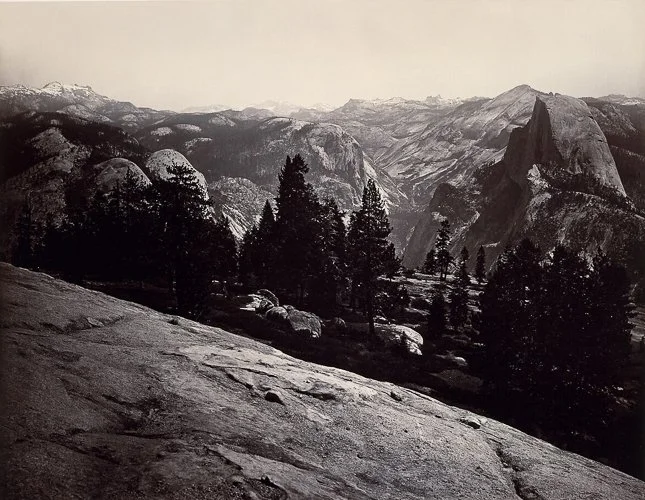
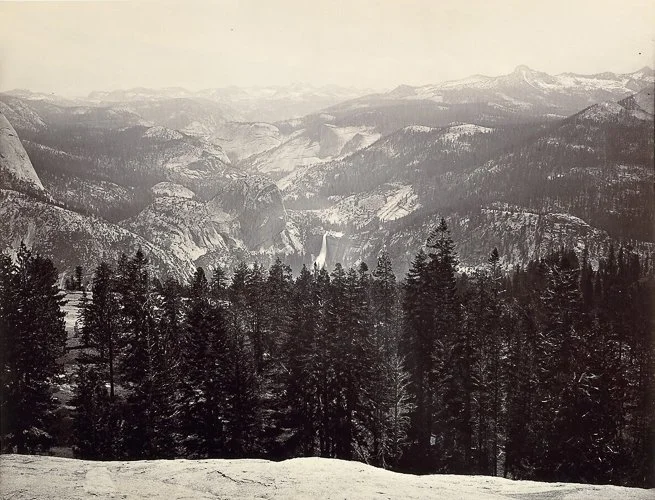
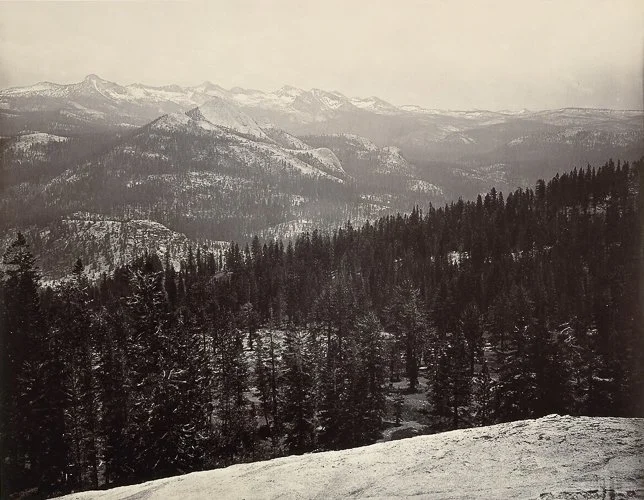
This is among the most consequential direct political effects of any series of photographs in the nineteenth century. Watkins returned to Yosemite repeatedly over the following two decades, refining his technique and extending his coverage; during his 1865–1866 visit, he made a series of three exposures from atop Sentinel Dome that, viewed together, constitute a comprehensive panoramic survey of the valley floor. He also produced extensive panoramic work in San Francisco and along the California coast, his wide-format sensibility extending naturally to both urban and maritime subjects.
Watkins' later life was unhappy. The financial difficulties that had plagued him intermittently throughout his career eventually overwhelmed him; he was declared bankrupt in 1876, losing his studio and his archive. He managed to rebuild his collection and continued working through the 1880s and into the 1890s, but the 1906 San Francisco earthquake and fire destroyed much of what he had accumulated over a lifetime.
He was by then elderly and near-blind, and he spent his final years in the Napa State Hospital, where he died in 1916. The partial recovery and preservation of his work — through the survival of negatives and prints held in various collections and subsequently consolidated by museums and archives — has allowed his reputation to be assessed properly in the century since his death. He is now recognised as one of the foundational figures of American landscape photography.
H.H. Bennett (1843–1908) — Henry Hamilton Bennett — arrived at photography by a route common to many nineteenth-century practitioners: necessity following injury. A carpenter and joiner before the Civil War, in which he served with the 12th Wisconsin Infantry, Bennett suffered a hand wound that effectively ended his original trade. He turned to photography in 1865 and established a studio in the small town of Kilbourn City, Wisconsin (later renamed Wisconsin Dells), where he would spend the remainder of his working life systematically documenting the extraordinary sandstone rock formations of the Wisconsin River valley.
Over forty-three years, Bennett produced a body of work remarkable for its patience, its technical precision, and its genuine commercial intelligence. The Wisconsin Dells landscape — eroded sandstone gorges, balanced rocks, narrow channels, and overhanging cliffs — presented photographic challenges that drove Bennett to develop technical solutions of more than local significance.
His most celebrated innovation was a spring-operated instantaneous shutter — he called it "the Snapper" — which he built himself using rubber bands, enabling exposure times short enough to freeze moving water. This device, primitive by later standards but genuinely novel in the mid-1880s, allowed him to photograph the river's rapids and cascades with a clarity that had previously been impossible; long exposures rendered moving water as a white blur, and Bennett wanted to show it as it actually appeared.
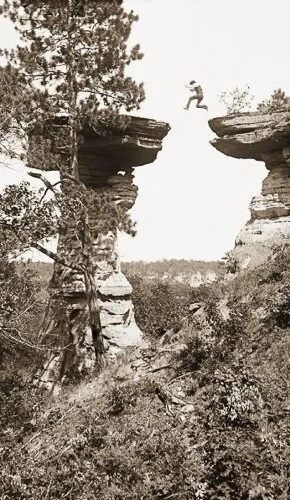
His best-known photograph, made in 1886, shows his seventeen-year-old son Ashley leaping across the 5½-foot chasm at Stand Rock — one of the most reproduced nineteenth-century American photographs. The image required Ashley to make the jump eighteen times before Bennett captured the exposure he wanted, and the stop-action clarity of the resulting photograph caused audiences at Bennett's magic-lantern shows to gasp audibly at what seemed an impossibility.
As panoramic work, Bennett's greatest achievement lay in his multi-plate prints combining three or four 20 × 24 inch negatives into seamless panoramic vistas of the Wisconsin River landscape, the joins between plates invisible in the finished prints. His studio in Wisconsin Dells — the H.H. Bennett Studio — is the oldest continuously operating photography studio in the United States.
George R. Lawrence (active c.1890s–1910s) was a Chicago-based commercial photographer whose approach to panoramic work was defined by an ambition so extreme as to border on the theatrical. Lawrence understood that panoramic photography, to justify itself as a commercial proposition, needed to show clients something they genuinely could not see any other way, and he consistently pursued that logic to its conclusion.
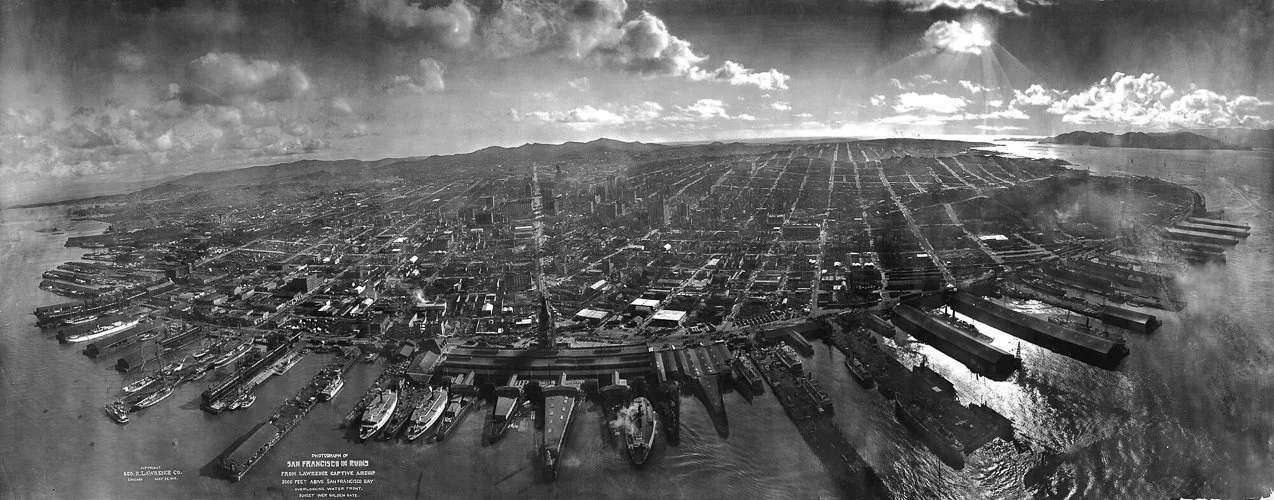
His most celebrated work began with a particular problem. In May 1906, six weeks after the San Francisco earthquake and the fires that followed it had devastated the city, Lawrence was commissioned to document the destruction from a vantage point that no terrestrial camera position could provide.
His solution was to construct a panoramic camera capable of being lifted 2,000 feet above San Francisco Bay suspended beneath a train of up to seventeen Conyne kites, triggered from the ground via an electrical current transmitted through the metal kite line. The camera — a bespoke instrument producing a mammoth negative 18 × 48 inches in size and weighing 49 pounds — was stabilised by three fifteen-foot bamboo booms attached to its sides, from each of which a 120-foot silk cord was suspended, joined together beneath the camera to support a counterweight.
The resulting photograph, San Francisco in Ruins, produced a 160-degree panoramic view of the destroyed city from Ferry House to Twin Peaks — a distance of approximately ten kilometres — in which the signage on the waterfront is clearly legible and individual figures moving among the ruins are visible. Lawrence sold prints of the image for $125 each, reportedly earning approximately $15,000 in total sales.
Many viewers, confronted with the image, refused at first to believe it was not a composite fabrication; the notion that a camera could have been suspended at such an altitude and produced a photograph of such clarity seemed implausible.
Beyond the San Francisco work, Lawrence built cameras of remarkable scale for ground-level panoramic use: his "banquet cameras" were capable of producing single negatives considerably more than a metre in width, and were used for group portraits, legislative sessions, industrial commissions, and major public events including the Republican National Conventions of 1904 and 1908. Some of the largest cameras ever built for practical commercial use, they represent the physical limit of what large-format wet-plate panoramic photography could demand of its operator.
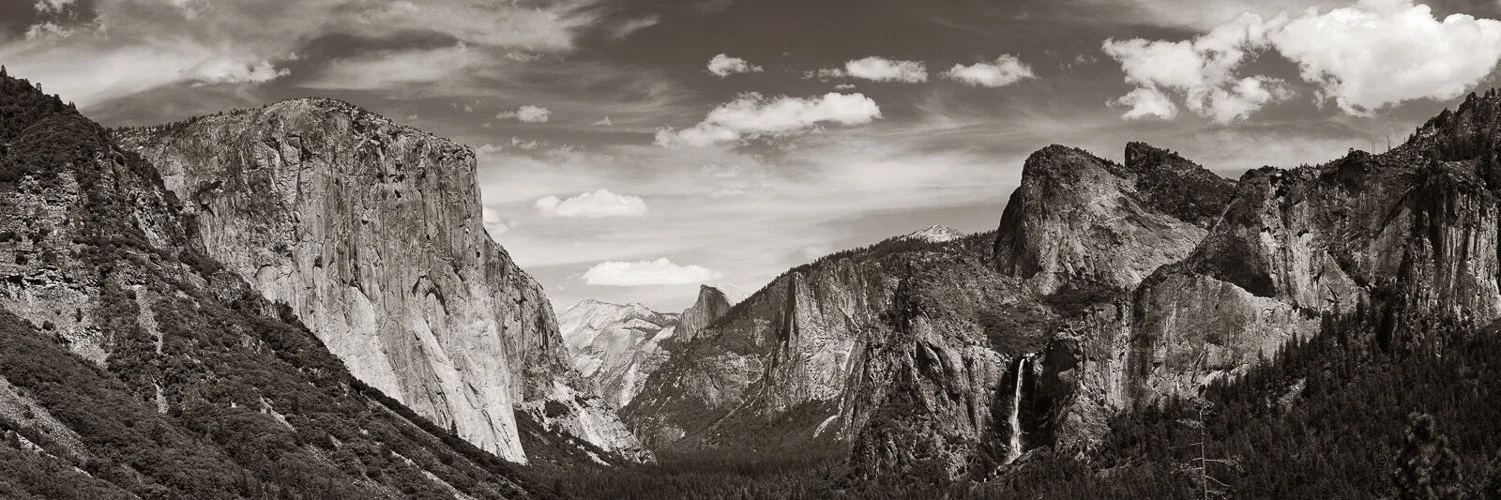
Ansel Adams (1902–1984) is not most naturally described as a panoramic photographer in the technical sense — he worked predominantly with large-format view cameras producing standard-proportion negatives rather than with rotating-lens or swing-lens instruments. His significance to the panoramic tradition lies in something subtler: his systematic exploration of the wide landscape as a subject that implicitly strains against the standard frame, and his development of technical methods specifically suited to recording it.
Adams' zone system — developed in collaboration with the photographer Fred Archer in the late 1930s and published in a series of technical manuals over the following decades — was, in essence, a methodology for managing the extreme tonal range of wide open-air landscapes.
A mountain vista on a clear day may present a tonal range from deep shadow in a pine forest to bright snow on a distant peak that exceeds the recording capacity of any photographic emulsion. The zone system's eleven-zone scale, with a corresponding discipline of exposure and development, allowed a photographer to pre-visualise exactly what tonal values would appear in the final print and adjust the exposure accordingly.
This was of particular value in panoramic landscape work, where the single frame must encompass lighting conditions ranging from a dark foreground to a bright sky, with no possibility of selective re-exposure as in a studio setting.
Adams' most panoramic images — Clearing Winter Storm, Yosemite Valley (c.1944), Moonrise, Hernandez, New Mexico (1941) — are not panoramic in their proportions; they are made on 8 × 10 inch view camera negatives of standard proportions. But their subject matter — the vast reach of an American mountain landscape, the full arc of a winter sky — is panoramic in its ambition.
Adams understood the American West as a subject that made the standard frame feel inadequate, and his entire technical programme was oriented towards recording it with sufficient fidelity that the viewer might feel the inadequacy compensated for. His conservation work, conducted over decades of association with the Sierra Club and pursued by distributing his photographs to legislators and public officials, was directly modelled on the precedent established by Carleton Watkins' Yosemite work: the large-format landscape photograph as an instrument of environmental politics. He was awarded the Presidential Medal of Freedom in 1980.
Colour & the Landscape Panorama
The arrival of commercially viable colour transparency film — Kodak's Kodachrome in 1935, followed by Ektachrome in 1946 — transformed the wide landscape photograph into a distinct and popular genre. Where the tonal control of black-and-white photography had demanded considerable technical sophistication, colour transparency film recorded the chromatic facts of the wide landscape automatically: the blue of a mountain sky, the ochre of sandstone, the green of a conifer forest, the silver of a river. The wide landscape in colour became, almost immediately, a subject of mass visual culture.
The distribution vehicle for this work was the large-circulation illustrated magazine. National Geographic, with its consistently high production standards and its editorial mandate to publish images of landscapes and places unfamiliar to most of its readers, established panoramic landscape photography as a genre expectation over the middle decades of the twentieth century. Life magazine, Horizon, and their international equivalents provided further platforms.
The technology of magazine printing — which by the 1950s could reproduce colour photographs at very high quality on large pages — suited the panoramic landscape in a way that the small 35mm print had not. A double-page spread in a large-format magazine offered something approaching the spatial experience of a proper panoramic print.
The professional technical standard for colour panoramic landscape work from the 1970s onwards was established by the medium-format rollfilm cameras producing 6 × 12 cm and 6 × 17 cm negatives or transparencies. The 6 × 17 cm format — producing a transparency approximately three times wider than tall — struck professional landscape photographers as an almost ideal proportional balance between width and cost of material; wide enough to convey the sweep of a large landscape without the operational difficulty of the enormous negatives required by banquet cameras or the Cirkut.
Cameras in this format by Linhof, Fuji, and Fotoman defined panoramic landscape photography's professional grammar through the 1980s and 1990s, their images appearing on the covers and double-page spreads of the major illustrated magazines and establishing the visual conventions of the genre.
Contemporary Practice
Andreas Gursky (born 1955) studied under Bernd and Hilla Becher at the Kunstakademie Düsseldorf — the rigorous, conceptually grounded photographers who had spent their careers making systematic typological records of industrial structures, approaching photography as a means of revealing systemic pattern rather than individual incident. Gursky absorbed this tradition and extended it in a direction his teachers had not taken: towards the large-scale, technically complex, digitally manipulated colour photograph as a vehicle for addressing the global economy and the environments it has produced.
His most celebrated single work, Rhein II (1999, revised 2011), is a panoramic-format colour photograph of the Rhine riverbank near Düsseldorf, stripped in post-processing of virtually every element other than the horizontal bands of water, grass, and sky. Dog-walkers, buildings, and vegetation visible in the original exposure were digitally removed; what remains is an image of radical simplicity — grey water, green grass, a pale sky, a horizon — that achieves an almost abstract severity whilst remaining emphatically a photograph of a specific place.
A print of this image sold at Christie's New York on 8 November 2011 for $4,338,500, then the highest price ever paid at public auction for a single photograph, a record it held until 2022.
Gursky's panoramic-format works — including Chicago Board of Trade II (1999), 99 Cent (1999), Amazon (2016), and dozens of others — use the wide horizontal field to reveal the systemic character of their subjects. A single image of the Chicago Board of Trade floor, several metres wide in exhibition, resolves into hundreds of individual figures and transactions that, viewed collectively, constitute a visual argument about the nature of modern finance.
A panorama of a factory floor in China reveals the conditions of mass production in a single horizontal sweep that no narrower frame could encompass. The panoramic format is not, for Gursky, primarily a compositional choice; it is a structural necessity imposed by his subject matter: the scale of contemporary industrial and commercial life.
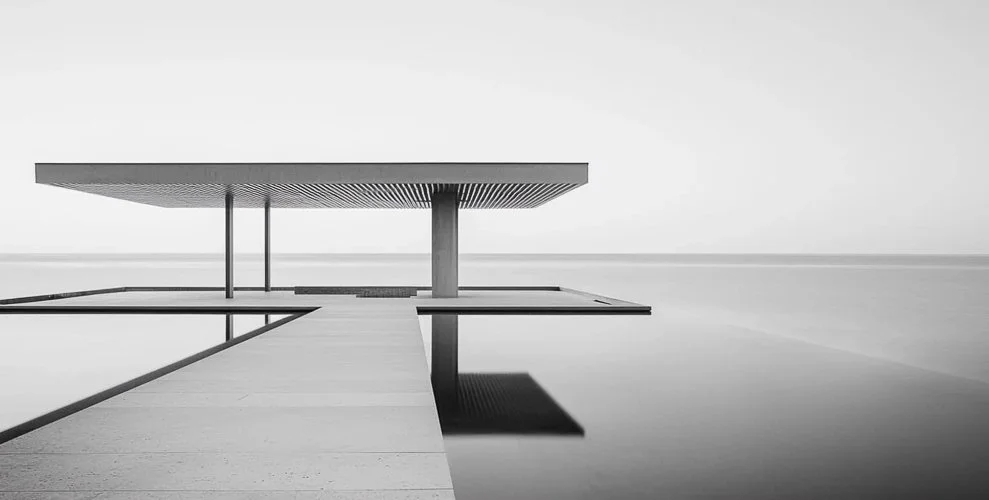
Hiroshi Sugimoto is discussed more fully elsewhere in this series in the context of his Theatres work and long-exposure photography, but his Seascapes series, begun in 1980 and continued across subsequent decades, constitutes one of the most sustained and rigorous panoramic photography projects of the late twentieth century.
Each image in the series is composed identically: the horizon bisects the frame precisely at its centre, sea below and sky above, the location varying from the Atlantic coast of New England to the North Sea, the Sea of Japan, and the Pacific. The format of these prints is not conventionally panoramic — they are generally square or modestly rectangular — but the series' relationship to the panoramic tradition is philosophical: it explores what remains when the wide landscape is stripped to its absolute minimum, when the only element retained is the horizontal line between water and sky that defines the experience of standing before an open sea.
Sugimoto has described the Seascapes as an exploration of what has remained constant across human history; seen in the context of the panoramic tradition, they read as an investigation of what the wide view contains when everything incidental is removed.
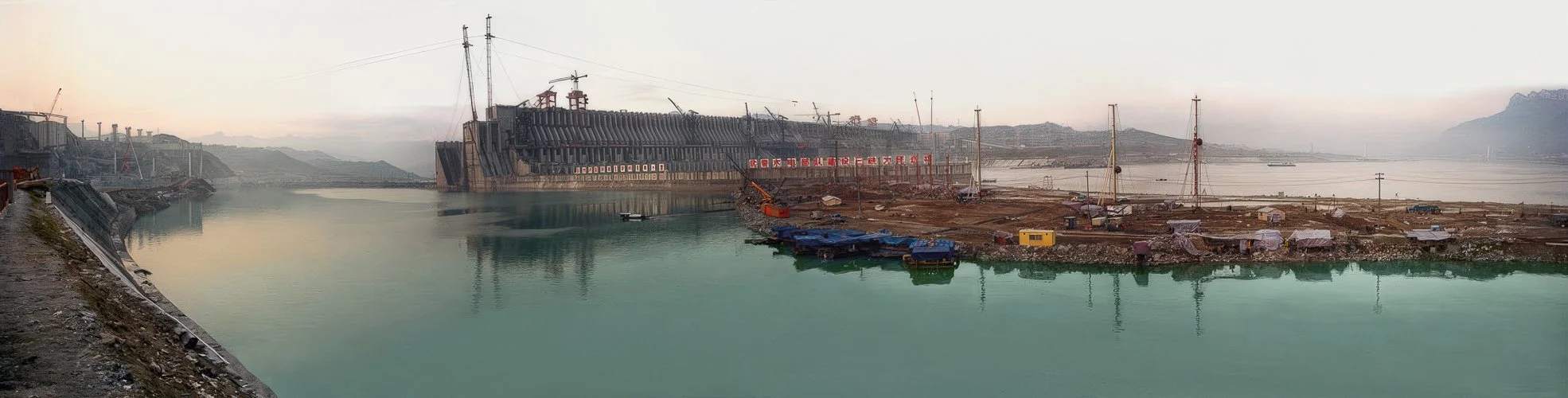
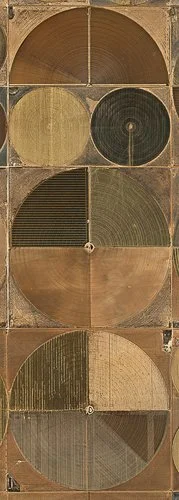
Edward Burtynsky (born 1955) is a Canadian photographer who has spent four decades making large-format photographs of the landscapes produced by industrial extraction and manufacturing — oil fields, ship-breaking yards, mining operations, nickel tailings, electronic waste sites, irrigated agriculture, and the physical infrastructure of contemporary capitalism.
His education was in photography and design; his early work was formalist landscape photography that engaged with the abstract compositional possibilities of industrial terrain. Over the 1980s and 1990s, his practice developed into something explicitly critical: a sustained investigation of the physical scale of human industrial transformation, and of the aesthetic beauty that frequently accompanies the destruction.
Burtynsky typically works with large-format view cameras — 4 × 5 and 8 × 10 inch formats — and with aerial photography, both of which produce the resolution necessary for his images to be printed at the large dimensions his subjects require. His major series — Railcuts (1985), Nickel Tailings (1996), Shipbreaking (2000–2001), Oil (2009), Water (2013), Anthropocene (2018) — are consistently panoramic in their sensibility if not always in their proportions, addressing subjects that literally require wide fields of view to be communicated honestly.
A ship being broken apart by hand on the beaches of Chittagong is not a subject that a telephoto lens cropping one worker from the hundreds present can represent adequately; only a wide field showing the full extent of the operation conveys what is actually happening. His work has received a TED Prize and has been the subject of documentary films, including Manufactured Landscapes (2006) and Anthropocene: The Human Epoch (2018).
The tension between the formal beauty of his images and the environmental devastation they record — a tension he has discussed at length in interviews — is perhaps the defining quality of his practice, and it is one that the panoramic scale actively produces: a landscape of industrial destruction, seen across a wide field, is both more comprehensible and, perversely, more beautiful than the same scene viewed through a narrower frame.
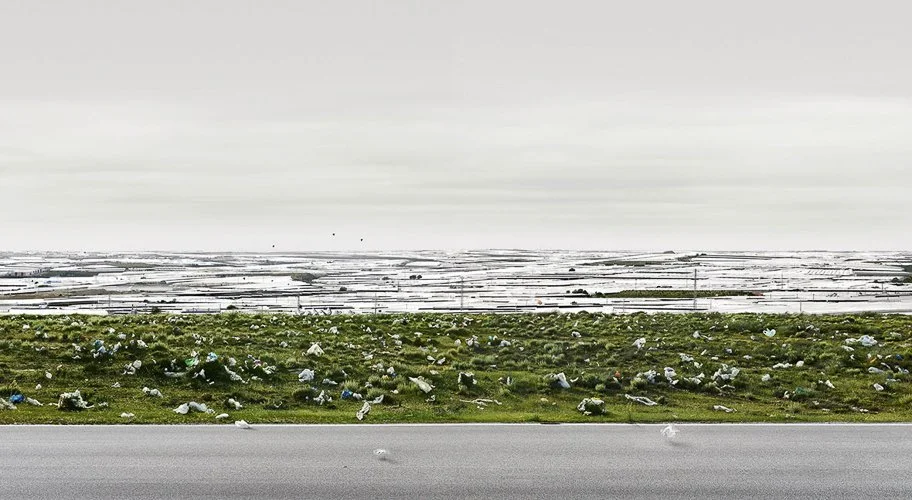
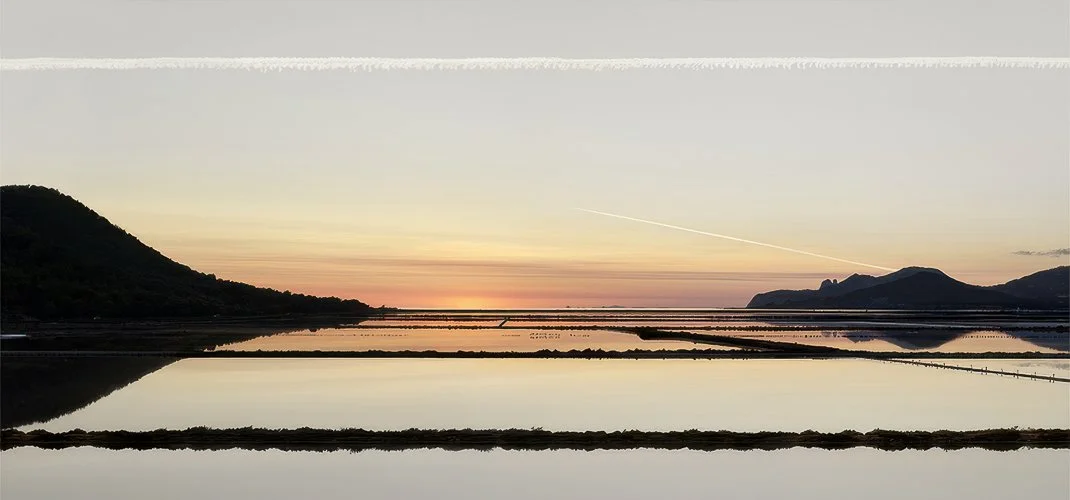
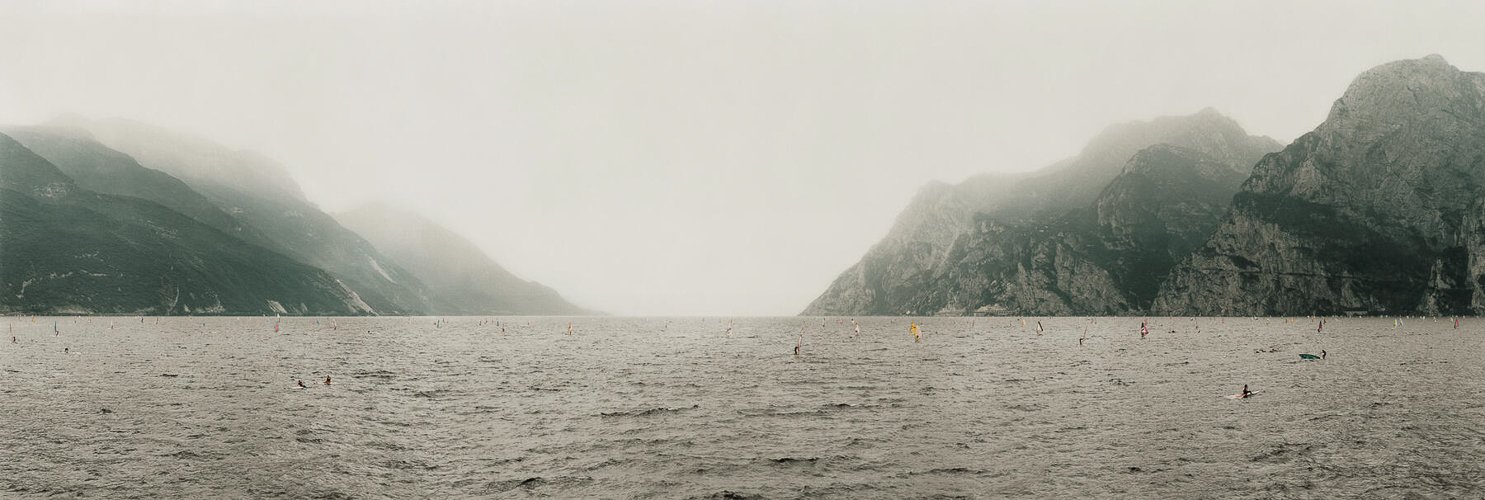
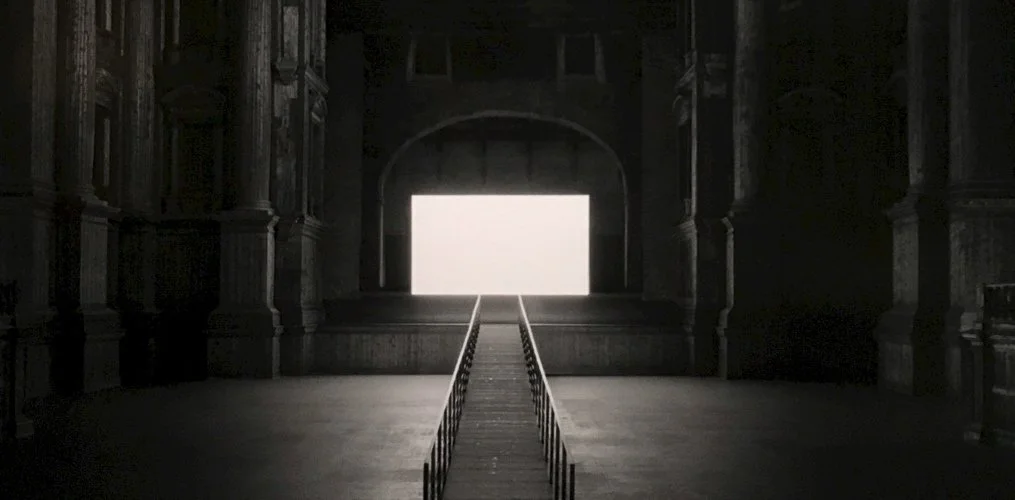
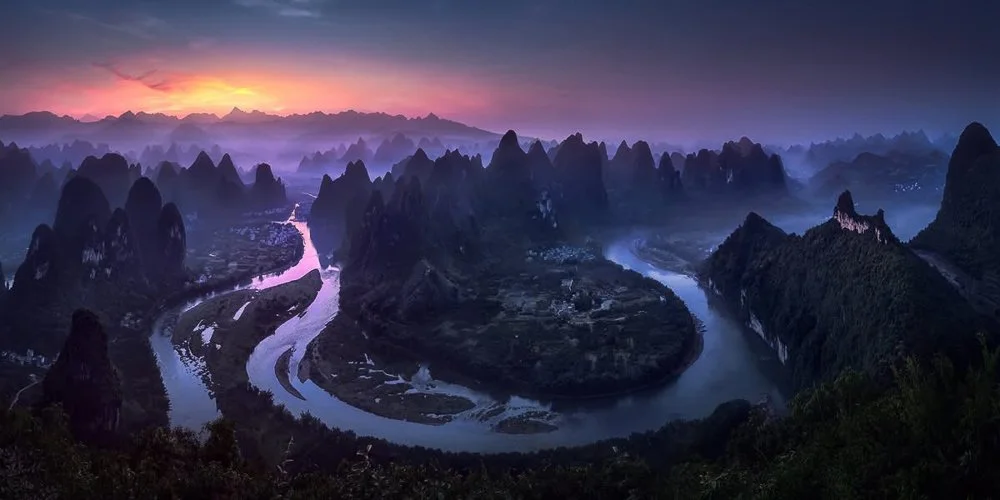
Jesus M. Garcia is a Spanish photographer whose work engages with the landscape panorama in the classical tradition of wide-angle documentary. His image Good Morning Damian Shan — a sunrise panorama of China's Li River in Guangxi Province, stitched from seven vertical exposures — received an Open Award in the Nature/Landscape category at the 2017 Epson International Pano Awards, one of the leading international competitions specifically for panoramic photography.
The image's construction from vertical frames, rather than horizontal ones, is characteristic of a meticulous approach to resolution: by rotating the camera to portrait orientation for each component exposure, Garcia maximised the vertical coverage and resolution of the final composite.
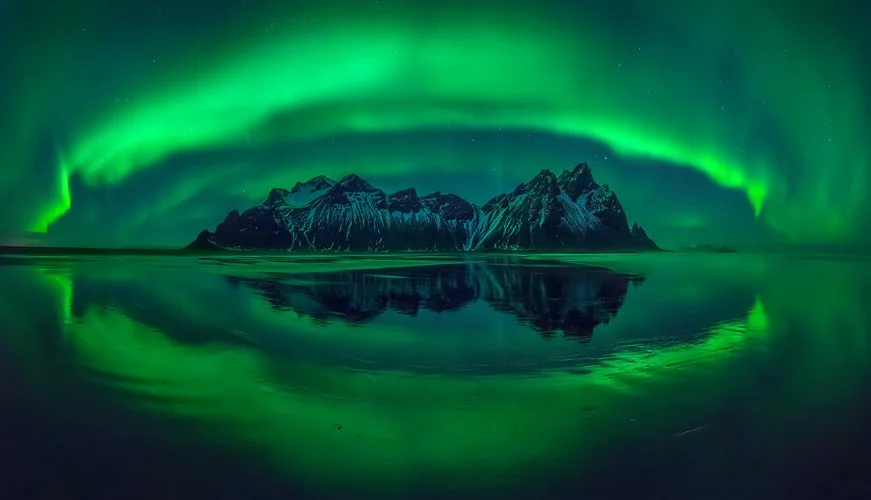
Wojciech Kruczynski is a Polish photographer whose work concentrates on landscape and natural phenomena, particularly the interaction of light and water in northern environments. His panorama Eye of Stokksnes — depicting aurora reflections on the black volcanic sand beach at Stokksnes, Iceland, with the Vestrahorn mountain range as backdrop — required the precise coordination of weather conditions, tidal state, and aurora activity, together with the technical management of an extreme dynamic range between the bright aurora and the dark beach. The image received the Carolyn Mitchum Award at the Epson International Pano Awards.
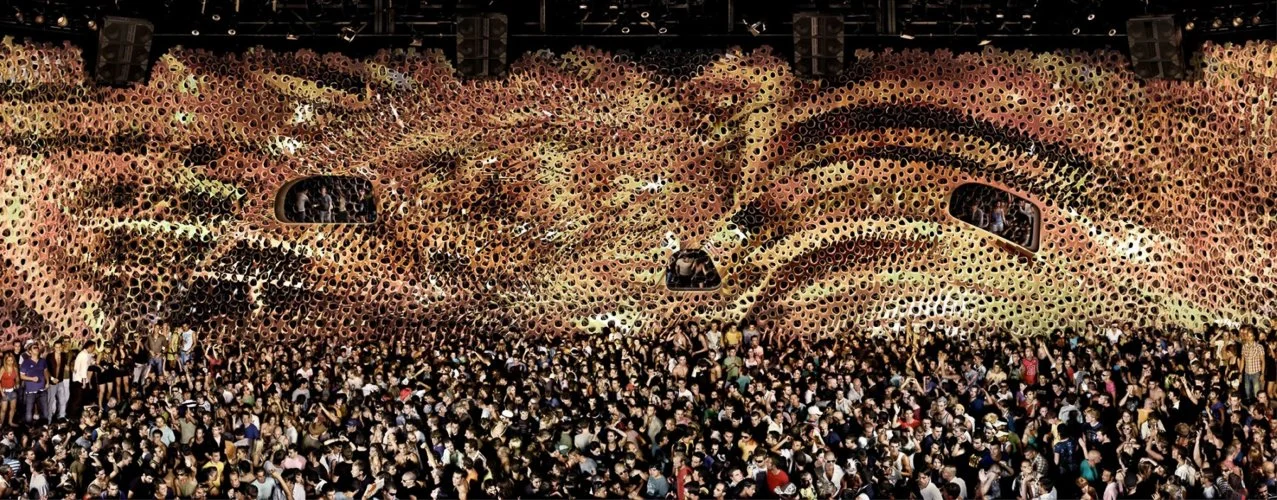
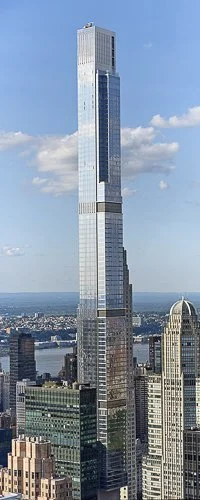
Andrew Prokos is a New York-based photographer specialising in panoramic images of cities, skylines, and architectural subjects. His large-scale panoramic prints — which can measure up to 200 inches (approximately five metres) in width — are produced as limited editions and have been exhibited in galleries and corporate collections internationally.
Prokos's work is notable for its management of the particular difficulties that urban panoramic photography presents: the wide tonal range between illuminated facades and the dark sky, the alignment of vertical elements across a wide composite, and the production of prints large enough to genuinely engage the viewer's own visual field.
Jeff Bridges (born 1949) is best known as an Academy Award-winning actor, but he has maintained an equally sustained and rather more private practice as a panoramic photographer since 1984, when his wife Susan gave him a Widelux F8 swing-lens camera.
The Widelux — a Japanese camera produced from the late 1950s until the mid-1990s, when the factory burned down and production ceased — uses a 28mm lens mounted on a rotating mechanism that sweeps 140 degrees across a curved section of 35mm film, producing an image approximately 24 × 59 mm in dimension: a proportional equivalent of widescreen cinema, which is precisely why the camera suited Bridges' purposes.
For more than four decades, he has used it to photograph film sets — the working environment he inhabits most consistently — during the production of the films in which he has appeared.
The Widelux's mechanical characteristics have shaped Bridges' photographic method in ways that he has discussed at length. With fixed shutter speeds (1/15 to 1/250 second) and apertures (f/2.8 to f/11) offering limited adjustment, and a rotating lens mechanism that introduces motion blur in moving subjects at the edges of the frame, the camera's limitations are in some respects its greatest virtues: they force a directness and immediacy that more controllable equipment would not.
Bridges has also exploited the swing-lens mechanism deliberately for double-exposure portrait work, in which a subject moves rapidly across the frame during the lens's sweep, appearing twice — a "tragedy and comedy mask" effect, as he describes it — in a single exposure.
The resulting body of work was published as Pictures in 2003, revised and expanded as Pictures: Volume Two in 2019. The books are collections of behind-the-scenes photographs made during the filming of works including The Big Lebowski (directed by Joel and Ethan Coen), The Fisher King (Terry Gilliam), True Grit (Joel and Ethan Coen), and Tron: Legacy (Joseph Kosinski), among dozens of others.
What distinguishes them from conventional production photography is the quality of attention: these are not promotional images designed to communicate the glamour of cinema but observational records of the mundane, collaborative, physically uncomfortable reality of filmmaking — makeup artists at work, grips adjusting scaffolding, actors in costume between takes, directors conferring with cinematographers.
The wide format suits this material precisely because film sets are sprawling, peripheral, chaotic environments in which the significant action is frequently not at the centre of the frame.
Bridges has partnered with Silvergrain Classics in recent years to relaunch the Widelux as the Widelux X, combining the original optical design with contemporary manufacturing. Proceeds from the Pictures books benefit the Motion Picture and Television Fund. The photographs represent an unusual instance of celebrity visual culture: a practice of genuine observation, conducted over decades, entirely without the image management that most public figures apply to their creative output.
Closing Thoughts
The panoramic photograph remains, at its core, an admission that the standard frame is not enough — that some places, some moments, some human gatherings are simply larger than a rectangle. The technology has changed entirely: from von Martens' curved daguerreotype plate, bent by hand to match the arc of a swinging lens, to a contemporary smartphone stitching thirty frames in under a second, interpolating between exposures with algorithms of remarkable sophistication. The motivation has not changed at all. The view from the top of the hill has always demanded more than a single glance, and photographers have always, in one manner or another, found the means to give it what it requires.