Silhouette Photography
There is a particular paradox at the heart of the silhouette. It is an image formed entirely by the absence of information: no colour, no texture, no internal detail, no legible expression. And yet the human eye reads it instantly. A silhouette of a seated figure, a running child, a bird on a wire — these register before the conscious mind has had time to process what it has seen. Form precedes description. The outline, stripped of everything, is not less than a photograph; in a certain cognitive sense, it is more. It reaches the part of the brain that evolved to distinguish the predator from the tree, the human from the rock, a fraction of a second before the machinery of detailed perception can engage.
For the photographer, this creates a specific and demanding set of conditions. The silhouette tolerates no ambiguity of shape. Where a conventional portrait can absorb a slightly awkward pose because the face and expression carry the weight of meaning, the silhouette depends entirely on what the outline does.
A silhouetted figure whose legs overlap, whose arms are lost against the torso, whose profile is unclear — is simply a dark blob. Every compositional decision matters more when detail is removed, not less. The demands on timing, position, light management, and the geometry of the subject are acute, and they have been so since the very beginning of human image-making.
That beginning is not merely historical. The silhouette is the oldest visual tradition that feeds directly and continuously into the practice of contemporary photography. Shadow and outline run like a single thread from the walls of Palaeolithic caves through the cut-paper profiles of Georgian England, the photographic experiments of the Pictorialists, the cinematic shadow play of Weimar Germany, and the politically charged installations of the late twentieth century, arriving without interruption at the photographs being made today. To examine that thread is to look at something close to the essential grammar of visual representation itself.
Shadow, Form & the Birth of an Idea
The founding myth of Western representational art is, at its core, a story about a silhouette. Pliny the Elder, writing in his Naturalis Historia around 77 CE, records a legend concerning the origins of painting — and locates those origins in the tracing of a human shadow.
According to Pliny, a Corinthian girl, facing the imminent departure of her lover, traced the outline of his shadow as it fell upon a wall. The act was simultaneously a record and an act of mourning: an attempt to fix form against the fact of loss. Pliny names the young man as Butades, and the girl as the daughter of the Corinthian potter Dibutades (some versions of the legend conflate father and son). The potter, recognising what his daughter had done, subsequently filled the outline in clay, giving it substance — and, in Pliny's telling, inventing portrait sculpture at the same stroke.
The story is almost certainly apocryphal, but it has exerted an extraordinary hold on the Western visual imagination. Painters from Joseph-Benoît Suvée to Joseph Wright of Derby depicted the Corinthian girl and her lamp through the eighteenth century and into the nineteenth, the legend serving as a perpetual meditation on representation, absence, and the human need to preserve likeness. That the original act was a silhouette — nothing but an outline on a wall — is not incidental. It is the point.
The impulse to capture form through outline, however, long predates Pliny's legend. The hand silhouettes at El Castillo in Cantabria, Spain — negative stencil images made by blowing pigment around a hand pressed flat against the rock — have been dated to at least 40,800 years ago, placing them among the oldest known examples of image-making anywhere in the world.
Similar images appear at the Chauvet Cave in the Ardèche, France, dating to around 36,000 BCE. At Lascaux, in the Dordogne, the animal paintings of roughly 15,000 BCE employ a closely related principle: these are not attempts at three-dimensional illusion but at the capture of characteristic form, the recognisable outline that identifies a species. The bison at Lascaux are not shaded or volumetrically rendered in any modern sense — they are silhouettes articulated, profiles given internal line.
The cognitive operation is the same as the Corinthian girl's: reduce the living subject to its identifying form, arrest it, fix it. The impulse to do this appears to be something very close to universal in the human species.
Across Asia, the same impulse produced one of the most sophisticated pre-photographic traditions of narrative through silhouetted form: shadow puppetry. The Javanese and Balinese tradition of Wayang kulit — literally "skin puppet theatre," the puppets being carved from buffalo or goat hide — has been practised in Indonesia for at least a thousand years, and quite possibly far longer.
A dalang (puppet master) manipulates intricately cut leather figures between a light source and a white screen, producing shadow performances of considerable narrative complexity, drawing on the Hindu epics Ramayana and Mahabharata as source material and lasting through the night. UNESCO inscribed Wayang kulit on its Representative List of the Intangible Cultural Heritage of Humanity in 2008.
Chinese shadow puppetry, known to have been practised since at least the Han dynasty (202 BCE–220 CE), operates on comparable principles: the puppet is a silhouette, its form entirely legible in outline, its expressive range achieved through posture, gesture, and movement rather than facial detail. Both traditions understood, by long practice, something that contemporary photographers working in silhouette must also learn: that the outline alone must carry the whole of the meaning, and that meaning depends on clarity and distinctiveness of form.
The European tradition of the cut-paper or painted silhouette portrait emerged as a distinct art form in the mid-eighteenth century, offering the middle classes an affordable alternative to the painted portrait miniature. Profiles were traced from a subject's shadow — cast onto paper by a candle or oil lamp — and cut freehand or filled in with black ink.
The physiognotrace, a pantograph-based instrument, permitted rapid mechanical reproduction of profile outlines. Artists such as John Miers and Auguste Edouart built substantial commercial practices from the cutting and painting of silhouette profiles, and the form became the primary affordable portrait medium for European and American middle-class families throughout the late eighteenth and early nineteenth centuries.
At their height of fashion, silhouette portraits hung in drawing rooms alongside their painted counterparts: not a poor substitute for a miniature, but a recognised genre in their own right, with their own aesthetic conventions and their own specialist practitioners.
Étienne de Silhouette & the Name
The word by which we now refer to all of this — silhouette — derives from a single individual whose name became a byword for austerity through no particular artistic achievement of his own. Étienne de Silhouette was born in Limoges on 5 July 1709 and appointed Contrôleur-Général des Finances under Louis XV on 4 March 1759. His tenure was one of the briefest and least comfortable in the history of French public finance.
France was deep in the Seven Years' War, the treasury was in severe distress, and de Silhouette responded with a programme of fiscal reforms that attempted to shift the burden of taxation towards the wealthy and towards luxury expenditure — reforms that were radical, politically unacceptable to the aristocracy, and sufficiently unpopular to ensure his dismissal from office after barely eight months, on 20 November 1759. He retreated to his estate at Bry-sur-Marne and died in relative obscurity in January 1767.
The attachment of his name to the cheap cut-paper portrait has two competing explanations, and the historical evidence supports both to varying degrees. The first is that de Silhouette was known as an amateur practitioner of cut-paper portraits himself — a hobby he is said to have pursued at his estate.
The second, and perhaps more persuasive, is that the phrase à la Silhouette entered common French usage as a general expression for anything done cheaply, in a reduced or austere manner, as a direct result of his penny-pinching reputation as a minister. On this reading, the shadow portrait — being the cheapest available form of likeness — naturally acquired the name of the minister who had made parsimony a public byword.
Either way, the term had entered French usage within a few years of his dismissal, and had crossed the Channel into English by the early nineteenth century.
There is a certain bittersweet quality to de Silhouette's legacy. He is recalled as an ineffective and briefly serving finance minister in an era not short of ineffective and briefly serving finance ministers. Yet his name now forms part of the vocabulary of visual art and photography in virtually every European language. He never sat for a silhouette portrait — indeed, no image of him in any form is known to have survived the French Revolution. The man who gave his name to the art of profile portraiture exists for posterity as a pure outline: present only in the shape that his name has left behind.
The Silhouette Portrait
When photography emerged in the late 1830s and 1840s, its early practitioners were not working in a visual vacuum. They brought to the new medium a set of aesthetic assumptions shaped by the long tradition of the silhouette portrait, the profile miniature, and the physiognomic study of the human face. The relationship between the photographic silhouette and these earlier traditions was not merely one of superficial resemblance; it ran deeper, through shared assumptions about the relationship between form, character, and identity.
The most important theoretical foundation for this was the physiognomical tradition associated with Johann Kaspar Lavater, the Swiss pastor and writer whose Physiognomische Fragmente appeared in four volumes between 1775 and 1778 (published in English as Essays on Physiognomy from 1789 onwards).
Lavater argued that the outward form of the human face — particularly the profile — was a reliable index of inner character, that the shape of the forehead, the set of the nose, the line of the jaw could be read as a moral text. His work enjoyed an enormous readership across Europe and America, and the cut-paper silhouette profile became, in this intellectual context, not merely a cheap substitute for a painted portrait but a document of genuine scientific and social interest.
The silhouette was the ideal format for Lavater's project: the profile, being consistent and unambiguous, could be measured, compared, and taxonomised in a way that a three-quarter portrait could not. The profile silhouette was the physiognomist's primary tool. That this supposed science was built on assumptions that would now be regarded as deeply problematic — Lavater's system encoded significant racial and class prejudice — does not diminish the historical importance of the tradition it created.
When photography arrived, it inherited a culture in which the profile was already understood as a meaningful and significant image, not merely a decorative one.
The daguerreotype and calotype processes of the 1840s and 1850s created an immediate technical intersection with silhouette aesthetics. Early photographic plates were orthochromatic, responding to blue and ultraviolet light but relatively insensitive to red and yellow wavelengths; skies and bright windows recorded as brilliant white, while subjects positioned against them recorded as correspondingly dark.
This was not primarily a stylistic choice — it was a constraint of the medium. But photographers recognised that it could be turned to expressive purpose. A subject photographed against a bright window, or in open shade with a light sky behind, would render as a clean silhouette.
The deliberate use of this tendency, placing subjects against bright light sources to produce the silhouette effect, became one of the early established techniques of portrait photography, continuing and extending the tradition of the cut-paper profile while bringing to it the unprecedented tonal range and detail of the photographic medium.
The transition from cut-paper to photographic silhouette was, in this sense, not a disruption but a continuation. The purpose was the same — to capture the characteristic form of a person or subject, to fix identity through outline — but the means were new. By the 1860s, as the carte-de-visite portrait craze swept Europe and America, the cut-paper silhouette had largely retreated from fashionable use. The photograph had won. But the aesthetic logic of the silhouette — the reduction of the subject to form and outline — was built into photographic practice from the beginning, not as a limitation to be overcome but as a possibility to be explored.
Pictorialism & the Artistic Silhouette
The Pictorialist movement, which dominated artistic photography from roughly the 1880s through to the First World War, found in the silhouette one of its most congenial and versatile tools.
Pictorialism was, at its core, an argument: photography was not merely a mechanical recording process but a medium capable of genuine artistic expression, and the measure of that expression was the degree to which a photograph departed from the purely documentary and approached the atmospheric, the contemplative, the aesthetically intentional. Soft focus, manipulated printing processes, tonal subtlety, and deliberate suppression of incidental detail were its characteristic marks — and the silhouette served all of these aims directly.
A figure silhouetted against a pale sky or a misted river surface was a figure from which the photographic fact had been stripped away, leaving only the pictorial. The Pictorialists recognised this and used it extensively.
The silhouetted landscapes and cityscapes of Pictorialist photography also owed a significant debt to the Japanese woodblock print tradition, particularly to the work of Katsushika Hokusai and Utagawa Hiroshige. Japonisme — the passion for Japanese aesthetics that swept Western art from the 1860s onwards — brought with it an appreciation for the flat, high-contrast, boldly outlined composition that was the distinguishing characteristic of the ukiyo-e print.
In a Hiroshige landscape, elements are not modelled in three dimensions but rendered as planes of colour defined by crisp edges. The horizon is a line, not a graduated transition. Figures are silhouettes against sky or water. This compositional language, translated into photographic terms, produced the kind of austere, graphic image that the Pictorialists admired: the dark mass of a building against a pale sky, a human form against shining water, branches against winter light.
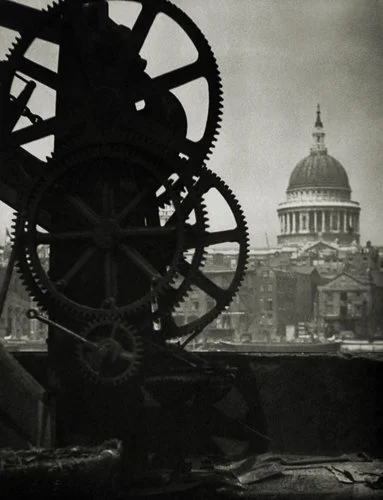
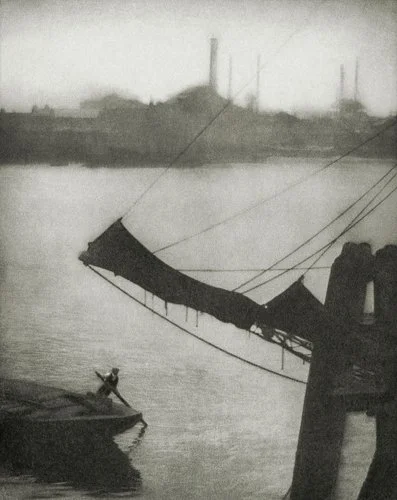
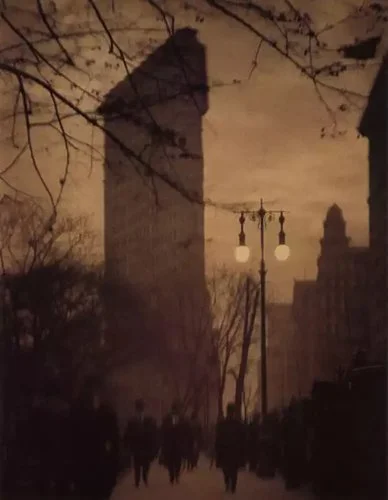
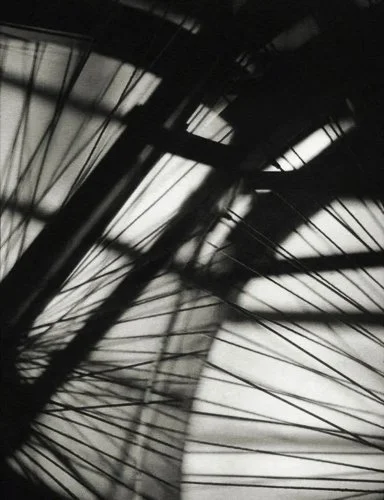
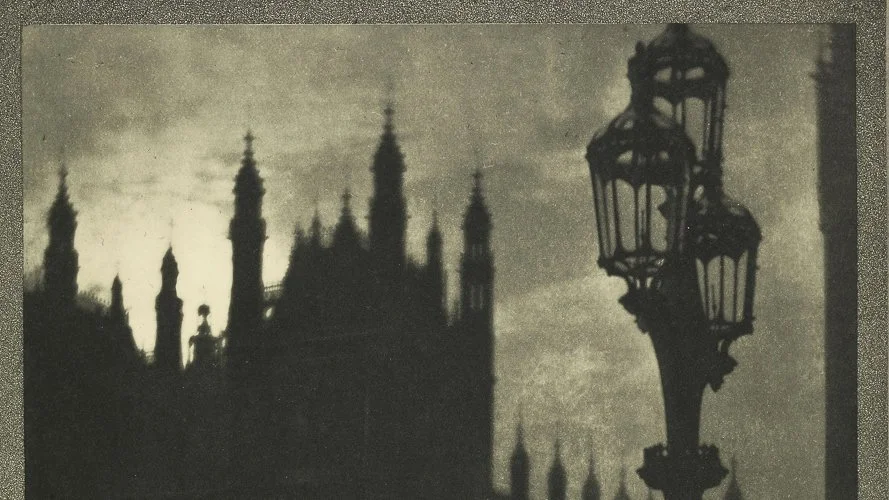
Alvin Langdon Coburn (1882–1966) stands as the central figure of Pictorialist silhouette photography in the English-speaking world, and his work spans a career of remarkable range and intellectual ambition. Born in Boston, Massachusetts, Coburn moved fluidly between the United States and Britain throughout his life, eventually settling in Wales. From early in his career, he found London — which he considered the most photogenic city in the world — to be his essential subject, establishing himself at a house by Hammersmith Bridge from which he could study the Thames light at every season and hour.
His book London (1909), a collection of handmade photogravure prints, is regarded as one of the cornerstone photobooks of the twentieth century, remarkable for the tonal quality of its printing and for the assurance of its compositional thinking. Its companion volume, New York (1910 or 1912, depending on the edition), matched the ambition of the London work and addressed it to the newer, harder-edged subject of the Manhattan skyline.
Among Coburn's specific images, Wapping (1904) demonstrates his mastery of the Thames as a reflective surface: the river is a mirror of pale sky, against which the dark forms of wharves, vessels, and waterside structures stand in silhouette, the tonal contrast flattened into something approaching the graphic clarity of a Japanese print.
The Octopus, New York (1912) — often described as his most famous single photograph — was made from the top of the Metropolitan Tower, looking directly down at a snow-covered Madison Square. The pathways radiate outward like the arms of a sea creature; the tower's shadow falls across the composition with a dark, ominous weight. The horizon is eliminated. The perspective is flattened. It is, as much as any photograph of its era, a purely formal image, concerned with shape and pattern rather than with reportage.
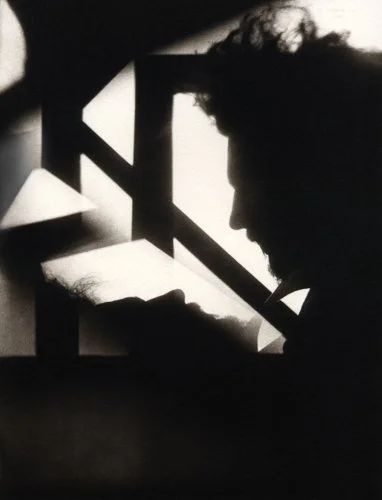
Coburn was also the pre-eminent portrait photographer of the Edwardian literary and artistic world. His friendship with George Bernard Shaw was close and productive: Shaw sat for him repeatedly, and in 1906 obligingly assumed the posture of Rodin's Le Penseur — the sculptor being known to both men — for a portrait that caused a minor scandal when exhibited, largely because Shaw had done so without the customary encumbrance of clothing.
The portrait of Shaw-as-Thinker was subsequently sent to Rodin himself and is now held in the Rodin Museum in Paris. Henry James sat for Coburn for the Men of Mark series (1913), as did Rodin, Mark Twain, Theodore Roosevelt, and others — a sustained project in collaborative portraiture that remains his most substantial body of work in this mode.
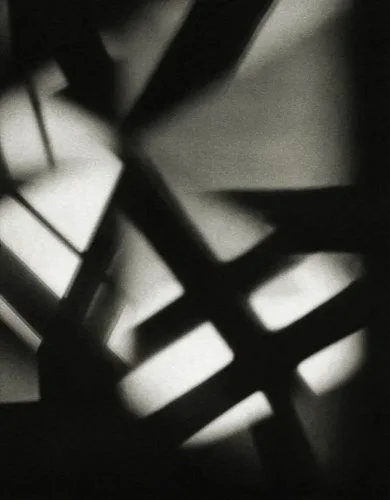
In 1916, Coburn made the photographs now known as the Vortographs: a series of images produced by fitting a kaleidoscope-like device of three mirrors — which Ezra Pound, who was closely involved with the project, named the Vortoscope — over the camera lens. The resulting photographs are the first consciously made abstract photographs in the history of the medium, predating comparable experiments elsewhere by some years.
The Vortoscope fractured and reflected whatever was placed before it — crystal, glass, ordinary objects — into unrecognisable but formally compelling patterns of light and tone. In this Coburn moved definitively beyond Pictorialism into a genuinely new territory. His later life was devoted almost entirely to mystical and esoteric study — Freemasonry, the Societas Rosicruciana, and eventually the Universal Order — and he more or less ceased to photograph after the mid-1920s. His photographic career was, by that point, one of the most concentrated and influential in the medium's history.
Modernism & the Abstract Silhouette
The Modernist period, broadly spanning the years between the First World War and the mid-twentieth century, transformed the silhouette from a representational tool into an abstract one. Where the Pictorialists had used silhouette to soften and poeticise, the Modernists used it to strip and formalise. Form ceased to be a means of capturing identity or atmosphere and became the subject itself. This shift was reinforced by the profound influence of German Expressionism and, more specifically, of Weimar-era cinema, which deployed shadow and silhouette as psychological instruments of the first order.
F. W. Murnau's Nosferatu (1922) and Fritz Lang's M (1931) are the canonical examples. In Nosferatu, the vampire Count Orlok is at his most terrifying not when seen in full but when glimpsed as a shadow — the angular, distorted silhouette climbing the stairs, the elongated claw-like hand reaching across the sleeping woman. The shadow does not depict the creature; it extracts its essence, its wrongness of form. Lang's M uses the shadow of the murderer Hans Beckert to announce his presence before the camera shows his face, making the shadow simultaneously a narrative device and a moral statement.
This tradition of cinematic shadow-as-character had an immediate and lasting influence on photographic aesthetics: the shadow and silhouette were no longer passive effects of lighting but active expressive tools, capable of conveying psychological states and moral meanings that a fully lit image could not.
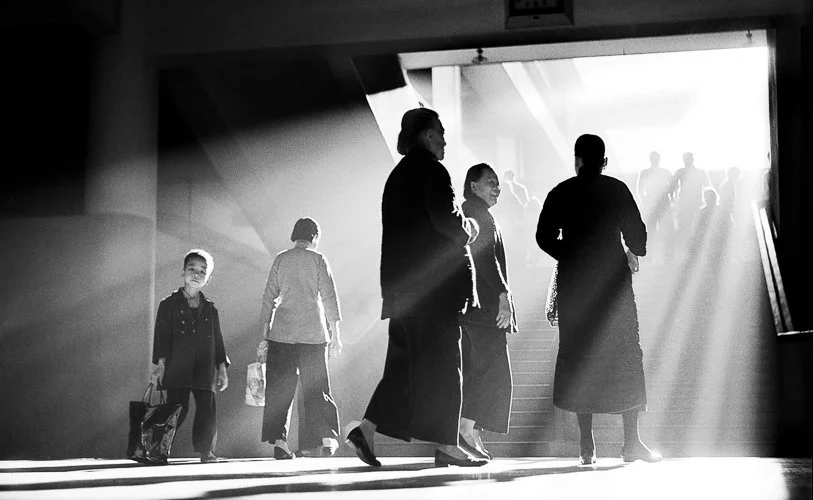
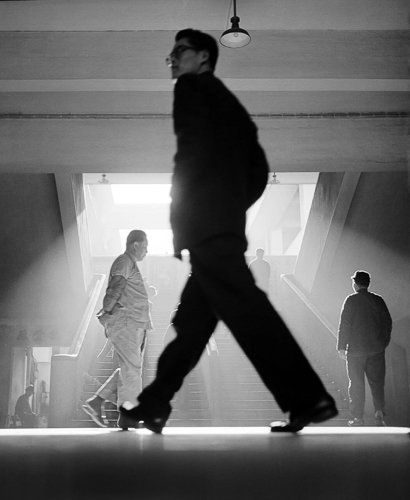
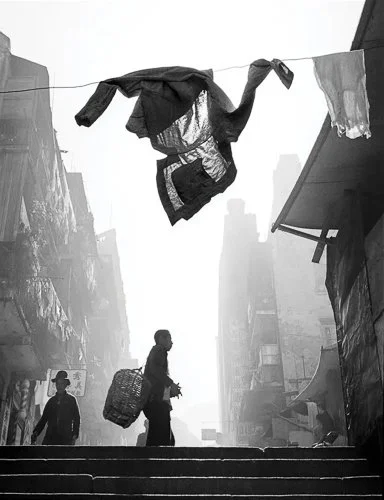
Fan Ho (1931–2016) absorbed all of these influences — cinema, Modernism, the aesthetics of available light — and applied them to a single subject with extraordinary discipline and intensity. Born in Shanghai, Fan Ho moved with his family to Hong Kong in 1949, part of the massive displacement that accompanied the Communist victory on the mainland.
He had begun photographing in his early teens, using a Rolleiflex given to him by his father, and in Hong Kong, he found a city whose particular visual qualities — the narrow streets and steep hillsides funnelling dramatic shafts of light, the constant steam and smoke of densely inhabited spaces, the interplay of geometric architecture and organic human activity — were ideally suited to his developing aesthetic.
His series Hong Kong Yesterday, made predominantly during the 1950s and early 1960s, is the body of work for which he is now celebrated. The images are cinematic in their sensibility: Fan Ho was deeply influenced by Sergei Eisenstein's theories of montage, by the Italian neo-realists, and by the structural thinking of Cartier-Bresson, though his work is in many ways more formally austere than any of these.
He titled his photographs as if they were short films — Approaching Shadow (1954), A Moment of Serenity (1954), On the Stage of Life — and this framing was not merely a gesture. The photographs possess a narrational quality, a sense of composition arrested mid-unfolding, that the titles reinforce and extend.
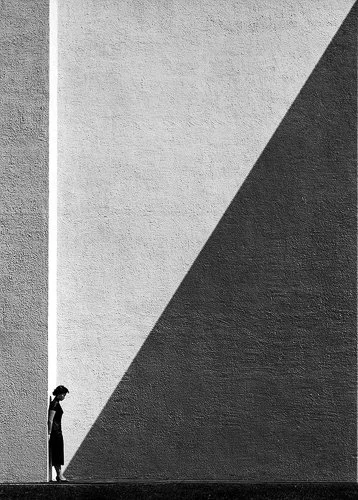
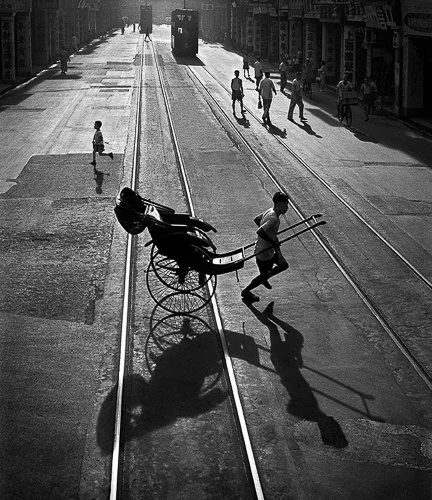
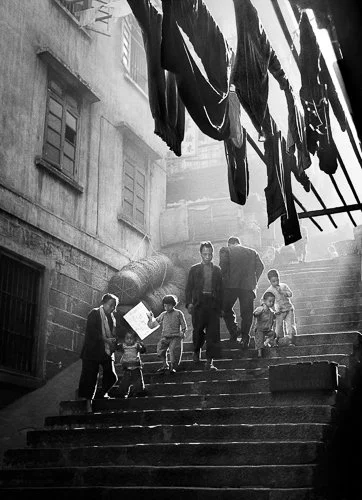
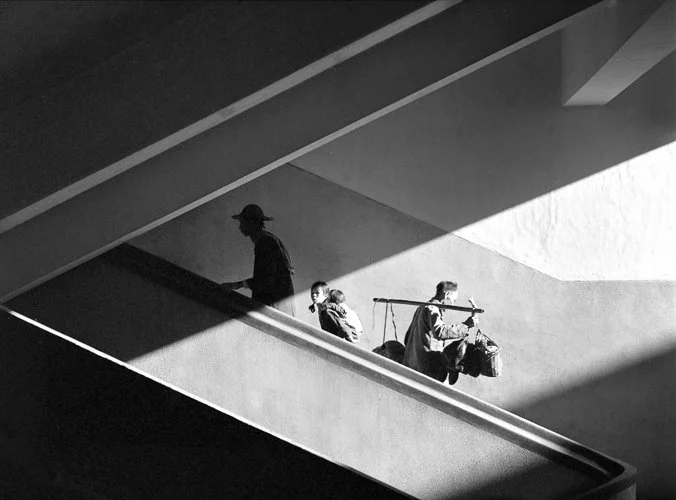
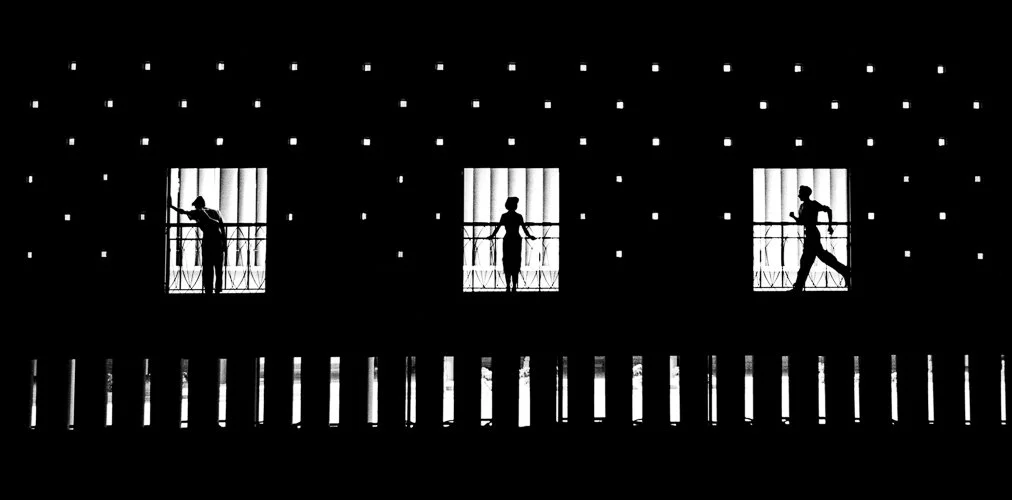
Approaching Shadow (1954) is among the most widely reproduced of his images: a figure, rendered as a near-silhouette, walks towards the camera along a wall against which the diagonal shadow of an overhanging awning advances at an opposing angle. The formal tension between the figure's movement and the shadow's geometry is precise and deliberate.
The light is available light, the geometry is found geometry, but the mastery lies in the decision — the moment of seeing and the moment of release. Fan Ho's rediscovery by a global audience in the digital era, as his work circulated through the internet and new monographs brought him to the attention of photographers who had not previously encountered him, was one of the more striking cases of posthumous recognition in twentieth-century photography. He died in 2016, having lived long enough to witness the beginning of it.
Beyond Fan Ho, the mid-century street photographers used silhouette and shadow as compositional elements even when they were not pursuing the silhouette as such. Henri Cartier-Bresson's theory of the decisive moment was, in part, a theory about form: the moment at which the geometry of a scene became perfect, at which figures occupied the frame with the same precision as notes in a musical phrase.
Many of his most celebrated images depend on the near-silhouetted figure against a bright ground — the man leaping over the puddle at the Gare Saint-Lazare (1932), the cyclists through the arch at Hyères (1932).
Brassaï's nocturnal Paris photographs, made through the late 1920s and 1930s, used gaslight and wet cobblestones to produce shadowed scenes of extraordinary formal beauty.
Vivian Maier, photographing Chicago and New York through the 1950s and 1960s, returned repeatedly to figures caught in silhouette against shop windows, underpasses, and the low winter light of the lakeside — using shadow as a constant compositional resource without ever making it her explicit subject.
The Commercial & Editorial Silhouette
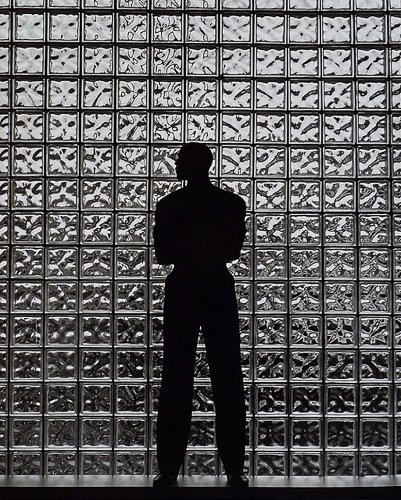
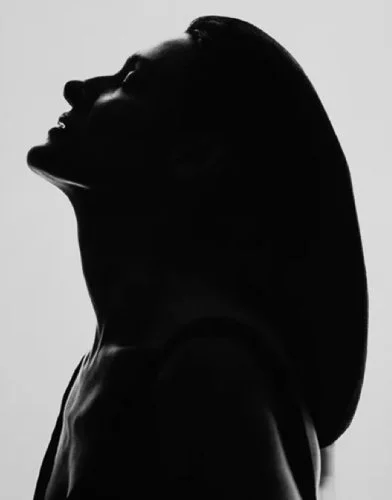
By the middle of the twentieth century, the silhouette had migrated firmly into commercial and editorial photography, where its graphic qualities — clean lines, strong contrast, instant legibility — made it a natural fit for magazine layouts, advertising, and the kind of controlled studio work in which the human body was treated as a formal element.
The fashion and advertising industries of the 1950s, 1960s, and 1970s discovered that the silhouetted figure against a white or pale background possessed exactly the visual properties that print reproduction required: it reproduced cleanly, it held its impact at small sizes, and it had a modernity and sleekness that softer, more detailed images often lacked.
Herb Ritts (1952–2002) was the photographer who brought the commercial silhouette to its greatest refinement and widest visibility. Born in Brentwood, Los Angeles, Ritts was shaped by the particular quality of Southern Californian light — strong, clear, hard-edged, capable of reducing the human form to something close to classical sculpture. He cited an interest in classical Greek sculpture as a conscious influence on his approach to the human body, and the connection is visible in the rigour with which he used light to emphasise contour and suppress incidental detail.
His work for Vogue, Vanity Fair, Rolling Stone, Harper's Bazaar, and a score of other publications through the 1980s and 1990s established him as one of the dominant figures in fashion and celebrity photography during a period of intense competition for both.
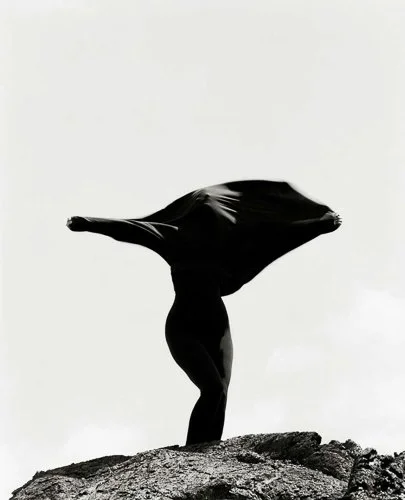
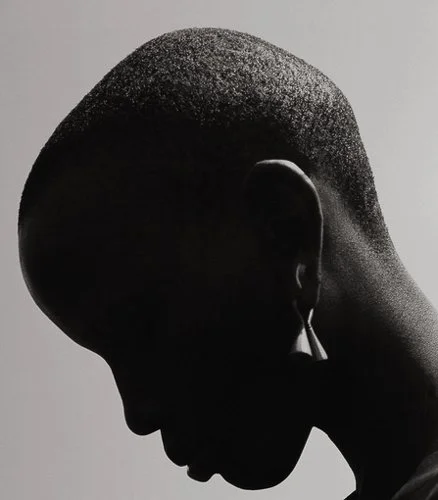
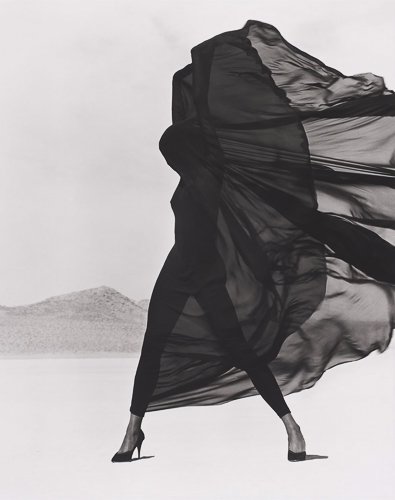
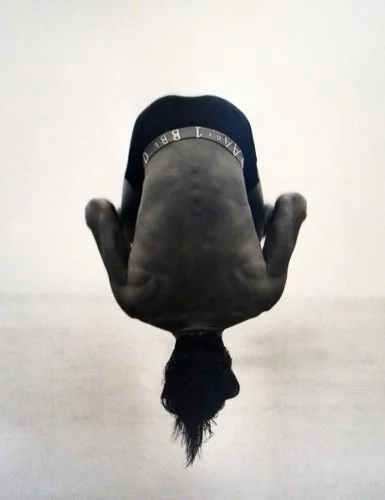
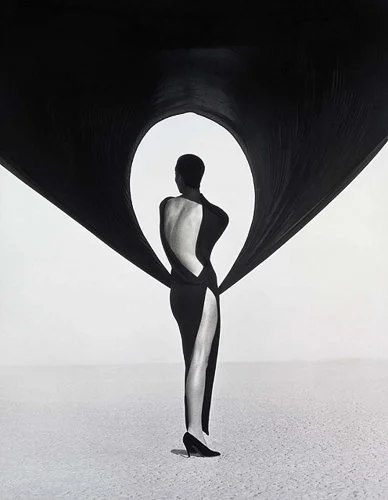
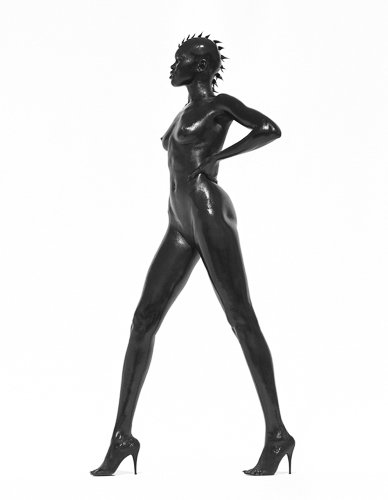
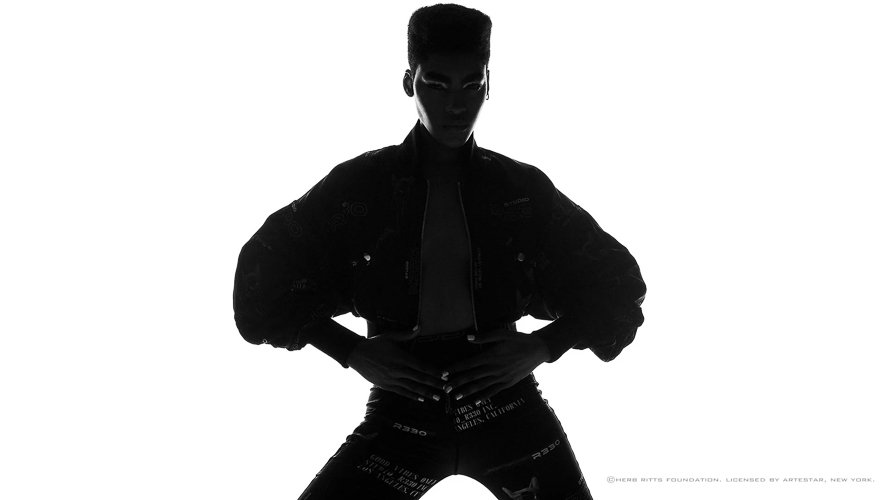
His landscape work — particularly the photographs made in the desert environments of the American West and the stark terrains of sub-Saharan Africa — brought together his interest in the sculptural body and his feel for the graphic qualities of strong sunlight.
The human figure photographed against the bleached light of desert sky, reduced to a near-silhouette against the horizon, becomes a formal element: mass, proportion, and movement distilled to their essentials. His 1988 photographs of Tatjana Patitz in the Joshua Tree desert, made for British Vogue, exemplify this approach, combining the precision of studio thinking with the scale and drama of an open landscape. Ritts himself articulated the appeal of these environments with characteristic directness, observing that landscapes such as the California desert could, seen through a lens, "abstract into light and texture and line and shade."
Ritts was HIV-positive from 1989 onwards — a diagnosis he never publicly disclosed during his lifetime — and died in December 2002 from complications of pneumonia. A 2017 Christie's auction of prints from his estate benefited the Elton John AIDS Foundation, a cause with which he was privately associated.
The fashion silhouette as a specialist genre — studio work against seamless white or evenly lit backgrounds, the body reduced to its profile and proportions — became a staple of commercial work from the 1970s onwards. The technique is straightforward in principle and extremely demanding in execution: every aspect of the pose, every line and proportion of the silhouetted body, must be considered in the absence of any other pictorial information. The genre produced some of the most formally accomplished fashion photography of the late twentieth century, and its influence on contemporary advertising and editorial practice remains substantial.
The Silhouette as Political Art
The silhouette entered the realm of explicitly political visual art through the work of Kara Walker (born 1969), an American artist who has used the cut-paper silhouette with greater conceptual sophistication and political force than any other practitioner of the form.
Walker made her New York debut in 1994 with a 25-foot-long wall installation at the Drawing Center, titled Gone: An Historical Romance of a Civil War as It Occurred b'tween the Dusky Thighs of One Young Negress and Her Heart. The title's sardonic, antebellum cadences are matched by the content: caricatured figures, cut from black paper and installed directly on the gallery wall, enact scenes of violence, sexuality, domination, and humiliation drawn from the plantation South.
The work caused immediate controversy, attracting both severe criticism — some prominent Black artists objected to what they saw as a gratuitous re-traumatising of historical wounds — and wide recognition, establishing Walker's reputation at a single stroke.
The choice of the silhouette as her medium was not accidental and is not decorative. Walker has consistently spoken about the deliberate tension she exploits between the silhouette's historical associations — the genteel, "innocent" visual language of Victorian parlour art, of ladies' hobby-craft, of the charming profile portrait — and the brutal subject matter she forces it to contain.
The silhouette was, in the eighteenth and nineteenth centuries, a form associated with refinement, with domestic sentiment, with the harmless and the picturesque. Walker's decision to appropriate it for images of slavery and its attendant horrors is a calculated provocation: the decorative form becomes a vehicle for exactly the kind of history that the decorative tradition exists, in part, to suppress. The black paper figure against the white wall becomes both a representation and a reversal — the enslaved body rendered in the visual language of the leisure class that enslaved it.
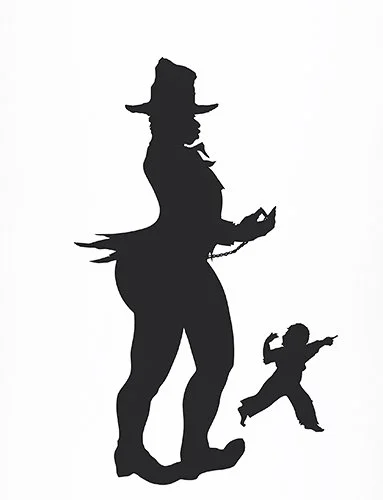
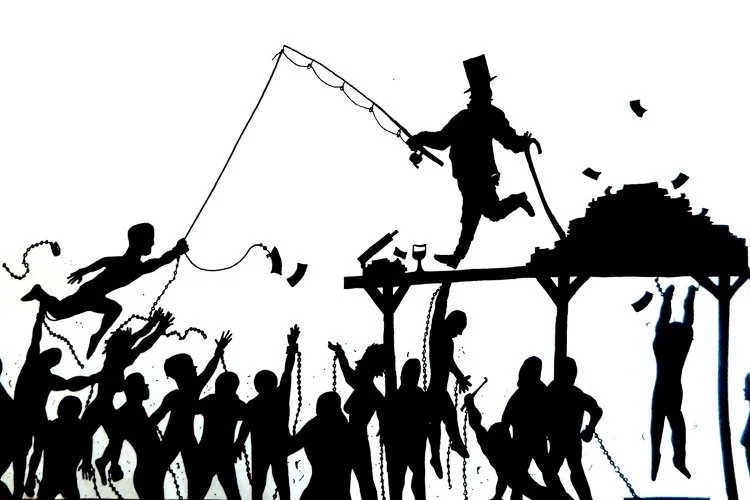
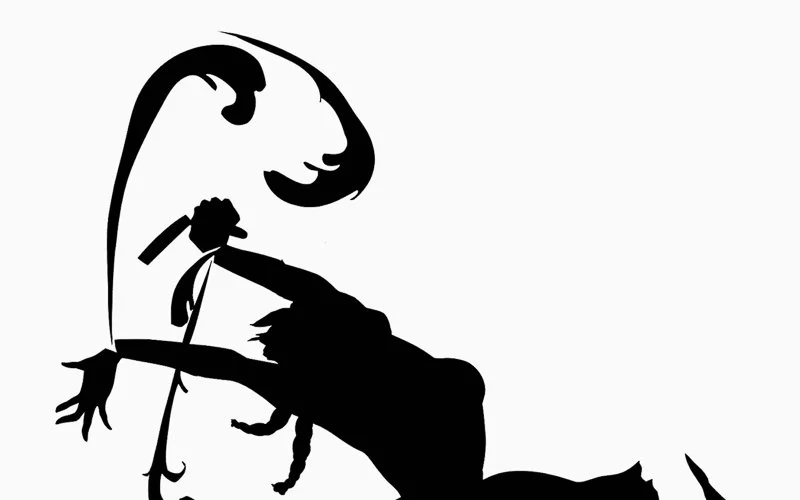
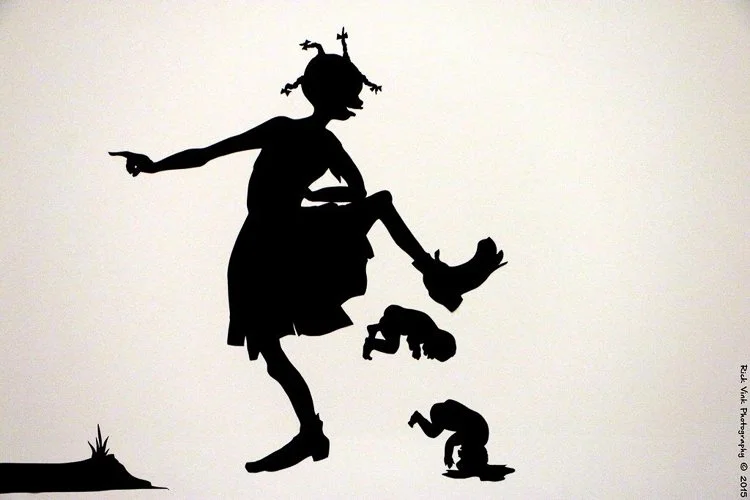
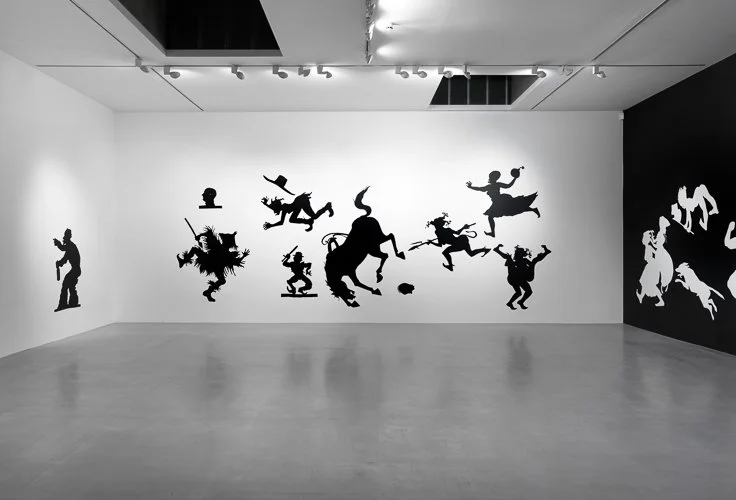
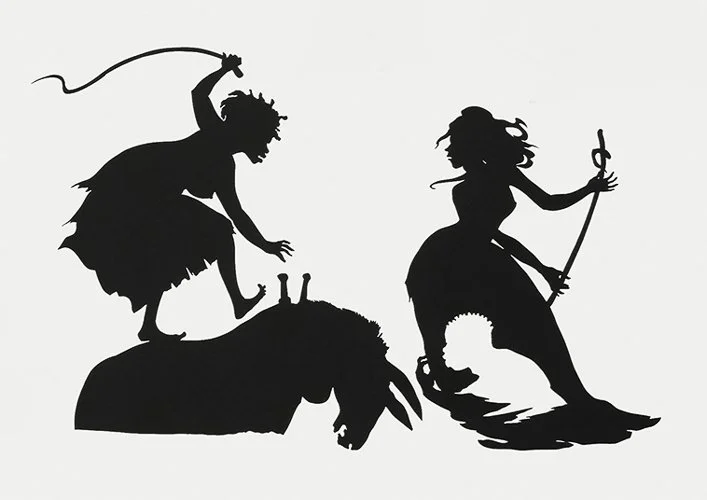
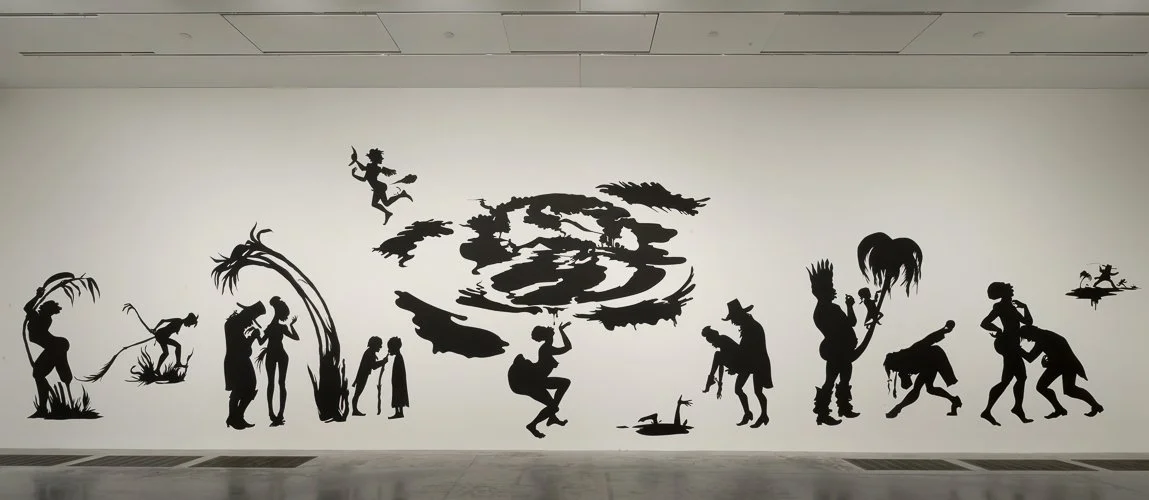
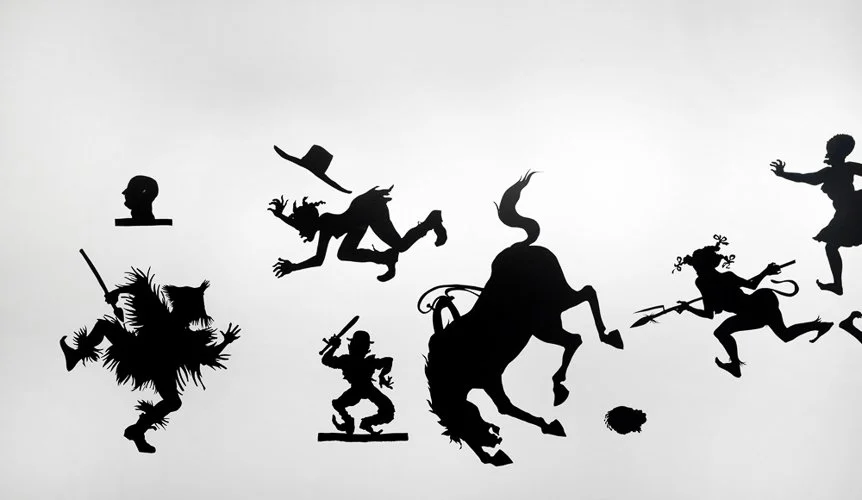
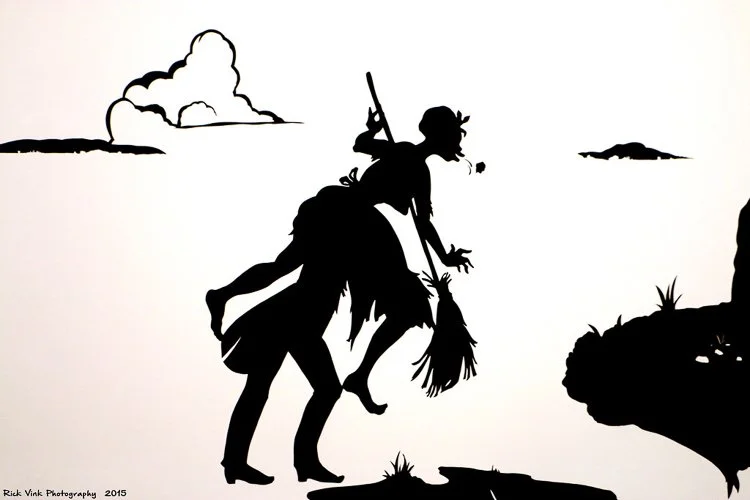
Her subsequent major installations extended this project with increasing ambition. A Subtlety, or the Marvelous Sugar Baby (2014) was sited in the soon-to-be-demolished Domino Sugar Refinery in Brooklyn — a building that was, as a sugar refinery, directly implicated in the economic structures of slavery and colonialism that Walker's work addresses. The centrepiece was a monumental sugar-white sphinx in the form of a Black female figure, surrounded by smaller molasses-dark figurines.
The work was a public commission by Creative Time and attracted enormous attendance during its brief installation. Though this piece was sculptural rather than a cut-paper silhouette in the conventional sense, it operated on the same principles — the monumental outline, the figure reduced to form, the racial and historical charge loaded into shape and material.
Walker is primarily a visual artist and not a photographer, and it is worth noting this clearly. But her work has had a profound influence on how photographers and image-makers think about silhouette as a vehicle for meaning: specifically, her demonstration that the reduction of the figure to outline, far from being a gesture of abstraction or aesthetic distance, can be a profoundly direct engagement with questions of identity, race, power, and history.
The outline is not neutral. The shape that a body makes, the pose in which it is silhouetted, the association it calls up in the viewer — all of these are culturally charged, and Walker's work made this visible in a way that permanently altered the critical conversation around the use of the silhouette in contemporary art and photography.
Contemporary Photography
The contemporary silhouette photographer works in a tradition with more than two and a half millennia of continuous practice behind it. What is distinctive about the present moment is, in part, the range of ways in which that tradition is being engaged: as a documentary and landscape tool, as a device for urban commentary, as a medium for conceptual play, and as a platform for practice that sits consciously at the intersection of photography and other visual arts.
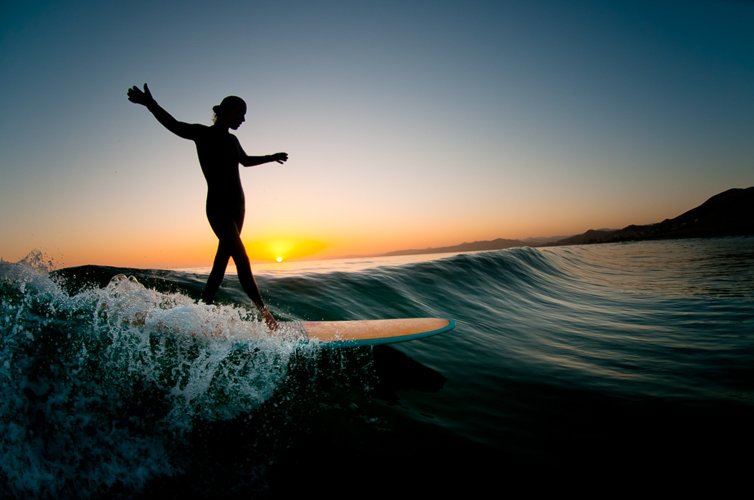
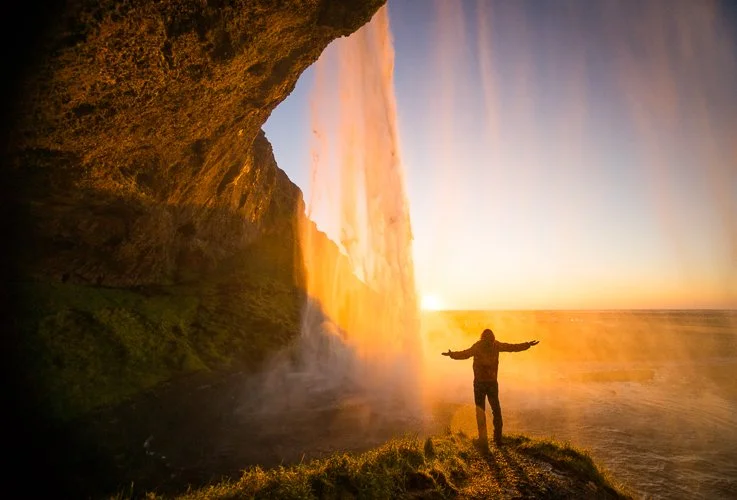
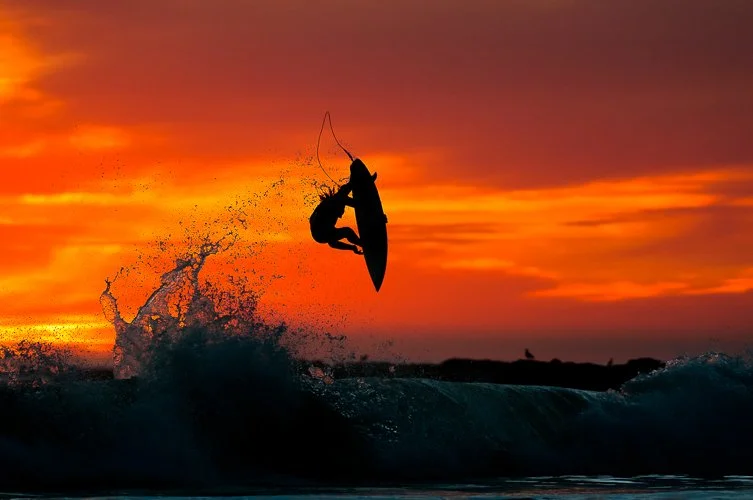
Chris Burkard (born 1986) works primarily in the vast and often brutal natural landscapes of the high latitudes — Iceland, Alaska, Norway, the Faroe Islands — photographing surfers, climbers, and other figures in extreme environments with an approach that balances editorial precision with a documentary sensibility. Born in San Luis Obispo, California, he was appointed senior staff photographer at Surfer Magazine at twenty-one and has since been published on the covers of more than thirty-five national and international publications, including National Geographic Adventure.
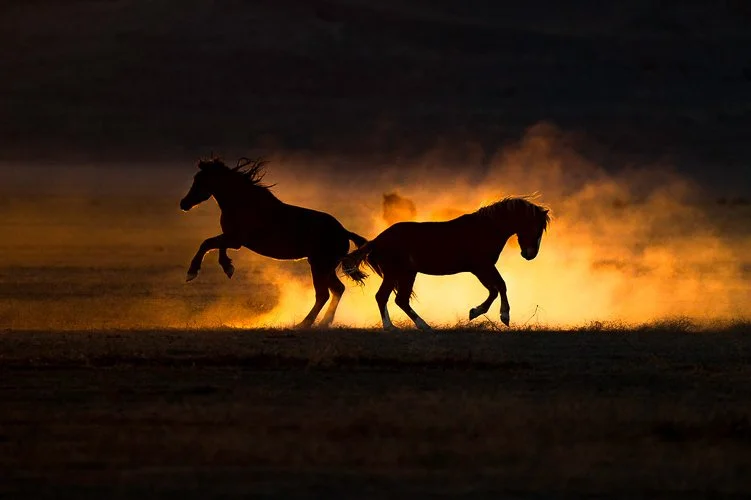
Silhouette lighting is a consistent element of his practice, used not for formal reasons alone but as a means of emphasising scale: the human figure, darkened against a vast grey sky or a luminous northern seascape, becomes a measure of the landscape's dimensions rather than an individual. Burkard has described his use of silhouette as a deliberate strategy of timelessness — an image in which no branded clothing or other datable detail is visible resists being tied to a specific moment. His social media presence, with tens of millions of followers across platforms, has made him one of the most widely seen outdoor photographers working today.
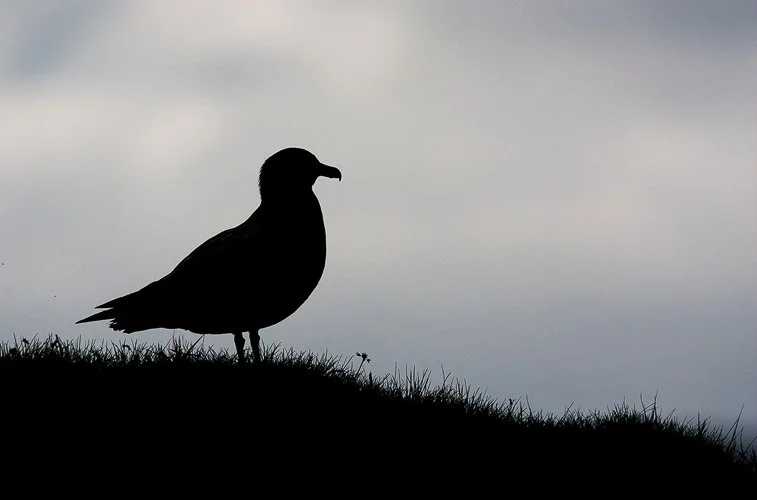
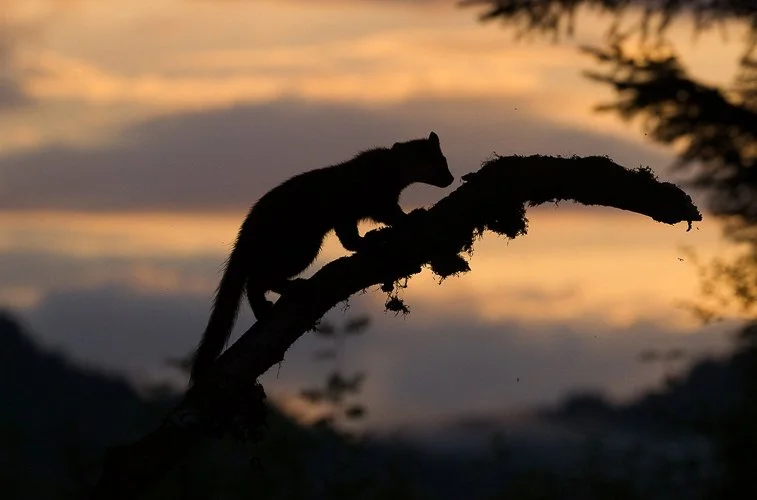
Nick Martin is a UK-based photographer celebrated for atmospheric silhouette work in urban and rural settings. His aesthetic is notably quiet — a quality of melancholy attentiveness to ordinary British locations, rendered with a compositional precision that elevates the unremarkable to the striking.
Martin works with the particular textures of British light: overcast skies, diffuse winter illumination, the muted palettes of industrial and suburban environments against which a silhouetted figure or structure acquires an unexpected gravity. His approach to wildlife silhouette work is methodically patient, involving careful positioning to align subjects with backgrounds — placing food on a branch, setting the camera level with the horizon so that branch and sky form the entire visual field, and waiting for the precise moment of occupation.
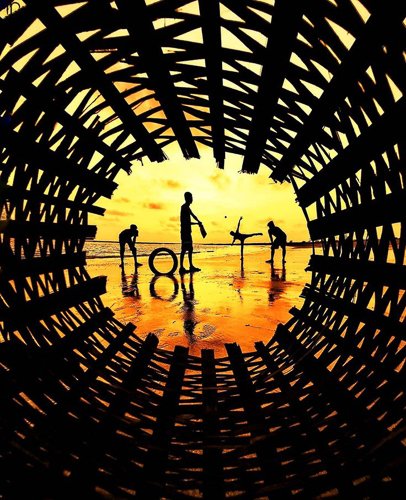
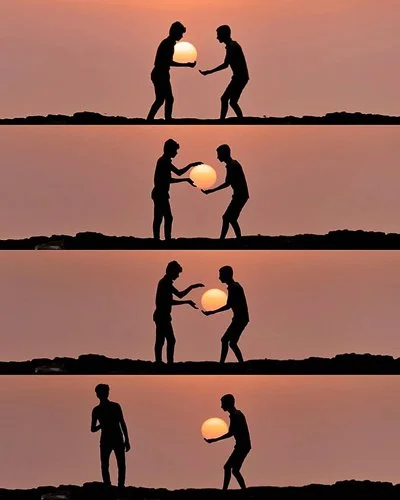
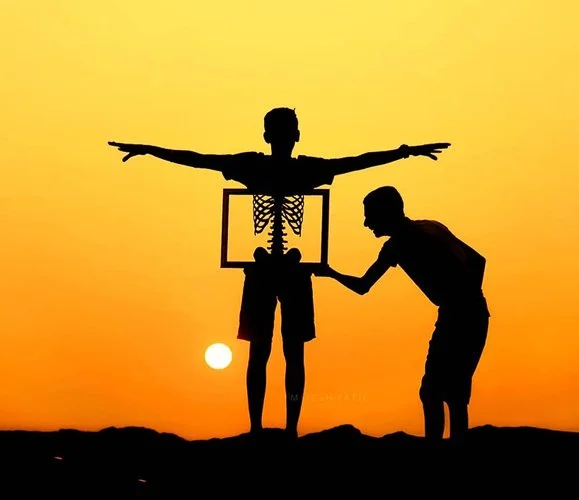
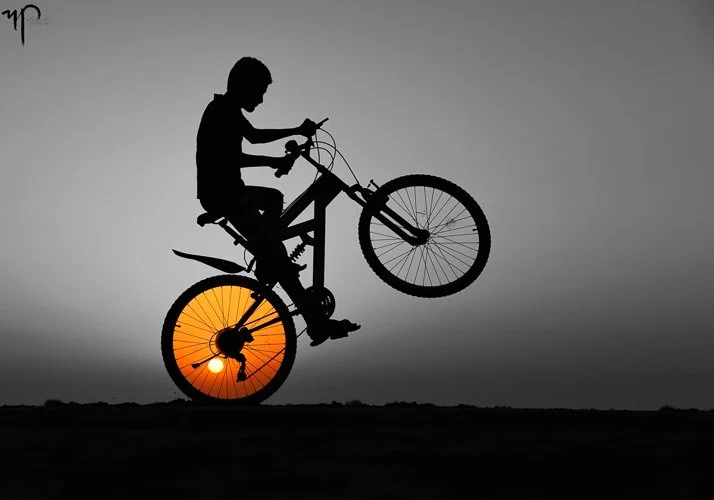
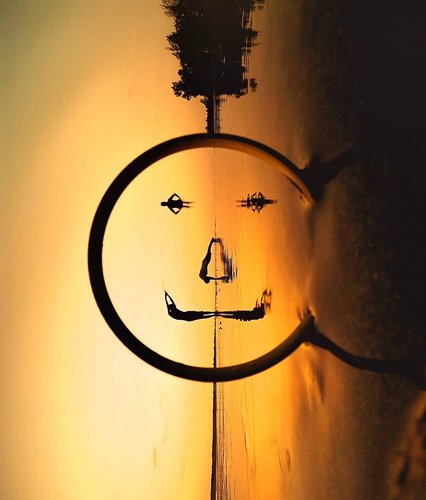
Mitesh Patil is an Indian photographer who came to wider attention through his conceptual sunset silhouette images, made near his home on the Maharashtra coast. His work is distinguished by the imaginative staging of human figures and objects in relation to the sun: images in which the silhouetted subject appears to be interacting directly with the solar disc — holding it, kicking it, balancing it.
The photographs are made with precise understanding of the geometry involved, exploiting the few minutes of usable light around sunset. Patil uses Adobe Lightroom in post-processing to strengthen the silhouette effect, and has spoken candidly about the technical difficulty of the work: the window of opportunity is narrow and mistakes cannot be reclaimed until the following day.




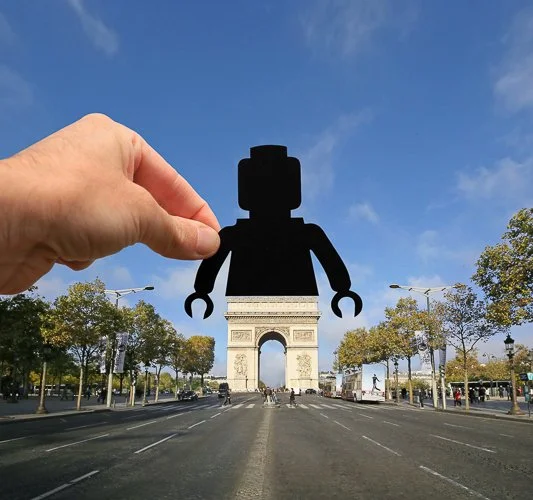
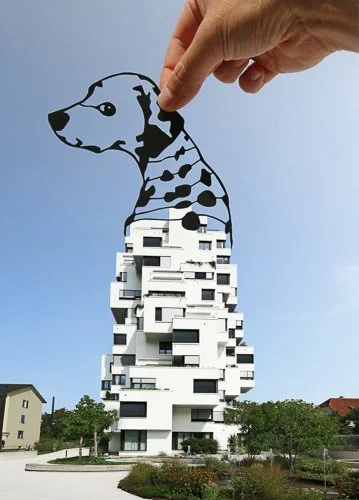
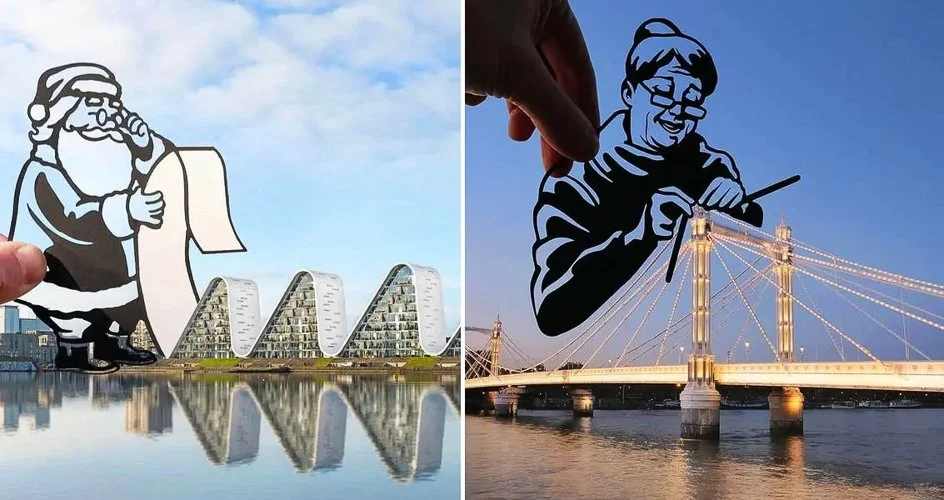
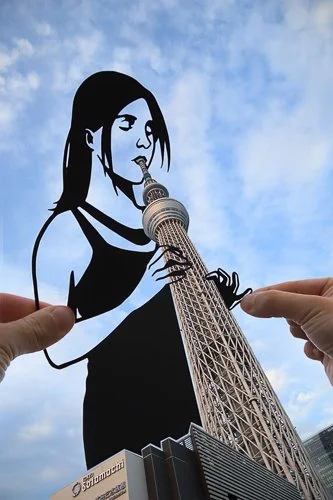
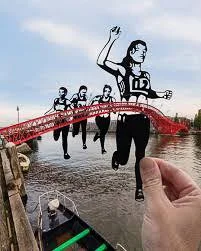
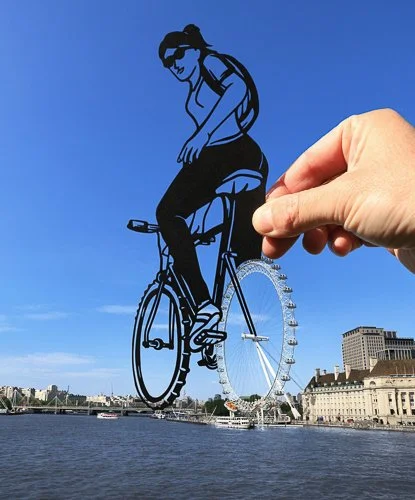
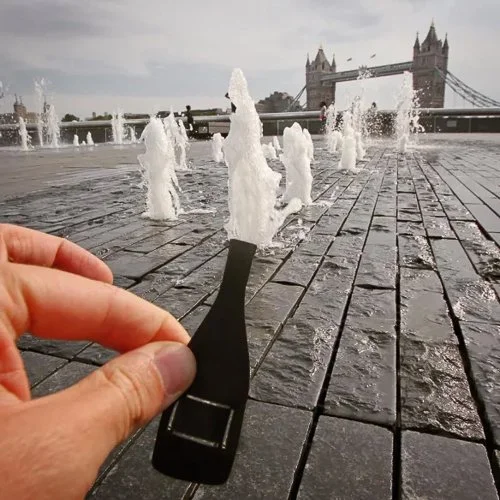
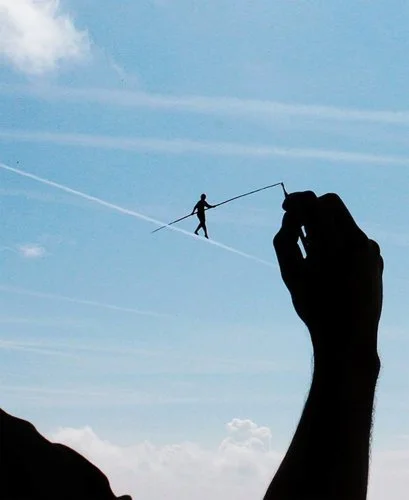
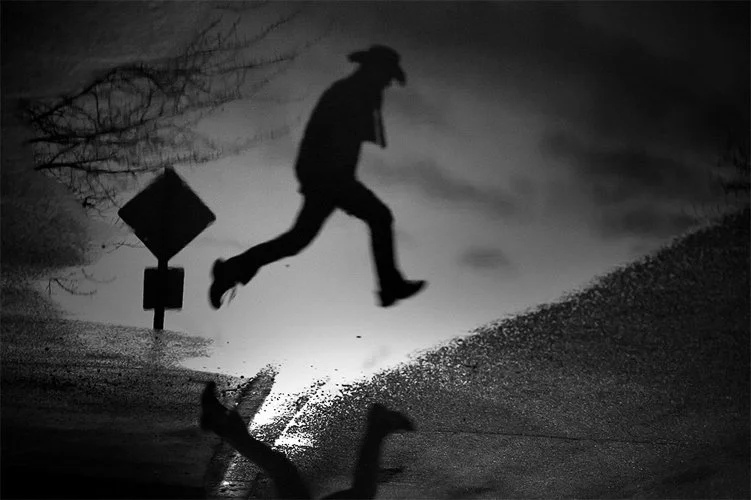
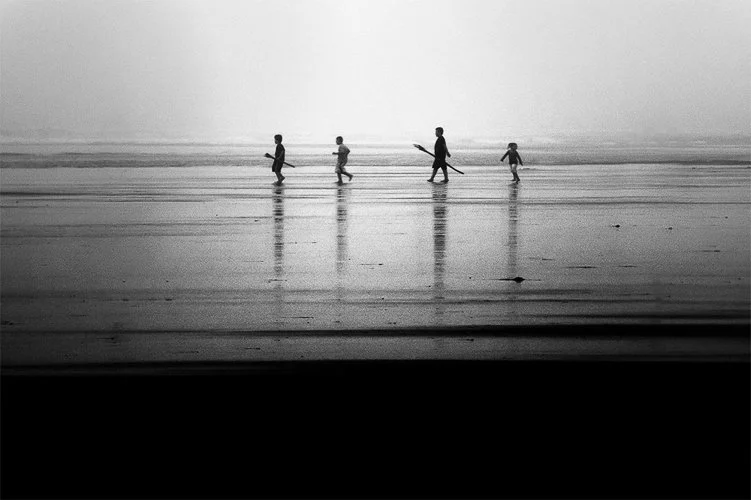
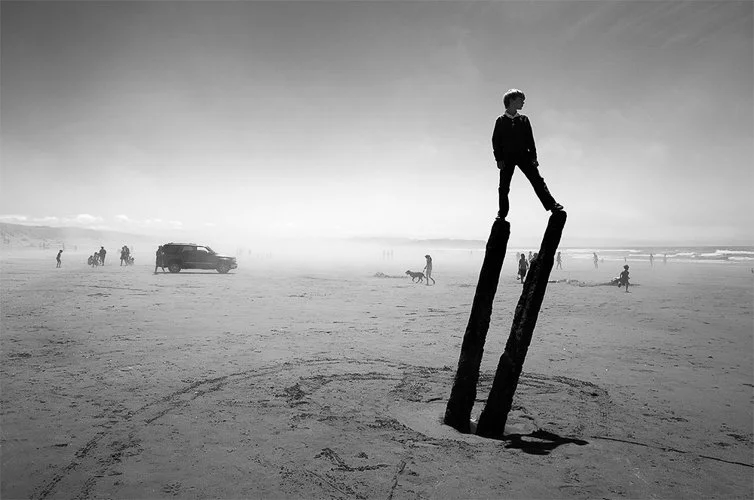
Rich McCor (Paperboyo) is a British artist and photographer whose practice involves creating cut-paper silhouettes and holding them before the camera in front of architectural and urban subjects, such that the paper shape transforms the site behind it into a kind of miniature theatre.
The London Eye becomes a bicycle wheel; the Arc de Triomphe becomes a Lego figure; a church spire is recruited as the arm of a figure reaching upwards. The paper cutouts are physically held — not digitally composited — and each composition requires a precise understanding of angle, distance, and proportion to bring the paper shape and the architectural background into the correct apparent relationship.
McCor typically invests several hours and over a hundred frames in arriving at the successful version of each image. His Instagram identity as Paperboyo has brought him significant social media attention and broadcast his work far beyond a conventional photography audience, attracting a following for whom the wit and precision of the visual puzzle are the primary appeal.
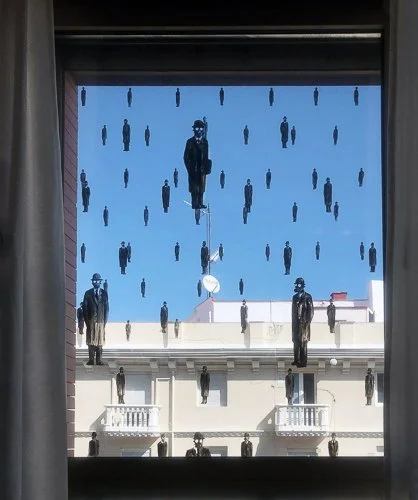
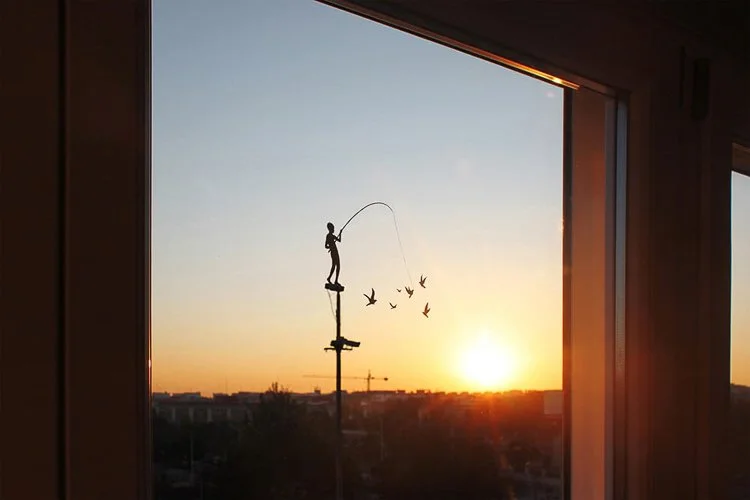
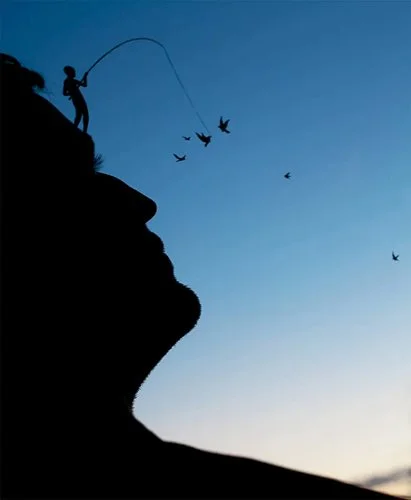
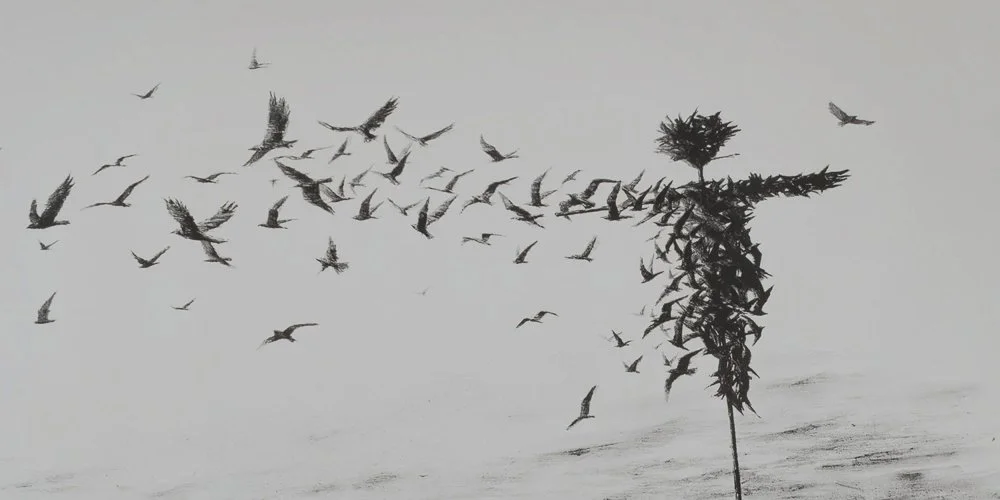
Pejac is a Spanish artist, born in Santander and based principally in Madrid, whose work straddles the boundaries between street art and photography. He is perhaps best known in the context of silhouette for his trompe l'oeil window interventions: painted silhouette figures on glass, positioned so that when photographed from the correct angle, they appear to be engaged with the exterior world beyond — walking, swimming, flying against a distant cityscape or sky.
These images are constructed rather than found, the result of precise calculation of viewpoint and painting, but they operate on photographic logic: they are images designed to be seen through a camera and to read as photographs. Pejac works across a wide range of media and urban contexts, but the window silhouette works — in which the boundary between interior and exterior is collapsed, and a painted shadow-figure inhabits both — remain among the most formally and conceptually inventive uses of silhouette in recent urban practice.
Nicolas Bouvier (1929–1998) presents a different and more complex case. Bouvier was primarily a Swiss travel writer — one of the finest of the twentieth century, and the author of L'Usage du monde (1963; translated as The Way of the World) and Le Poisson-scorpion (1981), works of travel literature that blend precise observation with philosophical reflection in the tradition of the great French travel essayists.
He was also, throughout his career, a working photographer and a professional iconographe — an image researcher — with a photographer's eye for the visual condensation of experience. His photographs, made across the extraordinary range of his travels from Yugoslavia to Japan, use shadow and silhouette as he uses language: to suggest scale, solitude, and the strangeness of the displaced observer encountering a world that does not acknowledge his presence.
It should be noted that reliable published information specifically on Bouvier's photographic practice and silhouette work is substantially less available than information on his writing. What can be said with confidence is that he understood photography and writing as parallel ways of fixing what the world looks like when you are not quite at home in it — and that the silhouette, with its sense of presence-without-detail, served that sense of displacement with particular economy.
Closing Thoughts
Silhouette photography removes almost everything that a photograph can contain. It removes colour, texture, the legibility of features, the evidence of age and character, the specificity of time and place. What remains is form: the outline of a thing against a lighter ground. This is the least that an image can be and still be an image.
And yet form is what the eye recognises fastest and retains longest. The neurological fact — that outline activates recognition before detail does — is not a curiosity but a fundamental truth about how human vision operates, one that artists and image-makers have been exploiting for at least forty thousand years.
The shadow portrait that the Corinthian girl traced on the wall in Pliny's legend, and the silhouette captured on a smartphone against a winter sunset, are separated by two and a half millennia of technical revolution, cultural change, and accumulated tradition. They are doing exactly the same thing: taking the residue that a body leaves when the light comes from behind it, and fixing it on a surface, so that what was present remains present in its absence.
The history of the silhouette is, in this sense, the history of a single enduring recognition — that the outline of a living thing contains within it something essential about that thing, and that the hand, or the cutting tool, or the camera, can take hold of it.